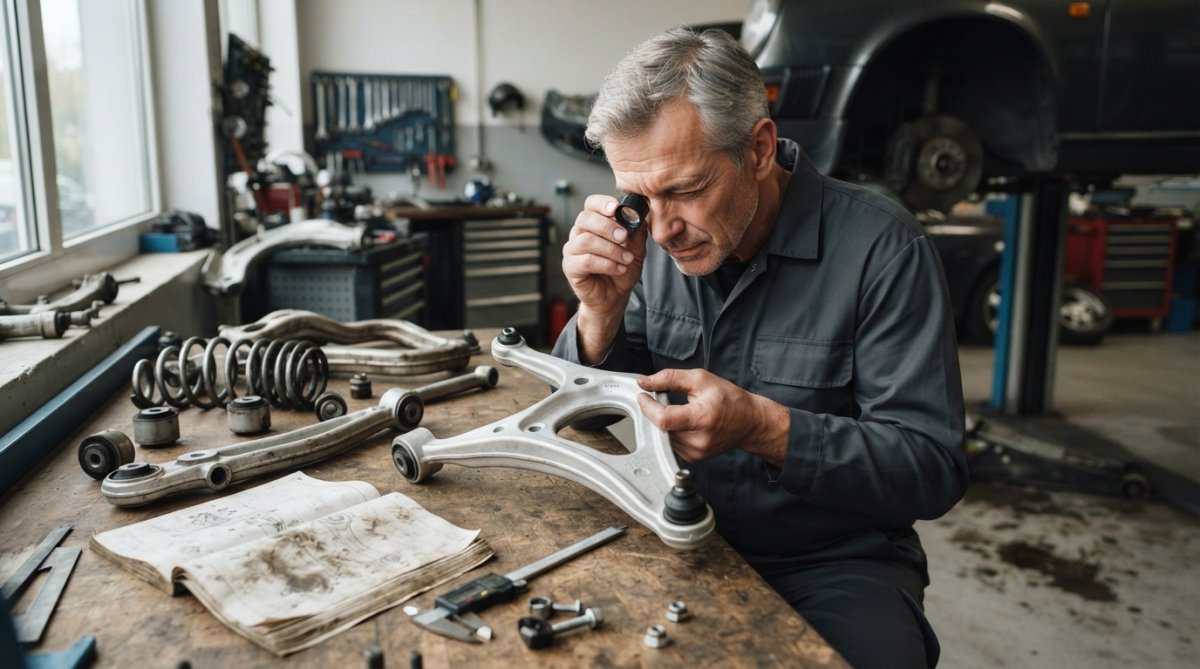
 how-to
How to Identify Real Porsche Suspension Parts
Table of Contents
- Why Authenticating Porsche Suspension Parts Matters
- Genuine vs OEM Porsche Parts: Understanding the Difference
- Step 1: Verify the Part Number and Serial Number
- Step 2: Inspect Physical Characteristics and Materials
- Step 3: How to Spot Counterfeit Auto Parts
- Step 4: Use Digital Verification Tools
- Step 5: Test Fitment and Engineering Tolerance
- Safety Implications of Using Counterfeit Suspension Parts
- Frequently Asked Questions
Last Updated: September 23, 2026
Why Authenticating Porsche Suspension Parts Matters
Counterfeit suspension components pose serious risks. A fake control arm, ball stud, or bushing can fail without warning. When suspension fails at highway speeds, you lose steering control. That's not a minor inconvenience, it's a safety crisis.

Beyond safety, counterfeit parts damage your Porsche's performance and resale value. Genuine suspension geometry depends on precise engineering specifications. A knockoff part throws off alignment, creates vibration, and accelerates wear on adjacent components. What started as a cheap repair becomes an expensive cascade of failures.
This is where European OEM Parts Direct helps. We maintain a comprehensive inventory of genuine parts and accessories specifically for Audi, Porsche, and Volkswagen vehicles. Knowing how to identify real Porsche suspension parts protects both your safety and your investment. Below, we'll walk you through five practical steps to authenticate suspension components before installation.
Genuine vs OEM Porsche Parts: Understanding the Difference
Genuine Porsche parts are manufactured by Porsche or authorized suppliers to exact OEM specifications. They carry official part numbers, proper documentation, and full compatibility with your vehicle's engineering tolerances.
OEM (Original Equipment Manufacturer) parts is the broader category. It includes genuine Porsche parts plus components made by licensed suppliers using Porsche specifications. All genuine parts are OEM; not all OEM parts are genuine Porsche-branded.
Aftermarket parts are made by third-party manufacturers. They may fit your suspension system, but they don't meet Porsche's engineering standards. Aftermarket suspension components often use cheaper materials, looser tolerances, and different geometry. Performance suffers. Handling becomes unpredictable.
The critical difference: genuine parts maintain your Porsche's original suspension geometry, load capacity, and safety margins. Aftermarket parts cut corners. Counterfeit parts are aftermarket parts sold under false Porsche branding.
Step 1: Verify the Part Number and Serial Number
Every Porsche suspension component has a unique part number stamped or molded into the component itself. This is your first authentication checkpoint.
Where to Find Part Numbers on Suspension Components
Part numbers appear in different locations depending on the component type:
- Control arms: Stamped on the forged aluminum body near the ball stud attachment point
- Ball studs: Stamped on the shaft or molded into the threaded base
- Bushings: Printed on the rubber or molded into the metal sleeve
- Spindles: Stamped on the casting near the wheel bearing bore
- Needle bearings: Etched into the outer race
Use a flashlight and magnifying glass. Genuine part numbers are crisp, evenly spaced, and consistent in depth. Counterfeit markings are often shallow, uneven, or poorly aligned. Run your finger across the stamping. Genuine stamps create a uniform texture. Fake stamps feel rough or inconsistent.
Cross-Reference Against OEM Specifications
Once you locate the part number, verify it against official parts catalogs. Use your vehicle's VIN to pull the exact part numbers your model requires.
European OEM Parts Direct's VIN search tool matches your specific Porsche to the correct suspension components. This eliminates guesswork and confirms the part number is legitimate for your model year and configuration.
Cross-referencing does two things:
- Confirms the part number is real (not fabricated)
- Verifies the part fits your specific Porsche model
A part number that doesn't appear in any official Porsche documentation is either counterfeit or designed for a different vehicle.
Step 2: Inspect Physical Characteristics and Materials
Counterfeit suspension parts fail on material quality and manufacturing precision. Genuine Porsche components use specific alloys, heat treatments, and tolerances. Fakes cut corners everywhere.
Examine Casting Marks and Stamping Quality
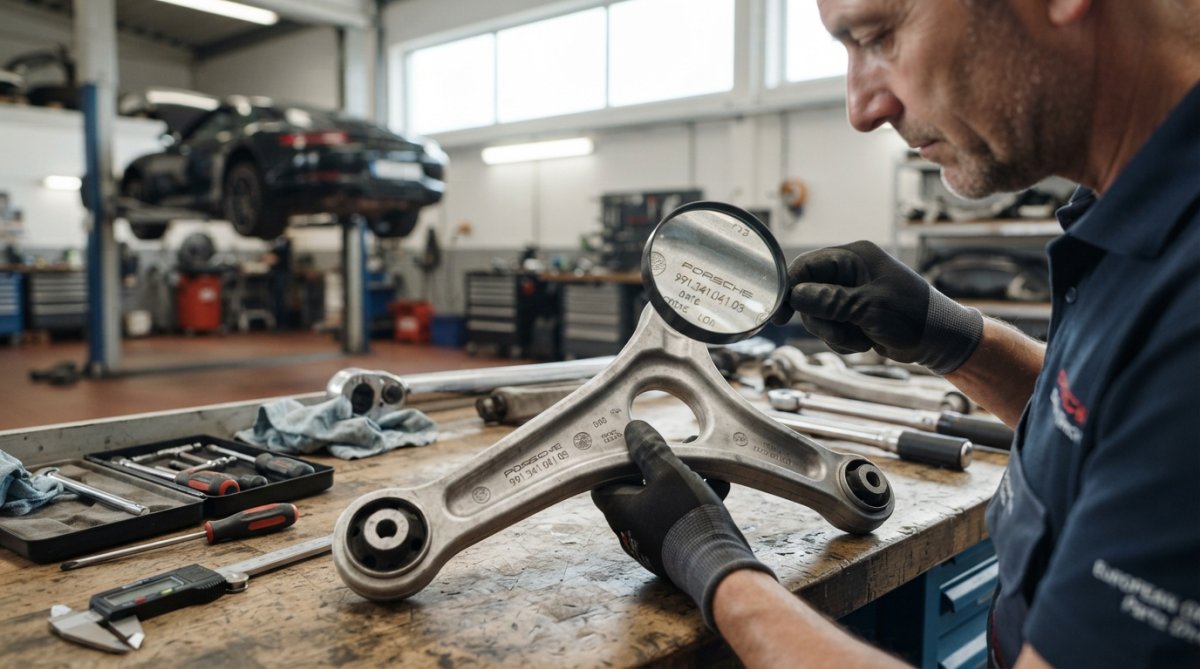
Forged aluminum control arms bear casting marks from the manufacturing process. Genuine parts show clean, consistent casting marks. The metal surface is smooth with no rough edges or porosity.
Counterfeit control arms often show:
- Rough, pitted casting surfaces
- Uneven metal texture
- Visible porosity or air pockets
- Inconsistent stamping depth
- Misaligned part numbers
Examine the ball stud attachment point closely. Genuine studs have precise geometry with tight tolerances. The threaded base is perfectly aligned. Counterfeit studs show sloppy geometry, loose tolerances, and rough threads.
Run your hand along the component's edges. Genuine parts are deburred and finished smoothly. Counterfeits often have sharp edges, rough spots, or grinding marks.
Ball Stud - Porsche (0B1-141-777-A) →
Assess Material Composition and Weight
Genuine Porsche suspension components use specific aluminum alloys engineered for strength, corrosion resistance, and weight. A counterfeit part often feels noticeably lighter or heavier than the genuine equivalent.
Weigh the component if possible. Compare the weight to official specifications.
Step 3: How to Spot Counterfeit Auto Parts
Counterfeit suspension parts share common visual red flags. Learn to recognize them, and you'll catch fakes before installation.
Common Visual Red Flags
Packaging quality is your first clue. Genuine parts arrive in professional boxes with clear labeling, part numbers, and serial numbers printed correctly. Counterfeit parts often come in:
- Generic or poorly printed boxes
- Misspelled text or inconsistent fonts
- Missing or incorrect part numbers on packaging
- No serial number or batch code
- Damaged or water-stained boxes
Inspect the component itself for these warning signs:
- Rough casting surfaces with visible porosity
- Inconsistent metal finish or discoloration
- Shallow or misaligned stamping
- Visible grinding marks or tool marks
- Loose or imprecise fitment of sub-components
- Rubber bushings that are discolored or deteriorated
- Missing or incomplete documentation
Counterfeit ball studs often have:
- Loose threads with inconsistent pitch
- Rough or unfinished shaft surfaces
- Incorrect taper angle (ball studs must have precise geometry)
- Weak or cracked welds (if welded components are involved)
Packaging and Labeling Verification
Genuine parts come with official documentation. This includes:
- Original Porsche part number label
- Serial or batch number for traceability
- Manufacturing date code
- Porsche logo and branding
- Barcode that matches the part number
Counterfeit packaging often shows:
- Blurry or low-resolution printing
- Incorrect Porsche logo (outdated design, wrong colors)
- Spelling errors or grammatical mistakes
- Missing barcodes or barcodes that don't match the part number
- No serial number or batch code
- Generic labels that could apply to any part
Open the box. Genuine parts are wrapped carefully with protective materials. Counterfeit parts often arrive with minimal or no packaging protection. The component itself should be clean and undamaged.
Step 4: Use Digital Verification Tools
Modern authentication goes beyond visual inspection. Digital tools verify part authenticity with precision.
Step 5: Test Fitment and Engineering Tolerance
The final authentication step is mechanical: does the part fit correctly and maintain proper engineering tolerances?
- Does the ball stud thread smoothly without binding or looseness?
- Do control arm mounting points align perfectly?
- Is there any play or rocking in the connection?
- Do bushings compress evenly under the vehicle's weight?
Counterfeit parts often show:
- Loose threading or excessive play
- Misaligned mounting points
- Uneven bushing compression
- Vibration or noise during operation
After installation, take the vehicle for a test drive. Genuine suspension components provide precise steering response and stable handling. Counterfeit parts create:
- Vague or imprecise steering
- Vibration at highway speeds
- Unusual noises from the suspension
- Alignment issues that persist after adjustment
Safety Implications of Using Counterfeit Suspension Parts
Counterfeit suspension parts don't just reduce performance, they create genuine safety hazards.
| Component | Genuine Risk | Counterfeit Risk | Failure Mode |
|---|---|---|---|
| Ball Stud | Rare under normal use | High within months | Sudden loss of steering control |
| Control Arm | Minimal wear over years | Cracks develop quickly | Alignment failure, vibration |
| Bushing | Gradual wear, 5+ years | Deterioration in weeks | Suspension noise, instability |
| Spindle | Extreme durability | Casting defects | Wheel bearing failure |
Frequently Asked Questions
How can I tell if my Porsche suspension parts are genuine?
Genuine Porsche suspension parts have clear, precise part numbers and serial numbers stamped or cast into the component. Check for OEM specifications, verify the part number against official databases, and inspect for professional casting marks and consistent material weight. Authentic parts also come with proper labeling and documentation. If you're uncertain, use a VIN search tool or contact European OEM Parts Direct to verify the exact part number for your vehicle model.
What is the difference between OEM and genuine Porsche suspension parts?
OEM (Original Equipment Manufacturer) parts are made by Porsche's authorized suppliers to exact engineering specifications. Genuine Porsche parts are the same components, they're OEM parts sold through official Porsche channels. The terms are often used interchangeably. Both meet strict tolerances and engineering requirements. Counterfeit parts, by contrast, may have inferior metallurgy, poor corrosion resistance, and fail to meet engineering standards, putting your vehicle's performance and safety at risk.
What are the risks of using counterfeit suspension parts on a vehicle?
Counterfeit suspension components can cause performance degradation, reduced handling precision, and premature wear. More critically, suspension systems directly affect braking, steering response, and vehicle stability. Low-quality replicas with poor tensile strength or incorrect fitment may fail under load, leading to loss of control. Counterfeit parts may also not meet safety compliance standards. The structural integrity of your vehicle's suspension is essential, using authentic parts protects both performance and occupant safety.
Do genuine Porsche parts always have a part number stamped on them?
Yes, genuine Porsche suspension parts have part numbers that are either stamped, cast, or clearly marked during manufacturing. The marking quality is precise and consistent. Some components also include secondary identification marks or holographic labels on packaging. However, part number presence alone isn't enough, counterfeits can be stamped with fake numbers. Always cross-reference the part number against official specifications and verify with your vehicle's VIN to confirm authenticity.