 comparison
Alternatives to Dealership Parts for Volkswagen
Table of Contents
- Why Owners Seek Alternatives to Dealership Parts
- OEM vs Aftermarket VW Parts: What's the Real Difference
- Best Online European Auto Parts Store Options
- How to Find VW Part Numbers for Your Vehicle
- Cost-Benefit Analysis: Genuine Parts vs Aftermarket
- Performance and Reliability Trade-Offs
- Warranty Myths About Non-Dealership Parts
- Sustainability: Remanufactured and Used Parts
- Frequently Asked Questions
Last Updated: September 25, 2026
Why Owners Seek Alternatives to Dealership Parts
Volkswagen owners quickly discover that dealership repair costs drain budgets fast due to premium markups reflecting overhead and labor rates, which is why many explore alternatives to dealership parts for Volkswagen. Many explore alternatives to dealership parts because the math doesn't work for long-term vehicle maintenance.
Owners now have options. Access to genuine OEM components through online retailers has shifted the repair landscape, allowing you to source authentic Volkswagen parts at competitive prices without dealership markups or scheduling delays.
European OEM Parts Direct recognizes this shift. The platform was built specifically for owners who want genuine parts without the dealership markup. Whether you're maintaining a GTI, Jetta, Atlas, or any other VW model, finding authentic alternatives to dealership parts is now straightforward if you know where to look.
The decision comes down to cost savings, convenience, and control over maintenance timing and methods.
OEM vs Aftermarket VW Parts: What's the Real Difference
OEM (Original Equipment Manufacturer) parts are components built to the exact specifications Volkswagen uses on the assembly line. Aftermarket parts are manufactured by third-party suppliers who may or may not meet those same standards. The difference matters more than marketing suggests.
Quality Assurance and Manufacturing Standards
OEM parts carry Volkswagen's engineering signature, manufactured under strict quality assurance protocols and tested to factory standards. They're guaranteed to fit your specific vehicle model and year.
Aftermarket components vary wildly in quality. Some maintain rigorous standards rivaling OEM quality; others cut corners on materials or testing to hit lower price points.
For critical systems like suspension and braking, the quality gap between top-tier aftermarket and OEM is minimal. For cosmetic trim and interior components, aftermarket options perform identically to OEM. For high-stress parts like transmission components and engine gaskets, OEM parts typically deliver superior lifetime reliability.
Warranty Coverage and Legal Protection
Many owners believe using non-OEM parts automatically voids their warranty. That's not accurate under U.S. law.
The Magnuson-Moss Warranty Act prevents manufacturers from voiding your entire warranty because you used a non-dealership supplier. Volkswagen cannot deny coverage on unrelated systems, but can deny coverage on that specific component if the aftermarket part causes a failure.
Using alternatives to dealership parts is legal and protected. Using a defective aftermarket part that damages your engine is different, Volkswagen can deny coverage for that specific failure chain.
Federal Trade Commission guidance on warranty rights clarifies that manufacturers must prove a non-OEM part caused the failure before denying coverage. This protection applies regardless of where you source your parts.
Best Online European Auto Parts Store Options
European OEM Parts Direct is a purpose-built platform for Volkswagen, Audi, and Porsche owners seeking genuine OEM components, combining authentic inventory, accurate identification tools, and competitive pricing.
The vehicle picker tool and VIN search function eliminate guesswork by cross-referencing your vehicle's exact specifications against the parts database, especially valuable for older models where compatibility becomes murky.
European OEM Parts Direct maintains comprehensive stock across maintenance items, filters, fluids, gaskets, brake components, and suspension elements.
Pricing reflects the cost of maintaining genuine inventory, supporting accurate identification tools, and standing behind purchases.
What to Look for in a Reliable Supplier
Genuine parts verification. Legitimate suppliers source directly from Volkswagen or authorized distributors and can document their supply chain. Avoid cheap-looking listings with vague sourcing.
Accurate part matching. Reliable suppliers invest in VIN search, vehicle picker, and cross-reference databases to prevent costly mistakes.
Return and exchange policies. Clear return windows, straightforward exchanges, and responsive customer service provide essential recourse for damaged or incompatible parts.
Shipping reliability. Reputable retailers use appropriate packaging, insure shipments, and track delivery to ensure parts arrive intact.
Responsive support. You need knowledgeable support for part compatibility and fitment questions, generic representatives cannot answer vehicle-specific questions.
How to Find VW Part Numbers for Your Vehicle
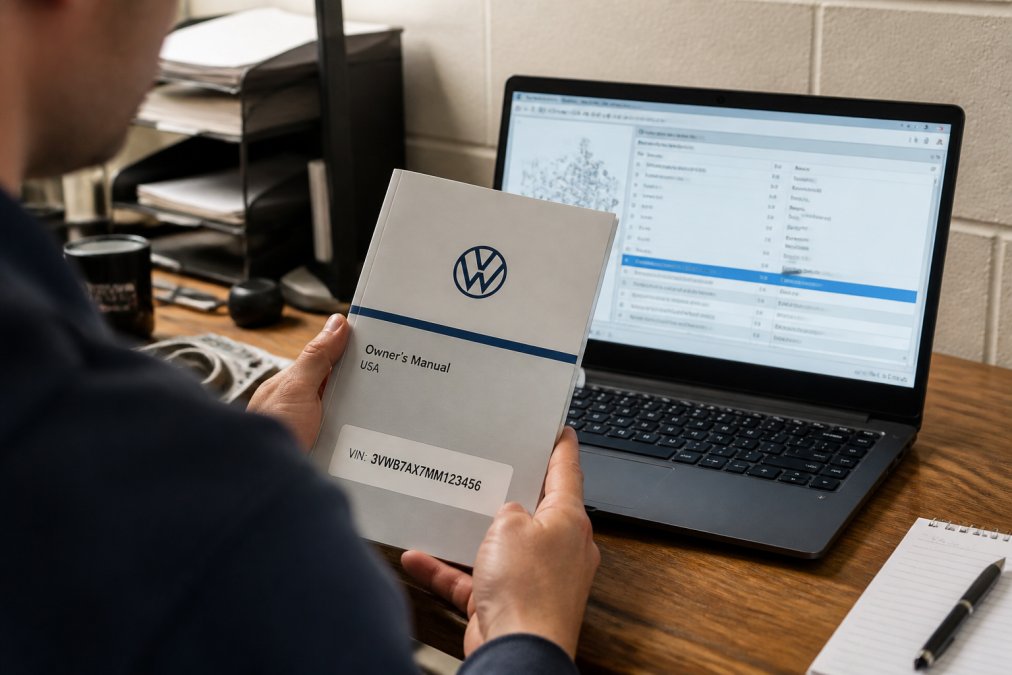
Finding your correct VW part number is the foundation of ordering the right component. Without it, you risk ordering incompatible parts, waiting for replacements, and delaying repairs. Three methods work reliably.
Volkswagen GTI leather shift knob →
Using VIN Search and Vehicle Picker Tools
Your VIN (Vehicle Identification Number) is a 17-character code encoding your vehicle's exact specifications, found on registration documents, insurance paperwork, and the driver's side dashboard.
A VIN search tool decodes this number and cross-references it against parts databases. European OEM Parts Direct's VIN search function takes your 17-character code and returns compatible parts for your specific model year, engine type, and trim level. This method eliminates ambiguity, the system knows whether you have a turbocharged engine or naturally aspirated, manual or automatic transmission, and which interior trim you specified at purchase.
Vehicle picker tools work similarly but require you to manually select your model year, body style, engine type, and trim. This method works well if your VIN is illegible or you prefer guided selection. Both approaches yield identical results when used correctly.
Cross-Referencing Parts for Older Models
Older Volkswagen models present challenges because parts databases sometimes contain incomplete or conflicting information. A 2008 Jetta might have multiple engine options, transmission variants, or interior configurations depending on the original purchase specifications and any previous repairs.
Cross-referencing involves checking multiple sources. Your owner's manual lists original component part numbers. Service records from previous repairs document what was installed. Volkswagen dealership parts diagrams (available online) show exploded views of components with part numbers labeled.
When ordering alternatives to dealership parts for Volkswagen on older models, compare the part number you find against what's documented in your service history. If a previous repair replaced a component, that service record proves what fits your specific vehicle.
Cost-Benefit Analysis: Genuine Parts vs Aftermarket
The decision between OEM and aftermarket components involves math, risk tolerance, and how long you plan to keep your vehicle.
Genuine OEM parts cost more upfront. A Volkswagen OEM serpentine belt might run $45-60, while a quality aftermarket alternative runs $20-30. Over a vehicle's lifetime, you might replace it twice. The total difference is perhaps $40-60 across ten years.
But consider a transmission solenoid or fuel injector. OEM versions cost significantly more, but failures carry consequences. A faulty aftermarket fuel injector might cause rough idling, reduced fuel economy, or check engine lights. An OEM component rarely exhibits these issues. The cost difference between OEM and aftermarket expands dramatically for critical components.
The real calculation factors in your vehicle's age, mileage, and your plans for ownership. If you're keeping your Volkswagen for another 100,000 miles, OEM parts on critical systems make financial sense. The reliability premium translates to fewer unexpected repairs, less downtime, and better resale value. If you're driving a vehicle you plan to sell within two years, aftermarket components on non-critical systems might make sense.
European OEM Parts Direct's pricing on genuine components reflects the cost of sourcing authentic parts and maintaining inventory. You're paying for reliability and accuracy, not dealership overhead.
Performance and Reliability Trade-Offs
Performance parts present different considerations than maintenance components. A Volkswagen GTI Performance Air Intake Kit ($389.00) from European OEM Parts Direct delivers sharper throttle response and more aggressive induction sound. This component enhances driving experience but doesn't affect reliability, it's a legitimate upgrade, not a repair necessity.

Reliability trade-offs emerge when comparing OEM maintenance parts to budget aftermarket alternatives. An OEM brake pad set wears more predictably, modulates braking force more consistently, and integrates seamlessly with your vehicle's ABS system. A budget aftermarket pad might deliver adequate stopping power but with less predictable wear patterns or dust accumulation.
The distinction matters most for systems where precision affects safety or longevity. Suspension components, brake parts, and engine gaskets benefit from OEM specifications. Interior trim, weatherstripping, and cosmetic components perform identically whether OEM or quality aftermarket.
For performance upgrades like the GTI intake kit, the trade-off is different. You're gaining performance characteristics, not replacing a failed component. The decision depends on whether the performance enhancement justifies the investment.
Warranty Myths About Non-Dealership Parts
The most persistent myth is that using alternatives to dealership parts automatically voids your warranty. This is false. Federal law protects you.
The Magnuson-Moss Warranty Act prevents Volkswagen from denying warranty coverage on unrelated systems simply because you sourced a part elsewhere.
Sustainability: Remanufactured and Used Parts
Remanufactured components represent an underutilized option for cost-conscious owners. A remanufactured alternator, starter, or transmission has been disassembled, inspected, restored to original specifications, and tested. It performs identically to a new OEM component but costs 30-50% less.
Frequently Asked Questions
How do I know if parts from an online retailer are genuine OEM and not counterfeit?
Genuine OEM parts come directly from the original equipment manufacturer with proper certification and documentation. Reputable online retailers source directly from manufacturers or authorized distributors and provide part numbers that match official Volkswagen specifications. Always verify the part number against your vehicle's documentation, check for holograms or security features on packaging, and purchase from established suppliers with transparent sourcing practices and customer reviews that confirm authenticity.
Will a VIN search tool work for older Volkswagen models?
Modern VIN search tools are designed to work across multiple model years, including older vehicles. The best approach is to use the VIN search as a starting point, then cross-reference the results with your owner's manual or contact customer support if you own a pre-2000s model.
What's the real savings when you factor in shipping costs?
While shipping adds to the total cost, the savings from online retailers often remain significant. You avoid labor charges when sourcing parts yourself. Compare the total out-the-door price rather than parts alone.
What happens if an online part doesn't fit my specific Volkswagen or arrives damaged?
Before ordering, verify the part number matches your specific vehicle model and year using the retailer's VIN search or vehicle picker tool. If a part arrives damaged, photograph the damage and contact the retailer immediately.