 listicle
Best Online Sources for Genuine VW Components
Table of Contents
- What Makes a Genuine VW Component Source Worth Your Money
- How to Use Volkswagen Parts by VIN for Exact Fitment
- Where to Buy VW Parts Online: What to Check Before You Order
- Pricing Breakdown: What Genuine VW Components Actually Cost
- Shipping, Returns, Warranties, and Core Charges Explained
- Counterfeit, Used, Remanufactured, and OEM-Equivalent Parts: Know the Difference
- Frequently Asked Questions
Last Updated: October 14, 2026
What Makes a Genuine VW Component Source Worth Your Money
Genuine VW components are parts manufactured to the same specifications Volkswagen used on the assembly line, sold under the brand's own part numbers. For anyone hunting the best online sources for genuine vw components, that definition is the whole ballgame. Buy from a seller who can prove that lineage, and your Golf, Jetta, or Atlas keeps the fit, finish, and durability it left the factory with.
At European OEM Parts Direct, we built our catalog around one idea: genuine VW components should be easy to find, correctly matched, and priced without the dealership markup. This guide covers how to separate real OEM sellers from lookalikes, how to verify fitment before you pay, and what shipping and returns actually add to the bill.
Genuine OEM vs. Aftermarket: What the Difference Costs You
The gap between OEM and aftermarket comes down to who controls the specification. OEM parts (also called OE or original equipment) are built to the automaker's drawings and tolerances, while aftermarket parts are built by third parties to their own interpretation of those specs.
That difference shows up in ways you notice later:
- Fitment: OEM brackets, clips, and connectors line up with factory mounting points. Aftermarket parts sometimes need persuasion.
- Materials: Sensor housings, bushings, and gaskets use the compounds the factory validated for your model year and trim level.
- Warranty path: A genuine part carries a manufacturer-backed warranty. Aftermarket coverage depends entirely on the reseller.
- Resale: A documented service history with OEM replacement parts supports the long-term value of a European vehicle.
Aftermarket has a place, particularly for wear items on older cars where the original supplier no longer produces the part. For engine management, cooling, and anything electronic, we recommend staying with genuine components.
How to Verify Genuine VW Parts Before You Buy
Verification starts before checkout, not after the box arrives. A genuine VW part carries a manufacturer part number stamped or printed on the component itself, plus packaging with the brand's markings and a scannable label.
Run through this checklist on any listing:
- The seller publishes the full Volkswagen part number, not just a generic description
- The listing states the exact models, years, and trim levels the part fits
- The seller identifies the part as new genuine OEM, not "OEM equivalent" or "OEM quality"
- Packaging photos show Volkswagen branding and a legible label
- The seller has a published return policy for fitment issues
- Customer support can answer a part-number question before you order
The Federal Trade Commission's guidance on deceptive advertising is clear that sellers cannot misrepresent a product's origin, which is why vague "OEM quality" language is a warning sign rather than a selling point.
How to Use Volkswagen Parts by VIN for Exact Fitment
Volkswagen parts by VIN lookup is the most reliable way to match a component to your specific car. The vehicle identification number encodes the model, model year, trim level, engine, and plant of assembly, so a VIN search narrows the catalog to parts that were actually built for your vehicle.
Part numbers alone can fail you. Volkswagen frequently revises a component mid-cycle, and two cars that look identical on the lot can take different sensors, mounts, or trim clips. A VIN-based search resolves that ambiguity before you order.
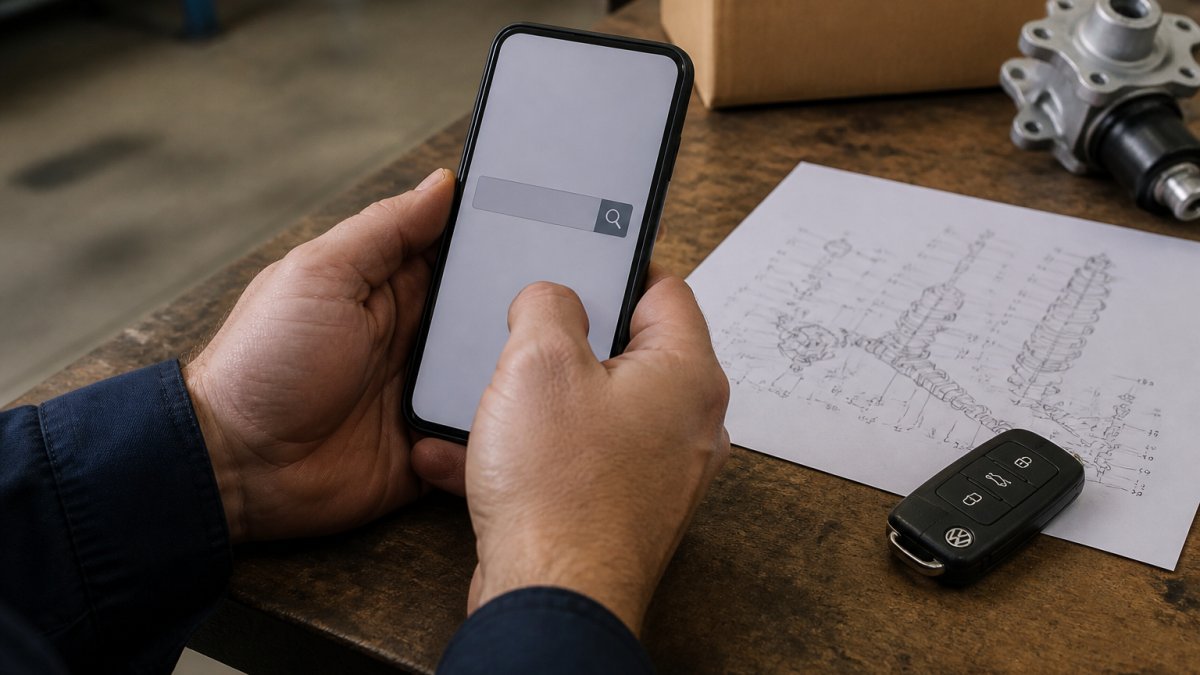
Our vehicle picker and VIN search exist for exactly this reason. Enter the number from the base of your windshield or the driver's door jamb, and the catalog filters to parts that match your build.
VW Part Number Lookup: Decoding What You Need
A VW part number is a structured code, and reading it tells you what you are looking at. Most numbers follow a pattern: a group prefix, a main group and subgroup, a part identifier, and a revision suffix.
Take a number like 3CN-061-161-A. The first three characters identify the model family or platform, the middle groups classify the component, and the trailing letter marks the revision or color variant. A revised part (ending in a later letter) usually supersedes the earlier version, so a "B" suffix often replaces an "A."
Two practical rules follow from this:
- Never order by description alone. "Trunk liner for Atlas" is not a part number.
- When a seller lists a superseded number, confirm the new number replaces the old one for your model year.
If decoding feels tedious, a VIN search skips the guesswork entirely.

Where to Buy VW Parts Online: What to Check Before You Order
Where to buy VW parts online comes down to four checks: authenticity credentials, fitment accuracy, total cost, and after-sale policy. A seller who is transparent on all four is worth your business.
Here is how we would evaluate any source before entering card details:
| Check | What Good Looks Like | Red Flag |
|---|---|---|
| Authenticity | Full VW part numbers published, genuine OEM stated plainly | "OEM quality," no part number shown |
| Fitment | VIN search or detailed year/make/model/trim filters | "Fits most VW models" |
| Total cost | Shipping and tax shown before checkout | Fees revealed at the final step |
| After-sale | Published returns, warranty, and core-charge terms | No return policy anywhere on the site |
European OEM Parts Direct keeps a comprehensive inventory on hand, so the part you order is the part that ships. Our catalog is built specifically for Audi, Porsche, and Volkswagen vehicles, which means fewer dead ends when you are chasing a hard-to-find component for an older model.
Pricing Breakdown: What Genuine VW Components Actually Cost
Genuine VW component pricing varies widely by category, and the honest answer is that a single "average price" does not exist. A cabin filter and a water pump live in completely different price bands, and condition (new versus remanufactured) moves the number again.
What we can show you is real pricing from our own catalog so you can calibrate:
2020-2025 Volkswagen Atlas - Trunk Liner With Extended Seat Back Cover →
| Product | Price | Category |
|---|---|---|
| 2020-2025 Volkswagen Atlas Trunk Liner With Extended Seat Back Cover (3CN-061-161-A) | $153.00 | Interior protection |
| Volkswagen GTI Leather Shift Knob | $98.00 | Interior trim |
| Volkswagen GTI Performance Air Intake Kit | $389.00 | Performance |
The Atlas liner is custom-molded for the model with a raised edge to contain spills and a textured, skid-resistant finish. The GTI shift knob is a direct replacement that installs in minutes with no modification. The intake kit is built for GTI-specific fitment and sharper throttle response.


Total Cost Comparison: Parts, Shipping, and Taxes
Sticker price is only part of the bill. Total cost equals the part price plus shipping, sales tax, and any return shipping if fitment goes wrong. A seller with a lower sticker and a strict no-return policy can cost you more than a slightly higher price with a real return window.
When you compare sources, add these four lines for each:
- Part price
- Shipping to your ZIP code
- Estimated sales tax
- Potential return shipping if the part does not fit
The lowest total, not the lowest sticker, is the number that matters.
Shipping, Returns, Warranties, and Core Charges Explained
Shipping, returns, and warranties are the fine print that decides whether a purchase goes smoothly.
Ask four questions before ordering:
- How fast does the part ship, and is tracking provided?
- What is the return window, and who pays return shipping on a fitment issue?
- What does the warranty cover, and for how long?
A seller who answers all four in writing is one you can hold to their word. If the policy page is silent, assume the worst case.
Counterfeit, Used, Remanufactured, and OEM-Equivalent Parts: Know the Difference
Counterfeit, used, and OEM-equivalent parts are four different things, and only one of them is genuine. Mixing them up is how people end up with a component that fails early or fits poorly.
-
Genuine OEM: New, built to the automaker's specification, sold under the brand's part number with a manufacturer warranty.
-
OEM-equivalent: Aftermarket, made to approximate the original spec. Quality varies by maker.
-
Used: Pulled from another vehicle. Condition is unknown and warranty is usually nonexistent.
-
Counterfeit: A copy sold as genuine. No spec control, no warranty, and sometimes a safety risk.
The National Highway Traffic Safety Administration tracks safety recalls tied to vehicle components, which is one more reason to know exactly what you are installing. A counterfeit brake or suspension part carries risk a genuine one does not.
Our recommendation is simple: for anything safety-related or electronic, buy new genuine OEM.
Frequently Asked Questions
How do I know if a VW part is genuinely OEM?
Check for the Volkswagen logo, a genuine part number stamped or printed on the component, and original manufacturer packaging. Genuine VW components also include a holographic authenticity label on the box. When buying online, purchase from sellers who provide the exact part number and vehicle fitment details before checkout. If the price is dramatically lower than other sources, treat it as a red flag and verify the seller's return policy and warranty terms first.
Can I use my VIN to find the correct VW part online?
Yes. A VIN-based search narrows results to components that match your specific model year, trim level, and factory configuration. This matters most for older or rare models where the same nameplate used different parts across production runs. Enter your 17-character VIN into the seller's vehicle picker or VIN search tool, then confirm the part number matches what is stamped on your original component before ordering.
Are genuine VW parts worth the extra cost over aftermarket?
Genuine VW components are engineered to original specifications for fit, durability, and material quality. Aftermarket parts vary widely; some meet or exceed OEM standards, while others cut corners on materials or tolerances. For critical systems like braking, suspension, and engine management, genuine parts reduce the risk of premature failure and preserve resale value. For cosmetic accessories, aftermarket options can work, but verify fitment and warranty coverage before buying.
What should I check before ordering VW parts online?
Confirm the part number against your VIN, verify the seller lists a clear return policy and warranty, and check whether shipping is included in the total price. Also confirm stock availability before checkout; a seller who lists a part as in-stock but cancels orders frequently is not a reliable source.
Can I return a Volkswagen part if it does not fit?
Most reputable online sellers accept returns on unused parts within a set window, typically 30 to 90 days. The part must be in original packaging with no signs of installation. Some sellers charge a restocking fee, and special-order or electrical components may be non-returnable. Before ordering, read the return policy carefully and confirm whether return shipping is covered. If the seller does not publish a clear policy, that is a warning sign.
Sourcing genuine VW components online should not feel like a gamble. The challenge is finding a seller who publishes real part numbers, matches by VIN, and stands behind shipping and returns. European OEM Parts Direct was built for exactly that: a comprehensive inventory of genuine OEM parts for Audi, Porsche, and Volkswagen, a user-friendly vehicle picker, and VIN search for accurate part identification. Get started with European OEM Parts Direct and find the exact component your vehicle needs.