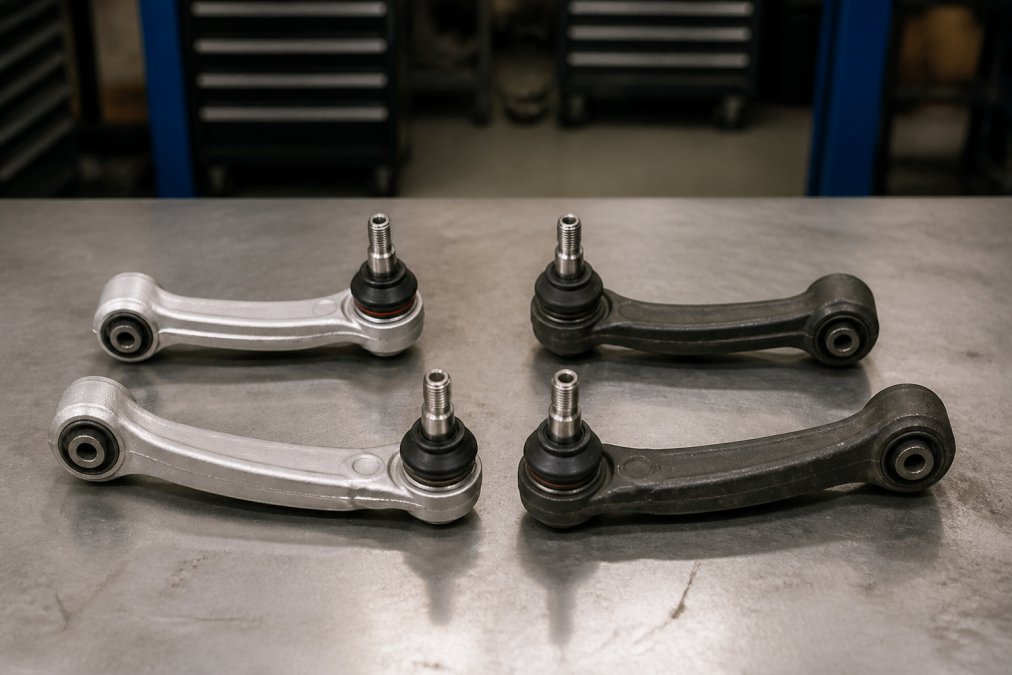
 comparison
OEM vs Aftermarket VW Parts: 2026 Comparison Guide
Table of Contents
- OEM vs Aftermarket VW Parts: What Actually Differs
- OEM vs Aftermarket VW Parts Comparison Table
- The Benefits of Using OEM Car Parts on a Volkswagen
- How to Find OEM Parts by VIN for Your Volkswagen
- Do Aftermarket Parts Affect Car Resale Value?
- When to Save With Aftermarket and When OEM Is Mandatory
- Genuine VW Parts Worth Buying From European OEM Parts Direct
- Frequently Asked Questions
Last Updated: September 16, 2026
OEM vs Aftermarket VW Parts: What Actually Differs
The difference between OEM vs aftermarket Volkswagen parts comes down to who made the part and who backs it. OEM parts are manufactured by the company that built your car's original components, sold under the automaker's brand. Aftermarket parts are made by independent suppliers and sold without that factory connection.
This guide from European OEM Parts Direct covers the OE versus OEM distinction most buyers miss, where aftermarket parts are safe, where they are not, and how to spot counterfeits before you install anything. Below, we break down fitment, warranty coverage, and the resale question that rarely gets a straight answer.
The OE vs OEM Distinction Most Buyers Miss
OE (Original Equipment) means the part was built for the assembly line and carries the VW logo on the box. OEM (Original Equipment Manufacturer) means the same factory built the part to the same specification, but it ships in the manufacturer's own packaging instead of VW-branded packaging.
Here is the tension: the part inside can be identical. The box, the markup, and the warranty path differ. A common mistake is assuming "OEM" is a downgrade. In practice, an OEM part from the same production line often is the genuine component without the dealership packaging premium.
OEM vs Aftermarket VW Parts Comparison Table
| Factor | OEM Parts | Aftermarket Parts |
|---|---|---|
| Manufacturer | Original factory supplier | Independent third party |
| Fitment | Exact, VIN-verified | Varies by brand |
| Warranty | Backed by manufacturer | Backed by seller only |
| Price | Higher upfront | Lower upfront |
| Quality control | Factory standards | Inconsistent |
| Best For | Safety, engine, drivetrain | Cosmetics, accessories |
The Benefits of Using OEM Car Parts on a Volkswagen
The benefits of using OEM car parts start with fitment and end with resale. OEM components are engineered to the vehicle's original technical specifications, so installation precision is predictable and the part behaves the way the factory intended.
Fitment, Durability, and Warranty Coverage
Fitment failures are the number one complaint with cheap aftermarket components. Mounting points sit millimeters off, connectors do not seat, and you end up grinding brackets to make a part work. OEM parts drop in.
Durability follows the same logic. Genuine parts are validated against the vehicle's expected service life, while third-party components vary wildly in material quality. Warranty coverage is the third pillar: OEM parts typically carry a manufacturer-backed warranty, whereas aftermarket suppliers often limit claims to replacement only, not labor.
How to Find OEM Parts by VIN for Your Volkswagen
Finding OEM parts by VIN is the most reliable way to get the exact component your vehicle left the factory with. Your VIN encodes trim, engine code, and production details that generic part lookups miss, which matters most on older or rare models where a single model year can span multiple part revisions.
Here is the process:
- Locate your VIN on the driver-side dashboard or door jamb sticker
- Enter the full 17-character VIN into a VIN search tool
- Confirm the returned part number against your old component
- Check the diagram to verify position and quantity
- Order and cross-check the number on arrival
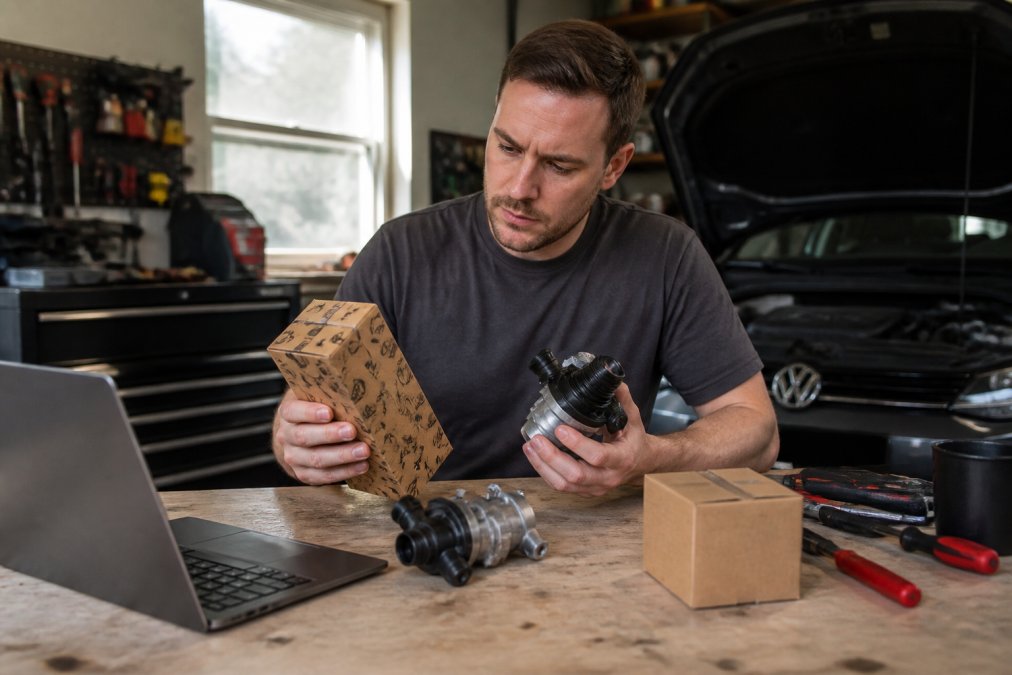
Spotting Counterfeit and Rebranded 'White Box' Parts
"White box" parts are the quiet problem in this market. A supplier buys genuine OEM components in bulk, repackages them in plain boxes, and sells them as either bargain OEM or premium aftermarket depending on the day. The part may be fine. The provenance is not.
Counterfeits are worse. Look for printing errors on the label, mismatched fonts, missing holograms, and packaging that feels flimsy.
Do Aftermarket Parts Affect Car Resale Value?
Aftermarket parts can affect resale value, and the effect runs in both directions depending on what was installed and who is buying. The mechanism is not the part itself, it is what the part signals to a buyer or inspector about how the car was maintained.
Where Aftermarket Helps or Is Neutral
Cosmetic and reversible upgrades rarely hurt value and can help with the right buyer:
- Quality shift knobs, floor mats, and interior trim
- Enthusiast-oriented intake or exhaust upgrades on performance models, where the buyer pool expects them
- Wear items replaced with reputable aftermarket brands (filters, wipers, batteries)
Where Aftermarket Hurts
Non-OEM parts in safety, engine, or drivetrain systems raise questions during a pre-purchase inspection:
- Mismatched or unbranded components in the brake system
- Aftermarket timing components with no service record
- Suspension parts of unknown origin on a car with no documentation
- Electrical or emissions components that trigger stored fault codes
The Service-Record Effect
This is the part most articles skip. Resale value is driven less by the parts themselves than by what the paperwork shows. A car with dealer or OEM-supplier invoices for every major service signals careful ownership. A car with a stack of generic receipts and no part numbers signals the opposite.
How Much Does It Matter?
The impact scales with the car's value and the buyer's sophistication:
- Late-model, still-under-warranty cars: Aftermarket parts in covered systems can complicate warranty claims and will be flagged by a franchised dealer at trade-in.
- Enthusiast models (GTI, Golf R, older air-cooled): Buyers often prefer documented aftermarket upgrades over mystery OEM replacements.
- Mainstream commuter models: OEM or OEM-equivalent parts with records hold value best; unexplained aftermarket parts in critical systems cost you at trade-in.
When to Save With Aftermarket and When OEM Is Mandatory
Save with aftermarket on cosmetics, wear items you replace often, and accessories where fitment is forgiving. Stick with OEM on anything tied to safety, emissions, or the engine and drivetrain, where a part failure carries real cost.
| Component | Recommendation | Why |
|---|---|---|
| Floor mats, trim | Aftermarket OK | No safety impact |
| Brake pads, rotors | OEM preferred | Safety-critical |
| Air filters | Either works | Low risk, easy swap |
| Timing components | OEM mandatory | Engine damage risk |
| Shift knobs | Aftermarket OK | Cosmetic, reversible |
Genuine VW Parts Worth Buying From European OEM Parts Direct
European OEM Parts Direct stocks genuine parts for Audi, Porsche, and Volkswagen, with a vehicle picker and VIN search built for accurate part matching. If you want to see what OEM quality looks like in hand, start with these:
- 2020-2025 Volkswagen Atlas Trunk Liner (3CN-061-161-A) at $153.00, custom-molded with a raised edge to contain spills
- Volkswagen GTI leather shift knob at $98.00, a direct replacement that installs in minutes
- Volkswagen GTI Performance Air Intake Kit at $389.00, built for authentic fitment and sharper throttle response
Frequently Asked Questions
Are VW OEM parts better than aftermarket?
For safety-critical and complex components, yes. OEM parts are built to Volkswagen's original technical specifications and manufacturing standards, so fitment and durability match what the car left the factory with. Aftermarket parts vary widely: some suppliers meet or exceed OE specs, while budget options cut corners on materials. For brakes, sensors, timing components, and anything tied to the warranty, OEM is the lower-risk choice.


Do aftermarket parts void my Volkswagen factory warranty?
Not automatically. Under the Magnuson-Moss Warranty Act, a dealer cannot void your entire warranty just because an aftermarket part is installed. However, if the aftermarket part causes a failure, the dealer can deny coverage for that specific repair. For example, an aftermarket suspension part that damages a related component may not be covered. Using OEM parts removes that argument entirely.
How do I find OEM parts by VIN for my Volkswagen?
Enter your 17-digit VIN into a parts lookup tool, and it will return the exact OEM part numbers built for your vehicle's trim, engine, and production date. This matters most for older or rare models where the same component changed across model years. A VIN search also helps you confirm compatibility before ordering, so you avoid return shipping on a part that does not fit.
Do aftermarket parts affect car resale value?
They can. Documented OEM maintenance and genuine replacement parts signal careful ownership, which supports resale value, especially on Audi, Porsche, and VW models where buyers inspect service history. Visible aftermarket modifications often narrow your buyer pool. If you plan to sell, keep receipts for OEM parts and avoid permanent modifications that cannot be reversed.
How can I identify genuine OEM Volkswagen parts?
Check for the VW or Audi logo and the OEM part number stamped or printed on the component or its packaging. Genuine parts arrive in branded packaging with a scannable part number. Counterfeits often use blurry logos, misspelled labels, or generic boxes. Buying from a supplier that matches parts to your VIN, like European OEM Parts Direct, removes most of the guesswork.
Deciding which parts deserve OEM money and which do not is the real skill here, and getting it wrong on a timing component or brake system costs far more than the part ever would. European OEM Parts Direct makes that call easier with genuine Audi, Porsche, and VW parts, a VIN search for accurate identification, and a vehicle picker that narrows the catalog to your exact model. Find your parts and keep your Volkswagen running the way it was built to.