 ultimate-guide
Buy Audi OEM Parts Online: The Complete Guide
Table of Contents
- Why Buying Audi OEM Parts Online Beats the Dealership
- OEM vs Aftermarket Car Parts: What Audi Owners Need to Know
- Audi VIN Parts Lookup: Finding the Exact Component for Your Vehicle
- How to Identify Counterfeit Audi Parts Before You Buy
- What to Expect When You Buy Audi OEM Parts Online
- DIY Installation: Getting the Most from Your Genuine Parts
- Featured Audi OEM Components Worth Knowing About
- Conclusion
Why Buying Audi OEM Parts Online Beats the Dealership
Dealership parts counters have a monopoly problem. They know you need the part, they know you're already there, and they price accordingly. For Audi owners, buying OEM parts online offers significantly lower prices and genuine convenience.
At European OEM Parts Direct, we've built our platform around one core frustration: Audi owners paying dealership markup on genuine parts when the same factory-certified components are available at significantly lower prices, shipped directly to your door.
The dealership experience means driving in, waiting for a service advisor, describing the part, waiting again while they look it up, then paying a premium as a captive audience. Online, you search by model or VIN, confirm fitment, and order, often with fast shipping that arrives before you could schedule a dealership appointment.
Dealerships stock what moves quickly. Genuine OEM parts for older or less common Audi models often aren't on the shelf, requiring a special order and more waiting. Online catalogs carry comprehensive inventories, including hard-to-find replacement components for vehicles outside the typical service window.
OEM vs Aftermarket Car Parts: What Audi Owners Need to Know
OEM vs aftermarket car parts is the central question for any Audi owner doing their own maintenance. Get it wrong and you're either overpaying unnecessarily or installing a component that won't meet the precision engineering your vehicle was designed around.
OEM stands for Original Equipment Manufacturer. Genuine OEM parts are manufactured to the exact specifications your Audi left the factory with, same materials, same tolerances, same fitment. They carry the factory warranty and are built to OE specifications that aftermarket suppliers often approximate rather than match.
Aftermarket parts are produced by third-party manufacturers. Quality varies enormously. Some perform adequately; others cut corners on materials or manufacturing tolerances in ways that only become apparent after installation or failure.
For Audi owners, the stakes are higher than average. Audi vehicles are precision-engineered systems where component compatibility matters. A brake pad that's slightly off-spec, a sensor that doesn't communicate correctly with the vehicle's control modules, or a seal that doesn't hold to factory pressure tolerances, these are documented failure modes.
Genuine OEM vs Remanufactured vs Salvage: The Real Differences
Genuine OEM parts are new, factory-produced components meeting original specifications. They're the default choice for any safety-critical system and any repair where fitment precision matters.
Remanufactured parts are used components rebuilt to a defined standard. For certain components like alternators and starters, remanufactured parts from reputable suppliers can be cost-effective. For sensors, electronics, and anything with tight tolerances, they're a risk.
Salvage parts are pulled directly from donor vehicles. Condition is entirely unknown without inspection. For non-critical trim and accessories, salvage can make sense. For mechanical and safety systems, it's a gamble.
The real difference comes down to certainty. Genuine OEM parts give you a known quantity.
Long-Term Cost Analysis: Cheap Parts vs Factory-Certified Components
A lower-cost aftermarket component might save money at purchase, but if that part fails prematurely, you're paying for the replacement part, labor to reinstall it, and potentially addressing damage caused by the failure. A genuine OEM part that lasts the vehicle's lifetime costs less in total than two or three aftermarket replacements.
There's also resale value to consider. Audi buyers pay attention to service history and parts quality. A documented history of genuine OEM maintenance supports a stronger resale position.
For non-critical accessories, body trim, and some consumables, the quality gap narrows enough to make aftermarket reasonable. For drivetrain, suspension, braking, and emissions systems, factory-certified components are the defensible choice.
Audi VIN Parts Lookup: Finding the Exact Component for Your Vehicle
Audi VIN parts lookup is the most reliable method for identifying the exact component your vehicle needs. Guessing by year and model alone results in parts that almost fit, which is the same as doesn't fit.
Your Vehicle Identification Number is a 17-character code that encodes your vehicle's production specifications, including engine variant, transmission type, trim level, and production plant. Two 2019 Audi A4s can have different part numbers for the same component if one has a different engine option or was built to a different regional specification.
According to NHTSA's VIN decoder guidance, every vehicle sold in the United States carries a standardized 17-character VIN containing specific production data. Using that number for parts lookup eliminates ambiguity entirely.
How to Read Your VIN and Use It for Catalog Search
Your VIN is located on the driver's side dashboard (visible through the windshield), the driver's door jamb sticker, and your vehicle registration and insurance documents.
The 17 characters break down into three sections:
- Characters 1-3 (WMI): World Manufacturer Identifier. Audi vehicles typically begin with WAU or TRU depending on production plant.
- Characters 4-8 (VDS): Vehicle Descriptor Section. This encodes body style, engine type, and restraint systems.
- Characters 9-17 (VIS): Vehicle Identifier Section. Includes model year, plant code, and sequential production number.
For parts catalog search, characters 4 through 9 are most useful, they distinguish between engine variants and trim configurations that affect part compatibility. Enter the full 17-character VIN into a VIN lookup tool and let the system match it.
Shop by Model: Navigating Parts Diagrams and Schematics
Parts diagrams are the most underused resource in DIY Audi maintenance. A good parts diagram shows the component in its installed position with callouts to the exact part number for each element in the assembly. This matters because many Audi systems are sold as assemblies that include multiple sub-components.
When navigating by model, start with the model year, then the body style, then the engine code. Audi's engine codes (visible on the engine block and in your documentation) are critical for filtering correctly. A 2.0T TFSI has different components than a 3.0T TFSI even in the same model year and body style.
| Search Method | Best For | Accuracy Level |
|---|---|---|
| VIN Lookup | Any vehicle, any model year | Highest, build-specific |
| Model + Engine Code | Known engine variant | High, engine-specific |
| Model + Year Only | Common consumables | Medium, may need verification |
| Keyword Search | Accessories, trim items | Lower, requires fitment check |
How to Identify Counterfeit Audi Parts Before You Buy
Counterfeit Audi parts are a genuine problem in the online marketplace. The quality gap between a genuine OEM component and a convincing fake isn't always visible until the part fails.
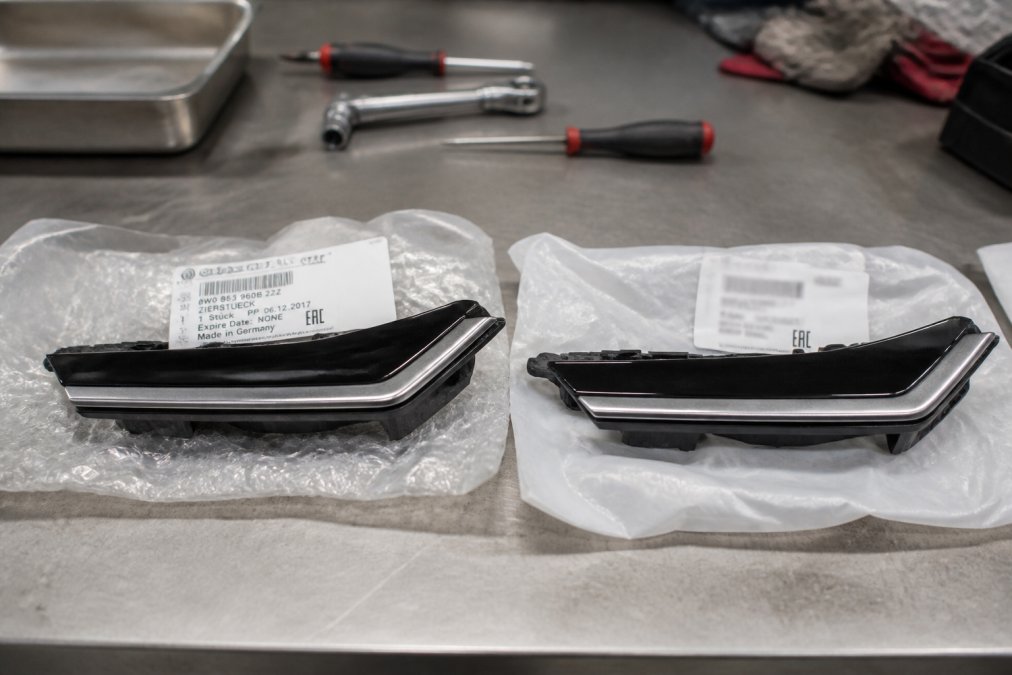
Packaging quality. Genuine OEM parts come in consistent, professional packaging with clear part numbers, barcodes, and manufacturer information. Counterfeit packaging often has blurry printing, misaligned text, incorrect fonts, or missing information. The part number on the packaging should match the part number stamped or molded into the component itself.
Part number verification. Every genuine Audi OEM component carries a part number that can be cross-referenced against Audi's official parts database. If a seller can't provide a part number, or if the number doesn't return results in a legitimate catalog search, treat that as a red flag.
Authorized dealer sourcing. The most reliable protection against counterfeit parts is buying from an authorized dealer or a supplier that sources directly from the manufacturer's distribution network. According to the Automotive Anti-Counterfeiting Council's industry resources, counterfeit automotive parts represent a significant safety risk and are most commonly found through unverified third-party marketplace sellers.
Price that seems too good. Genuine OEM parts have a floor price determined by manufacturing cost. A part offered at a fraction of typical OEM pricing from an unknown seller is almost certainly not genuine.
What to Expect When You Buy Audi OEM Parts Online
A reputable online source will give you clear fitment confirmation before you complete a purchase, transparent shipping timelines, and explicit return and warranty policies. If any of those three elements are vague or absent, shop elsewhere.
Shipping, Delivery, and What Happens If Something Goes Wrong
Many genuine OEM parts ship within one to two business days for in-stock items, with nationwide delivery available. What matters most is what happens when something goes wrong. A supplier worth trusting has a clear process for handling damage: documented damage claims, replacement shipping at no cost, and a support team that can actually resolve the issue.
Before ordering any high-value component, confirm the supplier's damage and loss policy in writing.
Returns, Warranty, and Fitment Guarantee
Genuine OEM parts carry the manufacturer's factory warranty, which covers defects in materials and workmanship. A fitment guarantee means that if you used the supplier's VIN lookup correctly and the part doesn't fit, the return is the supplier's problem, not yours.
Return policies for correctly ordered parts vary. Most reputable suppliers accept returns on uninstalled parts in original packaging within 30 to 90 days. Installed parts generally cannot be returned, which is why confirming fitment before installation matters.
DIY Installation: Getting the Most from Your Genuine Parts
DIY installation is where genuine OEM parts pay their biggest dividend. When you're doing the work yourself, part quality directly determines how long the repair holds.
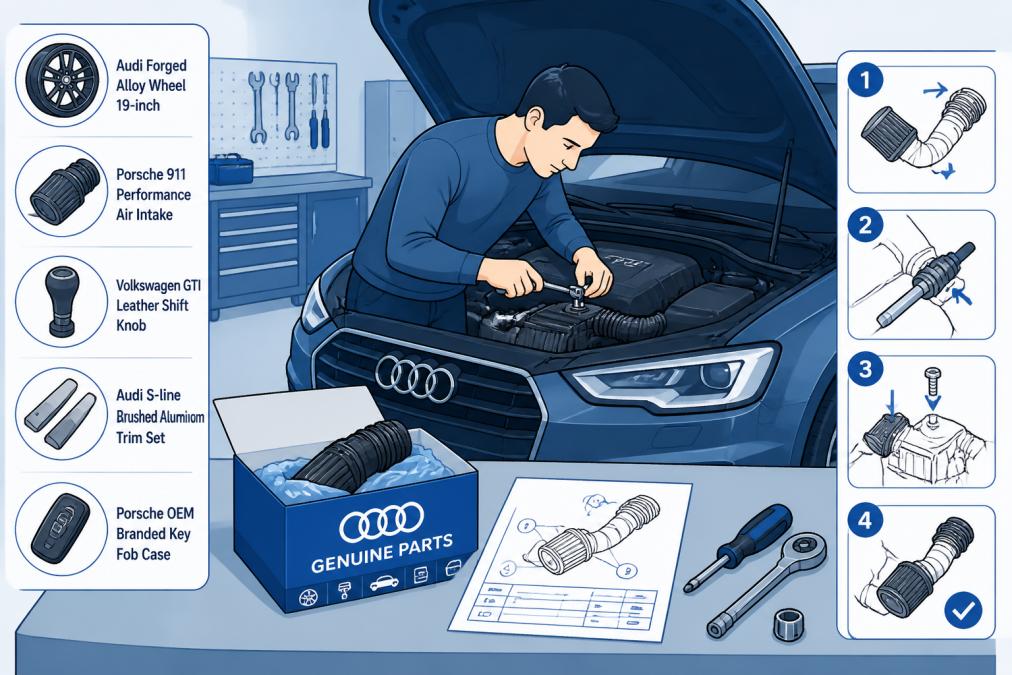
Audi's engineering is precise, and that precision cuts both ways. Genuine parts fit correctly and torque to spec predictably. Parts that are slightly off-spec require force to fit, creating problems that show up later.
Before you start:
- Confirm the part number against your VIN before ordering
- Download the relevant section of the Audi repair documentation for your model year
- Identify any special tools required
- Review the parts diagram to understand how the component integrates with adjacent systems
During installation:
- Torque fasteners to specification, not to feel
- Replace any seals, gaskets, or O-rings included with the assembly
- Verify the work through fluid level checks, brake pedal tests, or fault code scans
Featured Audi OEM Components Worth Knowing About
Certain components come up repeatedly for Audi owners doing their own maintenance. These parts wear predictably, matter for vehicle performance, and where genuine OEM quality has the clearest advantage over alternatives.
European OEM Parts Direct carries genuine OEM components across all major systems.
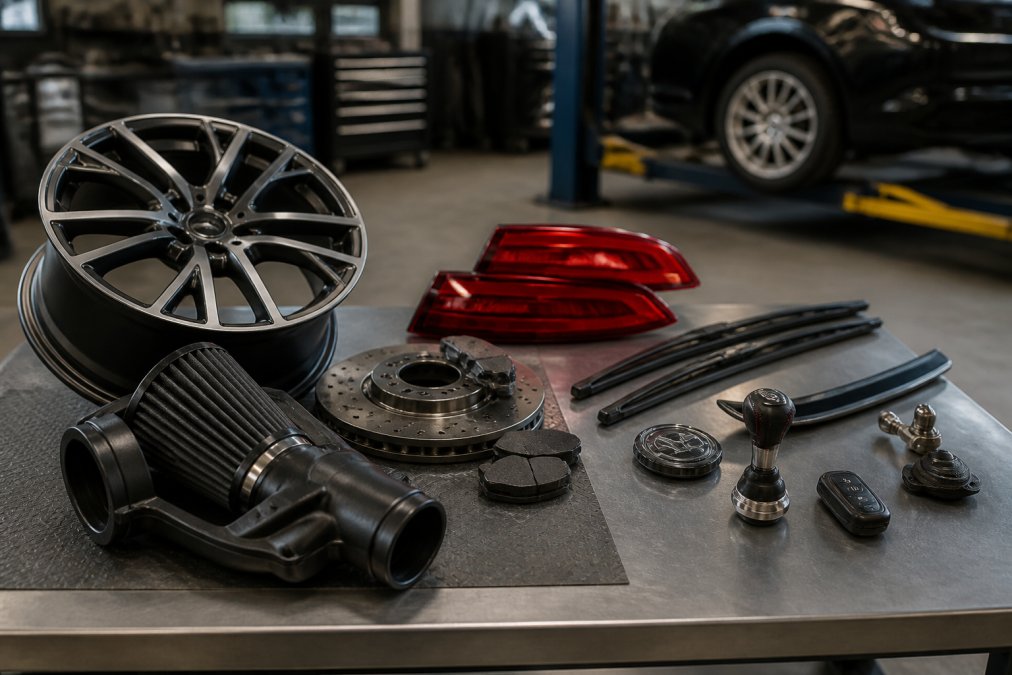
Wiper blades are one of the most overlooked maintenance items. The 2017-2025 Audi Wiper Blade set (part number 4M1-998-002) covers front positions at $81.67. Aftermarket wiper blades frequently cause streaking and noise on Audi curved windshields because the blade curvature isn't matched to OEM specifications.

Wheel center caps are a common replacement need after wheel refurbishment or alloy wheel damage. The 2017-2024 Audi Center Cap (part number 8W0-601-170) is a precision-fit genuine OEM component at $77.16.

Interior trim is another area where genuine OEM components outperform aftermarket alternatives. The Audi S-line Brushed Aluminum Trim Set at $525.00 provides the factory finish and fitment that aftermarket trim pieces consistently fail to replicate.

For comprehensive catalog search across Audi models, the vehicle picker and VIN search tools at European OEM Parts Direct narrow the catalog to components confirmed for your specific build.
| Component | Part Number | Price | Coverage |
|---|---|---|---|
| Wiper Blade Set | 4M1-998-002 | $81.67 | 2017-2025 Audi (front) |
| Wheel Center Cap | 8W0-601-170 | $77.16 | 2017-2024 Audi |
| S-line Aluminum Trim Set | OEM spec | $525.00 | S-line equipped models |
Sourcing genuine Audi OEM parts shouldn't require a dealership visit and the markup that comes with it. The real challenge is knowing exactly what your vehicle needs, confirming fitment before you order, and trusting that the parts you receive are actually what they claim to be. European OEM Parts Direct addresses all three: VIN search for accurate part matching, a comprehensive inventory of factory-certified components, and competitive pricing with convenient shipping. Find the exact parts your Audi needs, search by VIN or model and get genuine OEM components delivered directly to you.
Frequently Asked Questions
Is buying Audi OEM parts online safe and legitimate?
Yes, provided you buy from an authorized dealer or a verified retailer that sources directly from the manufacturer. Look for sellers that offer a fitment guarantee, publish OE part numbers, and provide clear return policies. Avoid listings with no part number, unusually low prices, or vague descriptions. When you buy Audi OEM parts online through a reputable source, you receive factory-certified components backed by a factory warranty, identical to what a dealership would supply.
How do I use my VIN to find the correct Audi parts online?
Your 17-character vehicle identification number encodes your Audi's exact build specifications, including engine variant, trim level, and production date. Enter it into a VIN lookup tool on the retailer's site and the catalog filters automatically to model-specific replacement components, eliminating compatibility guesswork. This matters most for older or less common models where a single platform or engine code can span multiple part numbers. Always confirm the part number matches before checkout.
What is the difference between OEM and genuine Audi parts?
Genuine Audi parts are sold through Audi's own dealership network and carry the Audi brand on the packaging. OEM parts are manufactured to the same OE specifications by the same supplier that built the original component, but may arrive in the supplier's own packaging rather than Audi-branded boxes. Both meet identical performance standards and qualify for factory warranty coverage. The practical difference for most owners is price: OEM-sourced parts through an authorized online dealer typically cost less than dealership retail.
Are online Audi parts stores cheaper than local dealerships?
In most cases, yes. Dealerships carry significant overhead, service bays, staff, physical inventory, and their parts counters price accordingly. An authorized online retailer with wholesale pricing passes a portion of that savings to the buyer. Shipping costs narrow the gap, but for parts above roughly $50, the net price online is usually lower. For DIY owners who skip dealership labor entirely, the combined savings on parts and installation can be substantial over the life of the vehicle.
This article was written using GrandRanker