 how-to
How to Find VW Part Numbers: Complete Guide
Table of Contents
- Why Finding the Correct VW Part Number Matters
- How to Find VW Part Numbers Using Your VIN
- How to Read VW Parts Diagrams and Schematics
- Locating Part Numbers on Physical Components
- OEM vs Aftermarket VW Parts: What's the Difference
- Cross-Referencing Superseded Part Numbers
- Mobile-First Strategies for Finding Parts On the Go
- Conclusion
Last Updated: August 28, 2026
Why Finding the Correct VW Part Number Matters
Ordering the wrong part wastes money, time, and frustration. You buy something, install it, realize it doesn't fit, and now you're stuck with a return process or a useless component. The real cost isn't just the part price, it's the labor you've invested, the vehicle downtime, and uncertainty about whether the replacement will work.
Finding the correct VW part number eliminates that risk. A precise part number tells you exactly what you're getting: fitment, material specifications, assembly compatibility, and whether it's genuine OEM or aftermarket. At European OEM Parts Direct, we help DIY enthusiasts and value-conscious VW owners avoid costly mistakes by matching their vehicles to the exact components they need.
The challenge is that VW's parts catalog system isn't intuitive. Part numbers contain prefixes, suffixes, and encoded information about fitment. Diagrams use reference numbers that don't always match physical component codes. Superseded part numbers mean the exact component you're looking for might be listed under a different code. Without a clear process, you're either guessing or making expensive dealership calls.
This guide walks you through every method to find VW part numbers, whether you're starting with a VIN, decoding a physical component, or cross-referencing a diagram. You'll learn where part numbers are located on your vehicle, how to read the encoded information they contain, and how to verify that what you're ordering will fit your specific model and year.
How to Find VW Part Numbers Using Your VIN
Your Vehicle Identification Number is the fastest, most accurate way to find VW part numbers. The VIN contains encoded information about your vehicle's configuration, engine type, trim level, and production date. When you feed that VIN into a parts decoder, the system returns part numbers specifically matched to your car's exact specifications (nhtsa.gov).
Step 1: Locate Your VIN
Your VIN is a 17-character code found in multiple locations (nhtsa.gov). The easiest spot is the driver's side dashboard, visible through the windshield at the base on the left. Alternative locations include the driver's side door jamb, the engine block, and your vehicle registration or insurance documents. Write down the full 17-character VIN exactly as it appears, a single digit error will return incorrect results.
Step 2: Access the VW Parts Decoder
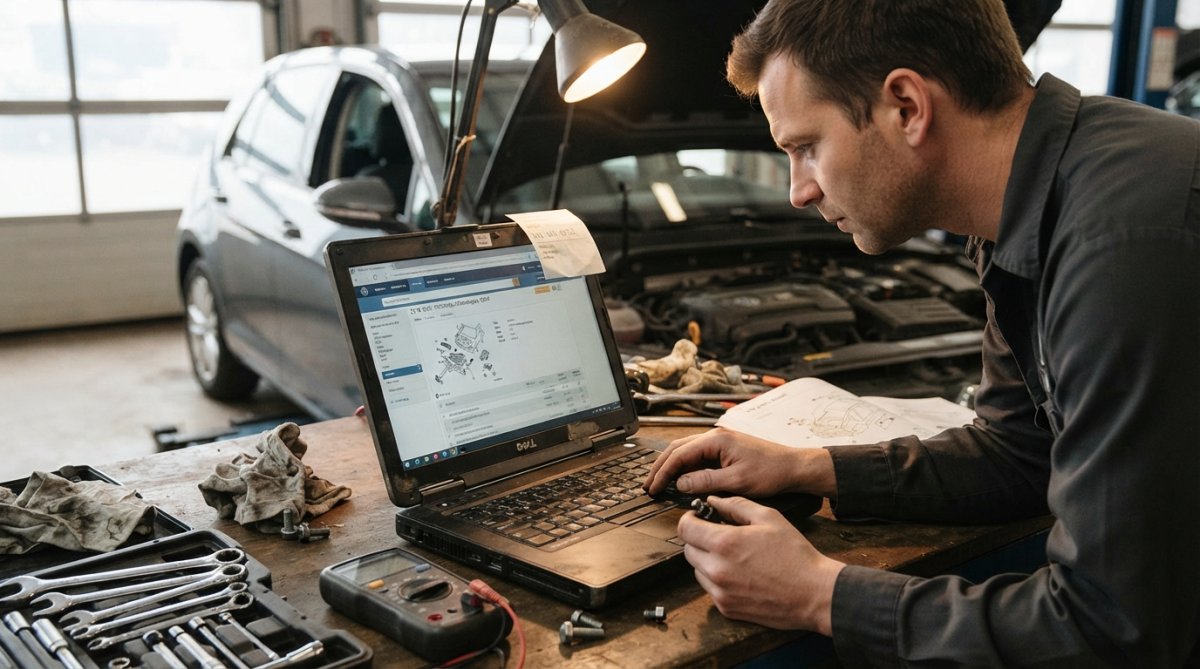
VW's official parts system is ETKA (Elektronischer Teilekatalog), the genuine OEM database that dealerships use. You can access it through official VW dealership websites or European OEM Parts Direct. Enter your VIN, select your vehicle configuration, and the system returns available parts with accurate part numbers and inventory status.
Step 3: Retrieve Your Part Numbers
Once you've entered your VIN, the decoder shows your vehicle's configuration: engine code, chassis code, trim level, and production date. This matters because a 2015 Golf and a 2018 Golf might use different components. Select the component category you need, and the system displays exploded diagrams with reference numbers. Click on the part to see the official part number, description, whether it's OEM or alternative, and pricing. Write down the part number exactly as displayed.
How to Read VW Parts Diagrams and Schematics
VW parts diagrams are visual maps of assemblies and components. Learning to read them is essential when identifying parts visually or understanding how multiple components work together.
Understanding Exploded Views
An exploded view separates an assembly outward so you can see each individual component and how it relates to others. For example, a door assembly exploded view shows the door panel, window mechanism, lock cylinder, interior trim pieces, and every fastener, laid out to show assembly order and identify individual components.
Reference numbers on exploded diagrams are not the same as part numbers. A reference number like "1" or "A5" points to a component in the diagram. You then use that reference number to find the actual part number in the parts list, usually printed below or beside the diagram.
Decoding Part Number Prefixes and Suffixes
VW part numbers follow a structured format that encodes information about the component. A typical VW part number looks like this: 3CN-061-161-A. Breaking it down:
- 3CN is the prefix, indicating the part family or assembly category.
- 061 is the base part code, identifying the specific component within that family.
- 161 is a suffix indicating fitment variations, material, or color.
- A is a revision code, indicating the version or generation of that part.
When comparing parts, the prefix and base code must match. The suffixes indicate variations. If you're replacing a part on a 2015 Golf and the part number ends in "-B" but your original ends in "-A", that's a revision difference, sometimes compatible, sometimes not. Always verify with the parts diagram or a specialist.
Locating Part Numbers on Physical Components
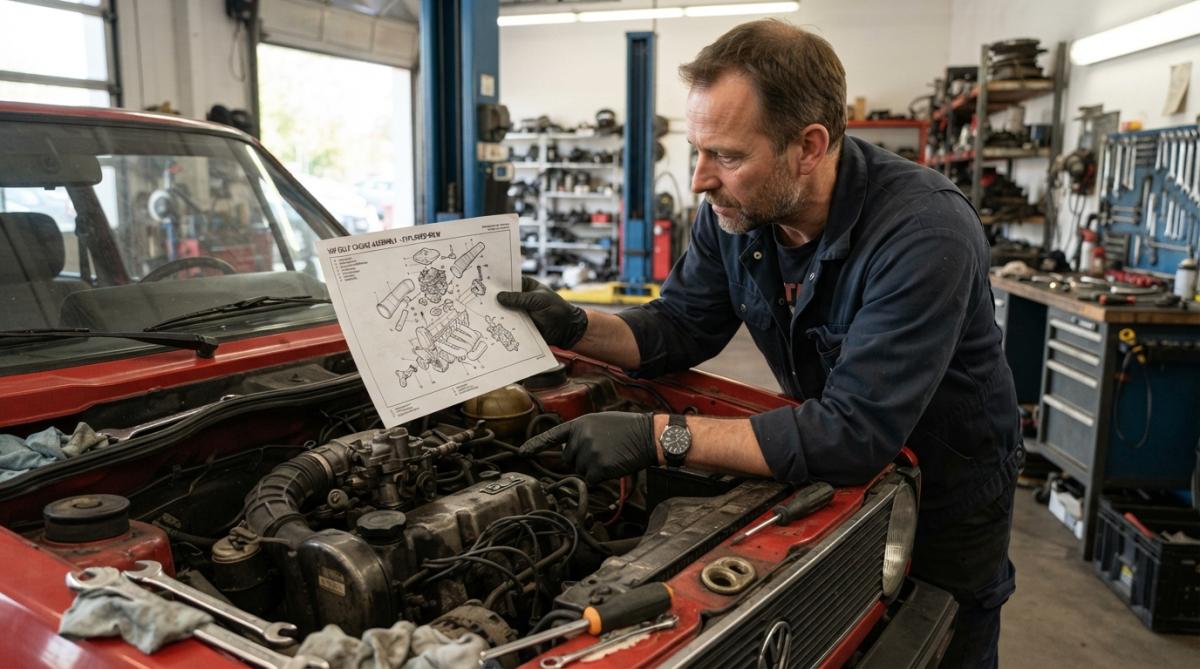
Sometimes you already have the part in front of you. Reading the part number directly from the component is faster than searching diagrams, but it requires knowing where to look and how to read sometimes-faint stamped or printed codes.
Where to Look on Your Vehicle
Part numbers are stamped, molded, or printed onto components in specific locations:
Engine components often have part numbers stamped into the casting on the block, head, or manifold. Look on flat surfaces away from moving parts and clean away oil and grime to read the code.
Interior trim pieces usually have part numbers molded into the plastic on the back or underside. Remove the component and flip it over to find the code.
Suspension and chassis components have numbers stamped into metal on sides, undersides, and flat mounting surfaces.
Electrical components like alternators and starters have part numbers printed on labels or tags attached to the housing.
Transmission and gearbox components have part numbers stamped into the case, sometimes requiring partial removal to access.
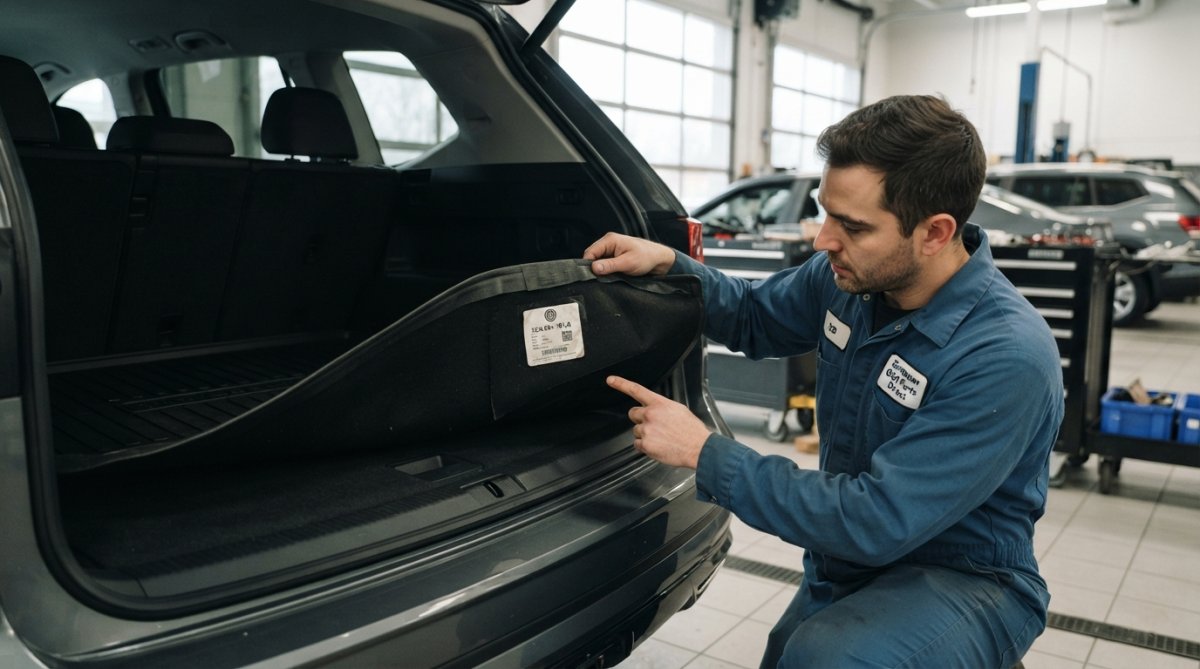
Part numbers on components don't always match catalog numbers. A component might have a manufacturer's code, a VW internal code, and a catalog part number. Identify the catalog part number, usually the longest code with the prefix-base-suffix structure.
Reading Part Numbers from Removed Components
Once you've located the part number, read it carefully using a flashlight if the stamping is faint. Take a photo with good lighting so you can zoom in later if needed. Write down the complete code, including all prefixes, suffixes, and revision letters. A missing digit will lead to the wrong part or no results.
If the code is too worn to read, search by component description and fitment (engine code, chassis code, model year, trim level) in the parts catalog, or contact a specialist. European OEM Parts Direct's customer support team can often identify parts from photos if you describe the component location and your vehicle configuration.
OEM vs Aftermarket VW Parts: What's the Difference
When you search for a part number, you'll often see two options: OEM (Original Equipment Manufacturer) and aftermarket. Understanding the difference is crucial because they affect fitment, longevity, warranty, and resale value.
OEM parts are manufactured by VW or authorized suppliers specifically for Volkswagen vehicles (vda.de). They're built to VW's exact specifications, tested for fitment and durability, and guaranteed to work with your specific model and year. OEM parts carry the official part number, VW branding, and often a manufacturer's warranty.
Aftermarket parts are made by third-party manufacturers. They're cheaper because they skip VW's quality control and testing. They might fit perfectly or not at all, and longevity varies widely. Resale value also takes a hit if buyers discover critical components were replaced with aftermarket parts.
For wear items like brake pads, air filters, and wiper blades, quality aftermarket parts are often acceptable. For structural, engine, suspension, transmission, gearbox, and electrical components, OEM is essential. When you order from European OEM Parts Direct, we specify whether each component is genuine OEM or aftermarket, so you know exactly what you're getting.
Cross-Referencing Superseded Part Numbers
VW updates and revises components regularly. When a part is updated, the old version is superseded and officially discontinued. Superseded parts create confusion because you might find references to the old part number in forums or old documentation, but the current catalog only shows the new number.
If you search for a part number and get no results, or find it listed as "superseded" or "discontinued," you need to find the current replacement. Most parts catalogs show the superseded-to relationship. Check the parts diagram for your specific model year, it shows the current part number for your configuration.
When ordering, always use the current part number. Dealerships and parts retailers won't have stock of superseded parts, and you're not guaranteed compatibility with your exact vehicle configuration. Some supersessions are direct replacements; others are not. The parts diagram and technical documentation clarify whether a supersession is backward compatible.
Mobile-First Strategies for Finding Parts On the Go
Not everyone has access to a computer when they need to find a part number. You might be at a salvage yard checking a component, at a parts counter verifying a number, or in your driveway with a part in your hands and a phone in your pocket.
Mobile VIN decoders and parts lookup apps make it possible to find part numbers from anywhere. European OEM Parts Direct's mobile platform is optimized for small screens, enter your VIN, select your component category, and get results instantly.
When looking at a physical part, take a clear photo of the part number stamping or label with good lighting. You can then search by image or type the number into the decoder later. If you're at a salvage yard or parts counter and need to verify a part number on the spot, a mobile parts lookup lets you confirm fitment and pricing before committing to a purchase.
Bookmark the parts decoder on your phone's home screen for one-tap access. Download a parts reference app if you work on VW vehicles regularly, some cache part numbers and diagrams for offline searching.
Finding the correct VW part number is the foundation of any successful DIY repair or maintenance project. Whether you're using a VIN decoder, reading physical stampings, or cross-referencing diagrams, the goal is matching your vehicle's exact configuration to the precise component you need. European OEM Parts Direct makes this process faster and more reliable with our VIN search tool, comprehensive OEM inventory, and accurate part matching for your specific vehicle. Start with your VIN, find the exact part number you need, and get the genuine component shipped to your door with confidence that it will fit and perform as designed.
Consider the 2020-2025 Volkswagen Atlas - Trunk Liner With Extended Seat Back Cover - Volkswagen (3CN-061-161-A) for $153.00. This custom-molded MuddyBuddy Cargo Liner is designed with a raised edge to contain spills and a textured skid-resistant finish to help keep items from shifting. It also includes a 4-piece CargoTech Cargo Containment System, providing true coverage to help protect your trunk or cargo area from dirt and spills.

Frequently Asked Questions
How can I find part numbers for my Volkswagen using VIN?
Your VIN contains your vehicle's build specifications, including engine code and chassis code. Use a VW VIN decoder tool to extract these codes, then cross-reference them in the official VW parts catalog or ETKA database. This identifies the exact part numbers compatible with your specific model year and trim level. European OEM Parts Direct offers VIN search tools that automatically match your vehicle to the correct parts.
What's the difference between OEM and aftermarket VW parts?
OEM (Original Equipment Manufacturer) parts are genuine Volkswagen components built to factory specifications and carry the full VW warranty. Aftermarket parts are third-party replacements that may be cheaper but often don't meet OEM standards for fitment, durability, or performance. For European vehicles like VW, Audi, and Porsche, OEM parts ensure compatibility and long-term reliability. Many performance-focused owners refuse aftermarket components to preserve vehicle integrity and resale value.
How do I decode a Volkswagen part number?
VW part numbers follow a 9-digit system with prefixes and suffixes that indicate component type, assembly, and fitment. The prefix identifies the part category (engine, transmission, suspension), the middle digits specify the exact component, and suffixes denote variations like color or material. Reading exploded diagrams alongside the part number helps clarify which assembly it belongs to. Understanding this system prevents ordering incompatible parts for your specific model.
Are VW part numbers universal across all models?
No. VW part numbers are model-specific, varying by year, engine code, and trim level. A part number for a 2020 Volkswagen Atlas differs from a 2015 Jetta, even if the components serve similar functions. This is why using your VIN or consulting the official parts catalog is critical, it ensures you get the exact part for your vehicle's configuration. Ordering by part number alone without verifying fitment can result in incompatible components.
This article was written using GrandRanker