 how-to
How OEM Parts Improve Volkswagen Engine Performance
Table of Contents
- How OEM Parts Improve Volkswagen Engine Performance
- Volkswagen OEM vs Aftermarket Parts: What the Differences Mean
- Genuine Volkswagen Engine Parts and Factory Specifications
- How to Identify Genuine VW Parts and Avoid Counterfeits
- Volkswagen Engine Performance Maintenance: When OEM Parts Matter Most
- Durability, Reliability, and Long-Term Value of OEM Components
- Selecting and Installing the Right OEM Parts for Your Volkswagen
- Frequently Asked Questions
Last Updated: October 12, 2026
How OEM Parts Improve Volkswagen Engine Performance
Genuine Volkswagen OEM parts don't just replace a component, they restore your engine to factory specifications.
The difference comes down to precision. A Volkswagen engine is engineered as a complete system, with every component designed to work at exact tolerances.
This guide explains how OEM parts improve Volkswagen engine performance, what separates genuine components from counterfeits, and how to select the right parts for your model.
Volkswagen OEM vs Aftermarket Parts: What the Differences Mean
The choice between OEM and aftermarket parts determines how your Volkswagen performs.
OEM parts deliver:
- Precise fitment to your specific engine configuration
- Factory-tested performance under real-world conditions
- Compatibility with all supporting components in your engine
Aftermarket parts often feature:
- Lower upfront cost
- Variable quality depending on the manufacturer
- Potential fitment issues requiring adjustment
The real cost difference appears over time. A cheaper aftermarket intake manifold might save money upfront, but if it causes air leaks or hurts fuel economy, those savings vanish within months.
Remanufactured parts occupy a middle ground: used components rebuilt to OEM specifications, costing less than new OEM parts while maintaining factory tolerances.
Genuine Volkswagen Engine Parts and Factory Specifications
"Factory specifications" is not a marketing phrase, it's a set of numeric targets the engine control module (ECM) expects, and every genuine part is built to land inside them. When a component drifts outside those targets, the ECM compensates, and performance quietly disappears.
What the ECM Is Actually Measuring
On most modern Volkswagen engines, the ECM reconciles inputs from the MAF, MAP, wideband oxygen (lambda), knock, and crankshaft/camshaft position sensors against mapped targets for a given engine speed and load, then trims fuel and ignition timing to hit them.
A genuine sensor reports within the ECM's calibration window. A low-cost sensor with a different output curve forces larger fuel trims or pulled timing, the engine still runs, but on a correction rather than the map.
Engine Hardware and Replacement Components
- Gaskets and seals. A valve cover or intake manifold gasket that does not seal to the specified compression allows unmetered air past the MAF sensor. The ECM sees a lean condition, adds fuel, and the engine runs rich at idle and lean under load, the classic rough-idle-plus-hesitation pattern.
- Timing components. Timing chains, tensioners, and variable valve timing (VVT) solenoids set when valves open relative to piston position. A stretched chain or a tensioner that bleeds down shifts cam timing, moving the torque curve and potentially setting a camshaft correlation code. Genuine timing components hold the specified timing relationship across the service interval.
- Fasteners and stretch bolts. Many Volkswagen engine fasteners are torque-to-yield, designed to stretch once and be replaced. Reusing them or substituting a generic bolt changes clamping load on the joint, which is how head gasket and bearing cap failures begin.
Intake Systems and Airflow Optimization
Airflow is not just volume, it's volume at the right temperature and velocity for the ECM's fueling map.
A genuine air filter flows within the restriction range the MAF calibration assumes; a high-flow filter can push the MAF reading outside its calibrated range, making the ECM add fuel it didn't intend to.
That's why an OEM-spec intake component often drives better than a larger aftermarket one. The goal isn't maximum airflow, it's airflow the ECM can meter accurately.
Where This Shows Up by Engine Family
The principle is the same across Volkswagen's lineup, but the critical parts differ:
- Naturally aspirated engines (for example, the 2.5L five-cylinder used in older Jetta and Golf models) are most sensitive to ignition components, vacuum integrity, and MAF accuracy. A small vacuum leak is a large percentage of total airflow.
- Turbocharged direct-injection engines (the EA888 family used across GTI, Golf R, Jetta GLI, and Tiguan, and the EA211 family in smaller models) are most sensitive to boost control, high-pressure fuel system components, and ignition coil and spark plug condition. Direct injection runs high cylinder pressures, so a weak coil or a plug gapped outside specification shows up immediately as a misfire under boost.
- TDI diesel engines are most sensitive to fuel injector calibration and emissions-related sensors. Injector flow variation that would be invisible on a gasoline engine can change combustion timing enough to affect power and fuel economy.
If you know your engine code, stamped on the block or available through a VIN lookup, you can identify which category applies to your car before you buy anything.
How to Identify Genuine VW Parts and Avoid Counterfeits
Counterfeit parts are a real problem in the European car market. A fake looks similar to the genuine article but fails much faster, and you won't discover it until your engine misfires or performance drops.
Verify authenticity using these methods:
- Check the part number: Every genuine Volkswagen part has a unique part number. Look it up on the Volkswagen parts database or use a VIN search tool. Counterfeiters sometimes use similar numbers that are off by one digit.
- Examine packaging and labeling: OEM parts come in branded packaging with clear labeling. Fonts should be crisp and colors consistent. Misspellings or blurry printing are red flags.
- Verify the seller: Buy from authorized Volkswagen dealers or verified parts retailers like European OEM Parts Direct. We guarantee authenticity on every part.
The cheapest online price often signals a counterfeit. If a part costs significantly less than the OEM price at authorized retailers, question why. European OEM Parts Direct offers competitive pricing on genuine parts.
Volkswagen Engine Performance Maintenance: When OEM Parts Matter Most
Not every repair requires an OEM part. Routine maintenance like oil changes and filter replacements can use quality aftermarket products. But when replacing components that directly affect engine performance, OEM parts protect your investment.
Replace with OEM parts when:
Volkswagen GTI Performance Air Intake Kit →
- The component affects fuel delivery, air intake, or combustion timing
- The part is integrated with your engine control system
- You're restoring performance after engine trouble codes appear
Aftermarket alternatives may work for:
- Cosmetic engine covers and trim pieces
- Secondary cooling system components
- Non-critical fasteners and clips
The distinction matters because your engine's computer constantly monitors performance. If a sensor detects a part isn't performing to spec, it adjusts fuel delivery or ignition timing to compensate, keeping the engine running but at reduced efficiency, costing you power and fuel economy while other components wear faster.
Durability, Reliability, and Long-Term Value of OEM Components
OEM parts last longer because they're engineered to your engine's exact requirements, so they aren't over-stressed by poor fitment or under-spec materials.
A genuine Volkswagen timing chain, for example, is designed to last the life of the engine under normal driving conditions.
The durability advantage compounds: when one component fails early, it stresses surrounding parts.
OEM parts protect against this cascade.
Resale value reflects OEM maintenance too.
Selecting and Installing the Right OEM Parts for Your Volkswagen
Most guides stop at "use your VIN", that's the first step, not the process. Here's a model-year and engine-code-aware approach that gets you the correct part and confirms it worked.
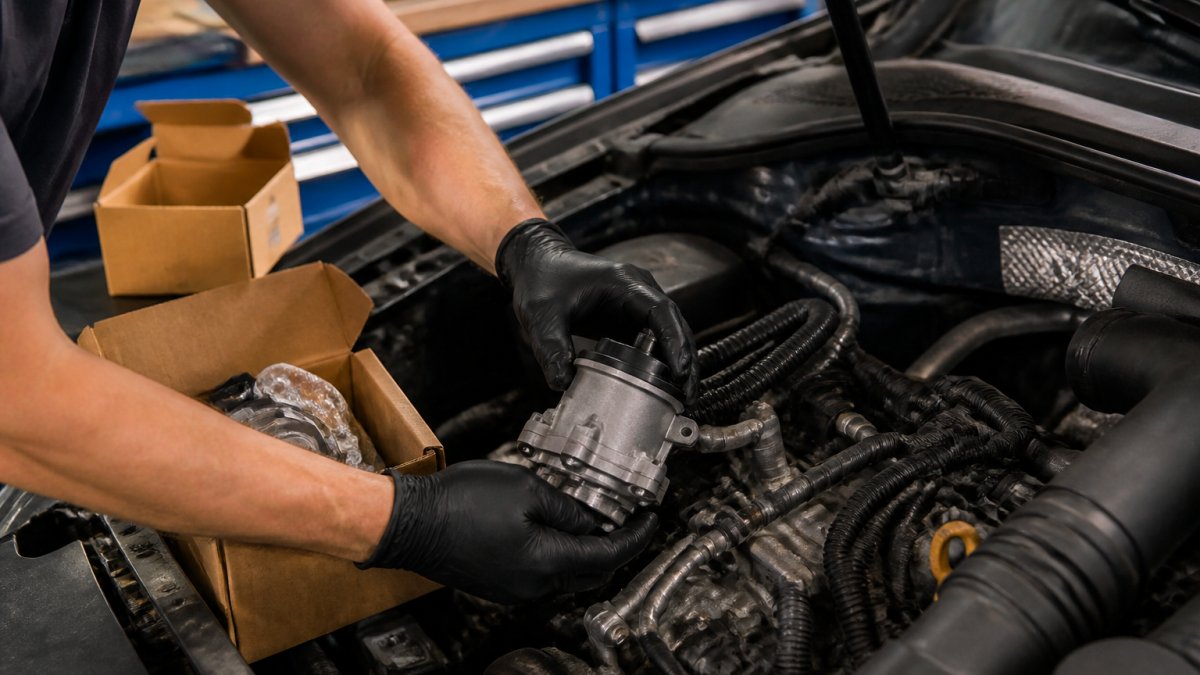
Step 1: Identify Your Engine Code, Not Just Your Model
Two 2018 Jettas can have different engines, and their parts aren't interchangeable. The engine code is what matters, typically a three- or four-character code stamped on the block and encoded in your VIN.
Common Volkswagen engine codes you will encounter:
- EA888, the turbocharged 1.8T and 2.0T family used in GTI, Golf R, Jetta GLI, Tiguan, and others. Within EA888 there are generations (Gen1, Gen2, Gen3, Gen3B) with different intake, fuel, and turbo hardware.
- EA211, the smaller turbocharged and naturally aspirated four-cylinder family used in Golf, Jetta, and Taos.
- EA113, the older 2.0T used in earlier GTI and Golf R models; parts do not cross over to EA888.
If you do not know your engine code, a VIN lookup will return it. Do not proceed on model and year alone.
Step 2: Decode the Part Number
Genuine Volkswagen part numbers follow a structure that tells you what the part is and often which engine family it belongs to. A typical number looks like 06K 103 495 AB:
- The first group identifies the model or engine family the part was designed for.
- The middle group identifies the component category.
- The suffix letters indicate a revision. A higher revision letter is not automatically better for your car, revisions are often tied to a specific production range, and a later revision may not be backward-compatible with an earlier engine.
This is why "it fits a GTI" is not enough. You need the revision that matches your engine code and production date.
Step 3: Verify Fitment Before You Buy
- Cross-reference the part number against the manufacturer's catalog for your specific engine code, not just your model.
- Check for superseded numbers. Volkswagen frequently replaces a part with a new number. A reputable seller will show the current number and note what it supersedes.
- Confirm supporting components match. A fuel injector for a turbocharged direct-injection engine is not the same as one for a naturally aspirated port-injection engine, even if the connector looks identical.
Step 4: Install to Factory Procedure
OEM parts are designed to be installed to a written procedure, and skipping steps is how good parts produce bad results.
- Torque specifications matter. Use a calibrated torque wrench. Many engine fasteners are torque-to-yield and must be replaced, not reused.
- Follow tightening sequences. Cylinder head and intake manifold bolts are tightened in a specific pattern to distribute load evenly.
- Replace single-use hardware. Gaskets, seals, and stretch bolts are typically one-time-use items.
Step 5: Verify the Result
This is the step almost no guide includes, and it is the one that tells you whether the job worked.
- Scan for codes before and after. Clear stored codes, drive a full readiness cycle, and rescan. A code that returns indicates the repair did not address the root cause.
- Check fuel trims. Long-term fuel trim should return toward zero after a correct repair. Trims that stay high or low indicate a remaining air or fuel delivery issue.
- Compare drivability. Note idle quality, throttle response, and any hesitation before and after. Improvement should be noticeable, not subtle.
What to Expect, and What Not To
A correctly installed OEM part restores factory performance, it doesn't add horsepower beyond the engine's rating. If you want more power than the factory rating, that's a tuning question, not a parts question, with its own trade-offs in warranty coverage, emissions compliance, and long-term reliability.
If your goal is to fix a car that feels down on power, runs rough, or has lost fuel economy, the process above is the right one, and the result should be measurable, not just felt.
Frequently Asked Questions
How can genuine Volkswagen parts help maintain engine performance?
Genuine Volkswagen engine parts are engineered to exact factory specifications, ensuring precise fit and optimal function. OEM components maintain proper airflow, fuel delivery, and combustion efficiency. When you replace worn parts with genuine OEM equivalents, you restore the engine to its original performance level, preventing power loss, fuel economy degradation, and reliability issues that aftermarket substitutes often introduce.
How do I know if a Volkswagen part is genuine?
Genuine OEM parts carry official Volkswagen part numbers, typically found on the packaging and component itself. Check for proper branding, quality printing on labels, and manufacturer information. Counterfeit parts often have spelling errors, poor packaging quality, or missing documentation. Purchase from authorized dealers or verified OEM retailers with authentication guarantees. Request documentation proving the part's origin, and verify the part number against your vehicle's specification using your VIN.
Are OEM parts really better than aftermarket parts for Volkswagen engines?
OEM parts are designed specifically for your Volkswagen's engine configuration and meet factory performance standards. They deliver precise fitment, original durability, and warranty protection. Aftermarket parts vary widely in quality and may not match factory specifications for airflow, combustion, or component interaction. For critical engine hardware, intake systems, and performance-sensitive components, OEM parts consistently outperform aftermarket alternatives in reliability and longevity.
Do OEM parts increase horsepower in a Volkswagen?
OEM parts restore your engine to factory performance specifications rather than increase horsepower beyond original design. If your engine has worn components, replacing them with genuine OEM parts recovers lost power output. For actual performance gains, performance-engineered OEM upgrades like the Volkswagen GTI Performance Air Intake Kit enhance airflow and throttle response while maintaining reliability and precise fitment that factory engineering demands.