 how-to
Does OEM Verification Prevent Fraud: What You Need to Know
Table of Contents
- What OEM Verification Actually Does (and Doesn't)
- How to Verify Genuine OEM Parts Before You Buy
- Counterfeit Car Parts Warning Signs You Can't Ignore
- OEM Part Number Lookup: Your First Line of Defense
- Using VIN Lookup for Car Parts to Confirm Authenticity
- What OEM Verification Cannot Prevent
- The Three Outcomes of Verification
- Bypass 1: Forged Documentation and Packaging
- Bypass 2: Compromised Seller Accounts
- Bypass 3: Data Mismatches and Input Errors
- Bypass 4: Manual-Review Errors and False Positives
- Bypass 5: Post-Purchase Fraud
- Bypass 6: Account Takeover and Payment Fraud
- How to Measure Whether Your Verification Is Working
- Building Your Own Verification Checklist
- Frequently Asked Questions
Last Updated: October 8, 2026
What OEM Verification Actually Does (and Doesn't)
OEM verification confirms a part is genuine and made by the original manufacturer, not a counterfeit or aftermarket alternative.
At European OEM Parts Direct, we help customers navigate this landscape with genuine OEM parts and transparent sourcing.
While OEM verification prevent fraud in many common schemes, casual counterfeiting and unauthorized-channel sourcing, sophisticated counterfeiters can still slip through.
How to Verify Genuine OEM Parts Before You Buy
Verification starts before you hand over money. A real OEM verification workflow validates three things: the part's identity, the seller's authorization, and the chain of custody.
Step 1: Confirm the Part's Identity
The part number is your anchor point. Every genuine OEM part carries a number matching your vehicle's specs, but counterfeiters sometimes use real numbers on fake parts, so cross-check.
Find the correct part number via your owner's manual or VIN, then verify it against multiple sources, never a single listing or seller.
Examine packaging closely. Genuine OEM parts use crisp, consistent fonts and official colors; counterfeit packaging often has blurry printing, misspellings, or off colors.
Check for holograms or security features. If the packaging claims one but you can't find it, that's a red flag.
Step 2: Verify the Seller's Authorization
Not every seller claiming to sell OEM parts is authorized.
Contact the manufacturer for a list of authorized dealers in your region, most maintain these online.
Check the seller's credentials: time in business, and whether reviews mention authenticity, verification, or sourcing guarantees.
Ask the seller directly about sourcing: do they buy from the manufacturer or distributors?
Step 3: Validate the Chain of Custody
This is the step most buyers skip, and where OEM-specific fraud hides.
Ask for the invoice trail.
Check country-of-origin markings against the manufacturer's published standards, counterfeiters often mislabel origin. Cross-reference the part number against the official catalog, not a third-party listing.
Look for tamper-evident seals. Many OEMs use seals that show visible damage if a box was opened and resealed.
Step 4: Document Everything Before You Pay
Screenshot the listing, the seller's authorization status, part number lookup results, and sourcing communication. Save the invoice and tracking number, this documentation supports a chargeback or warranty claim.
Step 5: Escalate When Something Doesn't Add Up
If the price is far below market, the seller dodges documentation questions, or the packaging looks off, do not proceed. Report suspected counterfeits to the manufacturer's brand protection team and the marketplace, eBay and Amazon have brand-registry complaint channels that remove listings.
Verification isn't a single check but a sequence that closes different fraud paths. Skipping any one leaves a gap a counterfeiter can exploit.
Counterfeit Car Parts Warning Signs You Can't Ignore
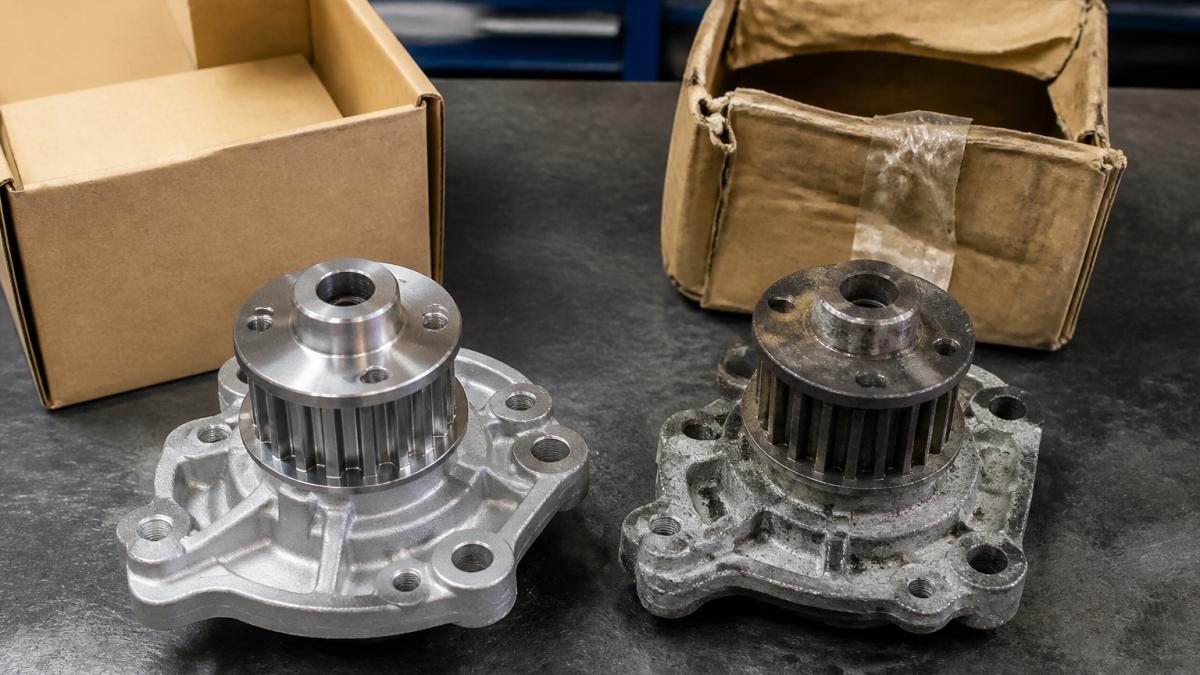
Counterfeit parts display patterns. Once you know them, spotting fakes gets easier across part types and manufacturers.
Packaging red flags:
- Blurry or faded printing on boxes
- Misspelled manufacturer names or part descriptions
- Inconsistent fonts or colors
- Missing or poorly reproduced logos
- Flimsy box construction (genuine OEM packaging is sturdy)
Physical part indicators:
- Rough machining or casting marks that look unfinished
- Discoloration or rust on supposedly new parts
- Misaligned seams or gaps in assembly
- Missing or poorly applied labels
- Weight that feels noticeably different from what you expect
Pricing anomalies:
- Prices significantly below market rates for that part
- Bulk discounts that seem unrealistic
- "Closeout" or "liquidation" claims without clear explanation
- Sellers pressuring you to buy quickly due to limited stock
Seller behavior patterns:
- Reluctance to provide documentation or sourcing information
- No physical address or business registration
- Poor communication or unhelpful responses to questions
- Unwillingness to accept returns or offer guarantees
The most dangerous counterfeits pass casual inspection, you discover the problem only when they fail after installation. That's why multiple verification steps matter more than any single check.
OEM Part Number Lookup: Your First Line of Defense
The part number is your verification starting point.
Use your VIN to access manufacturer databases.
Cross-reference the part number across the manufacturer's official site, authorized dealer websites, and independent parts databases.
Document the correct part number before shopping. Counterfeiters sometimes use similar-looking numbers differing by a single digit or character.
When a seller offers the part, verify the number matches exactly, character by character.
Using VIN Lookup for Car Parts to Confirm Authenticity
Your VIN is a powerful verification tool most buyers underutilize.
Enter your VIN into the manufacturer's parts lookup system to get parts designed for your exact vehicle.
VIN lookup also shows part compatibility, which parts work together as a system.
Use VIN lookup to verify seller claims.
Document your VIN lookup results.
VIN lookup also shows part availability.
What OEM Verification Cannot Prevent
Understanding verification limits matters as much as knowing what it can do. OEM verification is a risk-reduction tool, not a fraud-elimination tool: it prevents some fraud, detects other fraud after the fact, and does nothing against a third category of schemes.
The Three Outcomes of Verification
Verification does three things:
- Prevention: The fraud never completes because the check blocks it. Example: a counterfeit part with a mismatched part number is rejected before purchase.
- Detection: The fraud completes but is discovered. Example: a genuine-looking part arrives, but a serial number check reveals it was reported stolen.
- Risk reduction: The fraud is less likely or less costly, but not blocked. Example: buying from an authorized dealer reduces the chance of receiving a gray-market part, but does not guarantee it.
Most guides blur these together and imply verification prevents everything. It doesn't.
Bypass 1: Forged Documentation and Packaging
Sophisticated counterfeiters obtain genuine packaging and labels or reproduce them at high quality, forging invoices, certificates of authenticity, and distributor letters. Because the documents look correct, a document-only check passes.
Mitigation: Don't rely on documents alone. Cross-check the part number against the manufacturer's official catalog, verify seller authorization directly with the manufacturer, and inspect the physical part for anomalies documents can't fake.
Bypass 2: Compromised Seller Accounts
A fraudster can take over a legitimate seller's account and list counterfeit parts under a trusted name. History, reviews, and authorization status look clean because the account is real, the fraud is in the current listing.
Mitigation: Check whether the listing is recent and whether recent reviews mention authenticity problems. If a long-established seller suddenly lists deeply discounted OEM parts in high volume, report it to the marketplace and manufacturer.
Bypass 3: Data Mismatches and Input Errors
Verification systems compare your input against a database. Enter the wrong VIN and the system returns the wrong part number, the verification worked, the input was wrong.
Mitigation: Double-check your VIN character by character. Cross-reference the returned part number against at least two official sources. If a seller claims a part is "equivalent" to the number you found, treat that as a separate claim requiring separate verification.
Bypass 4: Manual-Review Errors and False Positives
Any verification process with human review can produce two errors: a false negative (fraud passes) and a false positive (a legitimate part is flagged).
Mitigation: Use layered checks so no single reviewer or data source is the sole decision point. Track false positives and adjust thresholds, a process that flags everything is as useless as one that flags nothing.
Bypass 5: Post-Purchase Fraud
Some fraud happens after a genuine part ships: it arrives damaged, the seller refuses returns, or it fails prematurely and the warranty is disputed.
Mitigation: Confirm return and warranty policies in writing before purchase, pay with a method offering chargeback rights, photograph the part and packaging on arrival, and retain all documentation for the warranty period.
Bypass 6: Account Takeover and Payment Fraud
A fraudster can use stolen payment information to buy parts shipped elsewhere, or impersonate a buyer to obtain parts without paying. This is payment fraud, not product fraud, and OEM verification doesn't address it.
Mitigation: Use payment methods with fraud protection and monitor statements for unauthorized charges. Sellers should use address verification and require signature on delivery for high-value parts.
How to Measure Whether Your Verification Is Working
If you buy OEM parts regularly, track these measures:
- Fraud loss rate: the share of purchases that turn out to be counterfeit, gray-market, or misrepresented.
- Detection rate: the share of fraudulent attempts you catch before payment.
- False-positive rate: the share of legitimate purchases your checks incorrectly flag.
- Review time: how long verification adds to a typical purchase.
- Verification completion rate: the share of purchases where you complete every step of your checklist.
These measures turn verification from a vague habit into an improvable process. If your fraud loss rate isn't falling, your checks aren't targeting the right bypasses; if your false-positive rate is high, your checks are too blunt.
Verification is a tool, not a guarantee. Used honestly, it prevents many fraud schemes, detects others, and reduces the cost of those that slip through. Used as a substitute for judgment, it creates false confidence.
Building Your Own Verification Checklist
Create a personal checklist before buying any OEM part and use it every time. Consistency prevents mistakes.
Before you buy:
- I have confirmed the correct part number using my VIN
- I've verified the part number against at least two official sources
- I've checked the seller's authorization status with the manufacturer
- I've reviewed customer feedback specifically about part authenticity
- I've compared the quoted price against multiple sellers
- I've confirmed the seller's return and warranty policies
When the part arrives:
- Packaging quality matches OEM standards
- Part number on packaging matches my order
- All security features are present and intact
- Physical condition shows no signs of damage or poor manufacturing
- Included documentation matches the part and my vehicle
- Part weight and dimensions feel correct
After installation:
- Part fits correctly without modification
- Part functions as expected
- No warning lights or error codes appear
- I've retained all documentation and packaging for warranty purposes
This checklist turns verification from a vague concept into concrete steps.
The checklist also helps with new sellers: you're less likely to skip steps when following a system rather than memory.
Buying genuine OEM parts requires vigilance, but the effort pays off.
OEM verification prevents most fraud, but it isn't foolproof.
Frequently Asked Questions
How can I tell if a car part is genuine OEM?
Genuine OEM parts have consistent, crisp printing on labels and packaging with no smudging or misalignment. Check that the part number matches your vehicle's VIN lookup results and verify the seller is an authorized distributor. Authentic parts arrive in OEM packaging with proper documentation. If the price seems unusually low or the seller has no verifiable authorization history, request proof of authenticity before purchasing.
Does OEM verification prevent all types of fraud when buying car parts?
OEM verification prevents counterfeit parts and mismatched components, but it cannot stop unauthorized resellers from claiming legitimacy or protect against shipping damage claims. Verification confirms a part is genuine and correct for your vehicle, but you still need to verify the seller's credentials and use secure payment methods.
Is a VIN search enough to verify that a part is genuine?
A VIN lookup confirms the correct part number for your specific vehicle, which is essential, but it does not verify that the physical part you receive is authentic. Use VIN lookup as your starting point to identify the correct part number, then cross-reference that number with the seller's authorization status and packaging details. Combine VIN verification with seller reputation checks and documentation review for complete protection.
What should I do if I suspect I bought a counterfeit car part?
Stop using the part immediately and document everything: packaging, labels, photos of the part, and your purchase receipt. Contact the seller with evidence and request a refund or replacement. If the seller refuses, report the transaction to your payment processor or credit card company for a chargeback. Document the issue with photos showing quality differences, and consider reporting the seller to relevant consumer protection agencies if the fraud is significant.