 listicle
7 Common Risks of Using Aftermarket Volkswagen Parts
Last Updated: October 26, 2026
Quick Summary
The most common risks of using aftermarket Volkswagen parts are fitment failures that damage surrounding components, counterfeit parts sold as genuine, and premature engine, clutch, or transmission failure. Safety-critical parts like airbags, crash sensors, and seat belts carry the highest stakes, since unverified calibration can disable or mis-time the system. Aftermarket failures are also not covered by Volkswagen's warranty, and resulting damage to covered components may be excluded.
- Cheap aftermarket parts often drift from factory tolerances, and fitment problems hit suspension, steering, engine mounts, and body panels hardest.
- Counterfeits turn up across filters, brake components, sensors, and ignition parts, so buy from a seller who can trace the part to a legitimate source.
- A part that is correct for a Golf may not be correct for a Jetta built in the same year, even if mounting points look identical.
- Verifying compatibility by VIN is the single most reliable way to avoid the wrong part.
- Keep a repair file with the part number, seller information, installation date, and mileage in case a warranty dispute arises.
Table of Contents
- Why Aftermarket Volkswagen Parts Carry Hidden Risks
- Volkswagen OEM vs. Aftermarket Parts: What Actually Differs
- Risk 1: Fitment Failures and Vehicle Damage
- Risk 2: Counterfeit Parts Sold as Genuine
- How to Identify Counterfeit Auto Parts Before You Install
- Risk 3: Engine, Clutch, and Transmission Failure
- Risk 4: Safety Systems and Crash Protection Compromised
- Volkswagen Parts Compatibility by VIN: Verifying Before You Buy
- What Aftermarket Savings Really Cost You
- Frequently Asked Questions
Why Aftermarket Volkswagen Parts Carry Hidden Risks
A lower purchase price feels like a win until the part fails. That is the core problem with aftermarket Volkswagen parts: the savings are visible up front, while the risks stay hidden until something breaks.
Below, we break down seven common risks of using aftermarket Volkswagen parts.
Aftermarket parts are components made by a company other than the vehicle manufacturer or its original suppliers. Some are solid. Many are not, and the difference is rarely visible at the point of sale.
Volkswagen OEM vs. Aftermarket Parts: What Actually Differs
OEM parts are built to the manufacturer's exact specifications, using the materials and tolerances the factory designed around. Aftermarket parts are built to whatever standard the third-party maker chooses.
The real difference comes down to three things:
- Tolerances: OEM parts hold the dimensions the assembly line was designed for. Cheap aftermarket copies often drift.
- Material quality: Housings, bushings, and brackets live in heat, vibration, and road salt. Lower-grade alloys and plastics age faster.
- Quality control: Genuine parts pass a defined inspection process. Generic parts may get spot checks or none at all.
Risk 1: Fitment Failures and Vehicle Damage
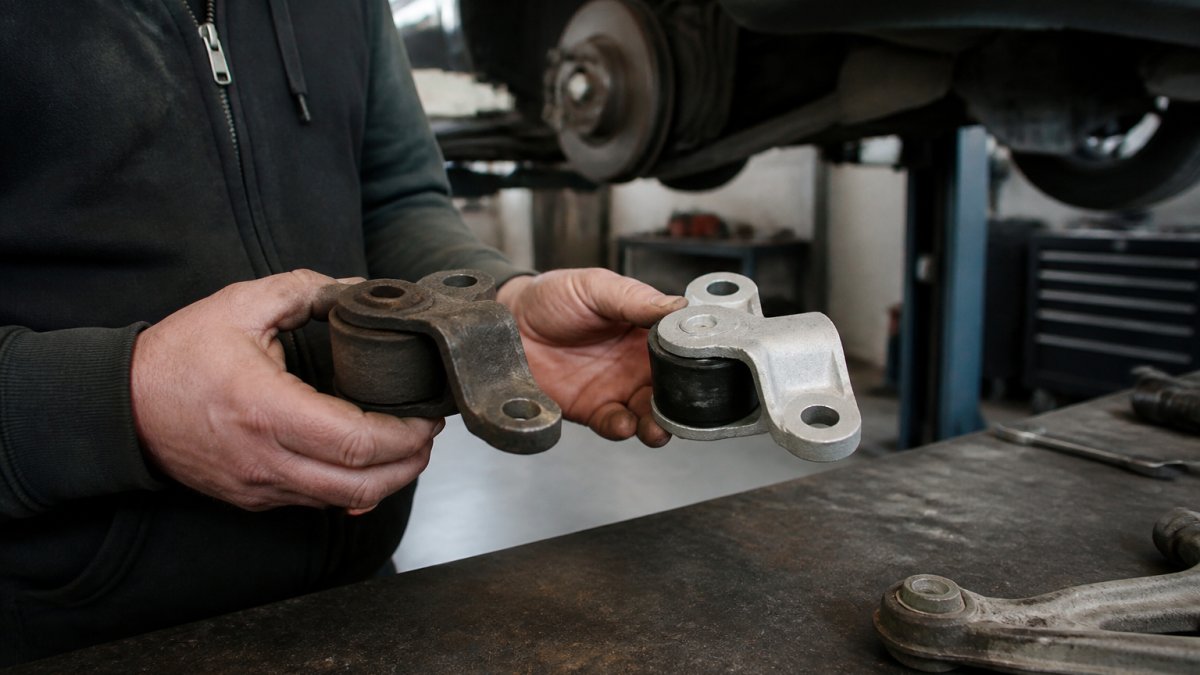
The most common failure with cheap aftermarket parts is fitment. A part that is "close enough" can bolt on but sit wrong, stressing everything around it.
Mounting holes that are slightly off can crack a bracket, a poorly molded bushing can wear through a control arm, and a trim piece that does not seat lets water in. None of these announce themselves at install; they surface months later as a rattle, a leak, or a repair bill that dwarfs the money you saved.
Where Fitment Problems Hit Hardest
Suspension and steering components, engine mounts, body panels, and anything with a precision mating surface are the usual offenders. Our guide to common VW parts that fail early puts these fitment and durability concerns in context.
Risk 2: Counterfeit Parts Sold as Genuine
A counterfeit part is not just a cheap alternative.
Counterfeits turn up across filters, brake components, sensors, and ignition parts. The U.S. Customs and Border Protection guidance on counterfeit goods explains how these products enter the supply chain, and the volume is significant.
The practical defense is buying from a seller who can trace the part to a legitimate source. A genuine part with a verifiable part number beats a bargain with a copied label every time.
How to Identify Counterfeit Auto Parts Before You Install
Spotting a fake takes a few minutes of inspection. Work through this checklist before the part goes anywhere near your car:
- Check the part number against your vehicle's actual specification, not the listing title
- Inspect the packaging for blurry print, thin cardboard, or mismatched fonts
- Look at the casting and mold marks for rough edges, flashing, or missing manufacturer stamps
Risk 3: Engine, Clutch, and Transmission Failure
An engine does not fail because one part was cheap. It fails because a cheap part stopped doing its job quietly.
The cost gap is brutal: a budget part saves money once, while a blown motor or failed transmission costs many times what the part saved, plus labor and downtime. See what happens if you install fake VW parts to major drivetrain components.
Risk 4: Safety Systems and Crash Protection Compromised
Structural and safety parts are where aftermarket savings carry the highest stakes, because Volkswagen safety systems are engineered as integrated assemblies.
2020-2025 Volkswagen Atlas - Trunk Liner With Extended Seat Back Cover →
Safety-Critical Part Categories and Their Specific Risks
Airbag modules and clocksprings. An airbag module contains an inflator, a propellant charge, and a control circuit calibrated to a specific deployment threshold.
Seat belts and pretensioners. A seat belt pretensioner uses a small pyrotechnic charge to retract the belt during a crash.
Structural brackets and mounts. Engine mounts, subframe brackets, and steering rack mounts hold safety-critical systems in place.
Why Volkswagen Safety Systems Are Particularly Sensitive
Volkswagen vehicles share platforms across models and model years, but the safety calibration is specific to each vehicle variant. A part that is correct for a Golf may not be correct for a Jetta built in the same year, even if the mounting points look identical. The airbag control module software, sensor thresholds, and deployment timing are matched to the vehicle's mass, structure, and occupant protection strategy, and aftermarket parts advertised as fitting multiple models often achieve that fitment with a single calibration optimized for none of them.
A Practical Decision Framework for Safety Parts
Before buying any part inside the airbag, seat belt, or crash structure system, ask three questions:
- Does the seller publish a part number that matches your VIN? A part number matching the vehicle's build specification is the minimum verification; a listing that only asks for make, model, and year is not sufficient for safety components.
- Can the seller document the part's origin and certification? Genuine Volkswagen safety parts carry traceable manufacturing records. Aftermarket safety parts should state the standard they were tested to, not just a claim of compatibility.
- What happens if the part fails? A return policy covering only the part price does not cover a failed airbag system, a repeat repair, or potential liability if the system does not perform in a crash.
Safety-system savings are the most expensive kind. A part that costs less but changes how the system performs in a crash is not a saving at all.
Volkswagen Parts Compatibility by VIN: Verifying Before You Buy
Verifying compatibility by VIN is the single most reliable way to avoid the wrong part. A VIN decodes to the exact trim, engine code, and production run, which determines which part numbers actually fit.
Part listings that only ask for make, model, and year are a warning sign, Volkswagen changed components mid-generation often, and two cars from the same model year can take different parts.
Our VIN search tool helps customers find parts for their vehicles.
What Aftermarket Savings Really Cost You
The purchase price is the smallest number in this equation. The real cost of an aftermarket part depends on what happens after installation, and on the repair coverage and warranty consequences that follow.
The Total Cost of Ownership Breakdown
Total cost of ownership includes four numbers:
- Purchase price. The visible number, and the only one most buyers compare.
- Labor to install. The same whether the part is genuine or aftermarket, but a part that fails at 15,000 miles means paying labor twice.
- Repeat repair and consequential damage. A failed aftermarket water pump can take out a timing belt, a thermostat housing, or a cylinder head; a failed control arm bushing can wear a tire unevenly and damage a wheel bearing.
How Aftermarket Parts Affect Volkswagen Warranty and Repair Coverage
- A failed aftermarket part is not covered by Volkswagen's warranty. If an aftermarket water pump fails, the replacement cost is yours. The warranty covers the part Volkswagen supplied, not the part you substituted.
- Damage caused by an aftermarket part may be excluded. If an aftermarket part fails and damages a covered component, for example, an oil filter that sheds material and damages the engine, Volkswagen may deny the engine claim if it can show the aftermarket part caused the failure. The burden is on the owner to show the part was not the cause.
- The Magnuson-Moss Warranty Act provides some protection. This federal law prohibits a manufacturer from voiding a warranty solely because an aftermarket part was used, unless the manufacturer can show the part caused the failure. In practice, the dispute often comes down to documentation: receipts, part numbers, installation records, and whether the part met the vehicle's specification.
How to Document Repairs and Check Warranty Terms
- Read the applicable warranty terms. Volkswagen's warranty booklet and any extended service contract will state what is covered and what exclusions apply. Look for language about aftermarket parts and consequential damage.
- Keep a repair file. Store the part number, seller information, installation date, and mileage. A photo of the part before installation and the packaging label is useful evidence if a dispute arises.
- Check whether the part meets the vehicle's specification. A part advertised as compatible but not meeting the original equipment specification is harder to defend in a warranty dispute. A part number that matches the VIN is the strongest documentation.
The Comparison That Actually Matters
| Factor | Genuine OEM Parts | Aftermarket Parts |
|---|---|---|
| Purchase price | Higher upfront | Lower upfront |
| Fitment | Built to factory specification | Varies by maker |
| Material quality | Controlled and inspected | Inconsistent |
| Safety-system compatibility | Verified | Often unverified |
| Warranty coverage | Defined and documented | Limited or unclear |
| Consequential damage risk | Low | Higher for cheap parts |
| Documentation for warranty disputes | Strong | Depends on seller and records |
| Long-term cost | Predictable | Risk of repeat repair and denied claims |
Frequently Asked Questions
Can aftermarket parts damage a Volkswagen?
Yes, in specific cases. Parts that do not match your vehicle's exact specifications can cause premature wear, misaligned mounting points, or electrical faults. A poorly made aftermarket clutch, for example, can wear the flywheel unevenly and lead to a full transmission repair. Damage is most common in structural, braking, and drivetrain components where tolerances are tight. Matching the part number to your VIN before ordering is the simplest way to reduce that risk.
Do aftermarket parts void a Volkswagen warranty?
Federal law, under the Magnuson-Moss Warranty Act, prevents a manufacturer from voiding your entire warranty just because an aftermarket part was installed. However, if a non-OEM part causes a failure, the manufacturer can deny coverage for that specific repair. Volkswagen warranty coverage on the affected system may be refused if the dealer can show the aftermarket component caused the damage. Keep receipts and documentation for every part you install.
How do I know whether an aftermarket part will fit my VW?
Check the part number against your vehicle identification number (VIN). A VIN-based lookup accounts for trim, engine code, and production year changes that generic fitment charts often miss. Volkswagen parts compatibility by VIN is the most reliable check, especially for older or rare models where mid-cycle updates changed components. Confirm the seller lists your exact model year and engine, and ask for the OEM part number the aftermarket part is designed to replace.
Are OEM and aftermarket Volkswagen parts the same?
No. OEM parts are manufactured to Volkswagen's exact specifications and are the same components sold through dealerships. Aftermarket parts are made by third parties and can range from high-quality equivalents to low-grade copies. The difference shows up in material quality, manufacturing tolerances, and quality control. Some aftermarket parts work fine for cosmetic items, but for engine, braking, and safety components, the specification gap is where risk lives.
How can you tell if a Volkswagen part is counterfeit?
Counterfeit parts often show inconsistent packaging, misspelled labels, missing holographic seals, or part numbers that do not match Volkswagen's format. Compare the part against photos from a trusted source and check the seller's reputation. Prices far below market rate are a warning sign. Buy from established suppliers who can confirm the part number and provide a return policy, and inspect the component for rough casting, poor finish, or loose fittings before installation.
Cheap parts are a gamble, and the odds get worse the deeper the component sits in your vehicle. We built European OEM Parts Direct to take that gamble off the table: genuine OEM parts for Audi, Porsche, and Volkswagen, a vehicle picker and VIN search that match the part to your exact car, and a full inventory on hand so your order does not get cancelled. Get started with European OEM Parts Direct and find the right genuine part the first time.