 how-to
How to Pack Heavy Engine Parts: 7 Materials That Work
Last Updated: October 29, 2026
Quick Summary
The best packaging for heavy engine components is an engineered wood crate on a pallet with internal blocking, sized to the shipping weight and lined with VCI wrap plus desiccant. Light parts under about 25 lb can use a reinforced corrugated box, but heavy, irregular or fragile parts need a rated crate.
- Classify the part by shipping weight, including crating and residual fluids, not bare weight.
- Parts over 75 lb typically need a wood crate with a skid base and wood blocking.
- Pair any sealed moisture barrier with a desiccant pack to prevent trapped condensation.
- Confirm the crate or pallet's working load limit exceeds the shipping weight with margin.
- Cap all oil and coolant openings before wrapping, and drain all fluids first.
Table of Contents
- Why Heavy Engine Components Need Specialized Packaging
- Material Selection Matrix: Matching Packaging to Weight, Geometry, and Shipping Conditions
- How to Package an Engine Block for Shipping
- Corrosion Protection for Metal Parts in Transit
- Crate vs. Box for Heavy Components: Choosing the Right Container
- Engine Parts Cushioning and Blocking: Stopping Movement in Transit
- Booking Your Next Genuine Parts Order for Shipping
- Frequently Asked Questions
Last Updated: October 29, 2026
Why Heavy Engine Components Need Specialized Packaging
Heavy engine components such as cylinder blocks, cylinder heads, and crankshafts can weigh anywhere from tens to hundreds of pounds and carry machined surfaces, threads, and flanges that are easy to damage.
Packaging for these parts has to do three jobs at once. It must carry the weight without collapsing, hold the part still so it cannot strike the carton walls, and shield bare metal from moisture during transit. Corrosion is often the quietest failure, because it does not appear until the part is installed.
Most packing failures come from one of two errors. Either the container is too weak for the load, or the part can move inside it. Fixing both problems usually costs less than replacing a damaged component.
Material Selection Matrix: Matching Packaging to Weight, Geometry, and Shipping Conditions
No single material suits every engine part. The right choice depends on three factors: the part's weight, its shape, and how it will travel. A workable selection method converts weight, geometry, and shipping conditions into a specific container and inner-layer combination you can specify on a purchase order.
Step 1: Classify the Part by Weight
Start with the shipping weight, not the bare part weight. Add the weight of fluids left in the part (drain them, but plan for residue), any attached brackets, and the blocking and cushioning you will add.
| Weight Band | Typical Components | Outer Container | Inner Support |
|---|---|---|---|
| Under 25 lb | Sensors, covers, small housings, timing components | Single-wall or double-wall corrugated carton | Foam inserts or molded pulp |
| 25-75 lb | Cylinder heads, intake manifolds, turbochargers, water pumps | Double-wall corrugated carton or light wood crate | Molded pulp, polyethylene foam, or custom foam |
| 75-300 lb | Cylinder blocks, crankshafts, camshafts, transmission cases | Wood crate with skid base | Wood blocking plus foam or VCI wrap |
| Over 300 lb | Complete engines, bare blocks with attached hardware | Heavy-duty wood crate on a pallet base | Bolted or blocked to the crate floor |
These bands are starting points, not absolutes. A 60 lb part with a fragile machined flange may need a crate even though a carton is technically rated for the load. When in doubt, size up.
Step 2: Read the Geometry
Weight decides the outer container. Geometry decides the inner support, because the shape of the part determines where loads concentrate and where damage happens first.
- Flat, blocky parts (cylinder blocks, bare heads): load spreads across a broad face, so a flat base with side blocking works well. The risk is sliding, not point loading.
- Long, slender parts (crankshafts, camshafts, axles): the part can bend or whip under shock. Support it at multiple points along its length and never let it span unsupported between two blocks.
- Parts with protruding threads, studs, or flanges: these concentrate force on a tiny area and crack or bend easily. Use foam or molded pulp cradles that surround the protrusion rather than resting the part on it.
A useful test: lay the part on a table and push down on each face in turn. Whichever face would take the load in a drop is the face that needs the most cushioning.
Step 3: Match the Moisture Barrier to Shipping Conditions
Shipping conditions decide the inner barrier layer, and this is where most selection guides go quiet. Bare machined metal rusts when humidity, condensation, and temperature swings combine, and a sealed container can make that worse if moisture is trapped inside.
| Condition | Barrier Approach |
|---|---|
| Domestic ground freight, short transit | VCI paper or film wrap plus a light oil coating on machined faces |
| Long transit or multi-leg freight | VCI barrier bag with a desiccant pack inside a sealed bag |
| Ocean or international freight | VCI bag, desiccant, and a moisture-resistant outer wrap; verify wood packaging compliance before crating |
| Long-term storage before installation | VCI wrap plus desiccant, with the part re-inspected on a schedule |
Step 4: Confirm the Container Is Rated for the Load
A material name is not a load rating. Before you commit, confirm the container's stated capacity against the shipping weight with a margin for handling and stacking.
Our rule of thumb: match the outer container to the heaviest load, then match the inner layers to the most fragile surface. When the two conflict, protect the surface and add blocking to carry the weight.
How to Package an Engine Block for Shipping
Packing an engine block is a multi-step job. Work in a clean area, and keep fasteners and small hardware in labeled bags so nothing is lost during packing.
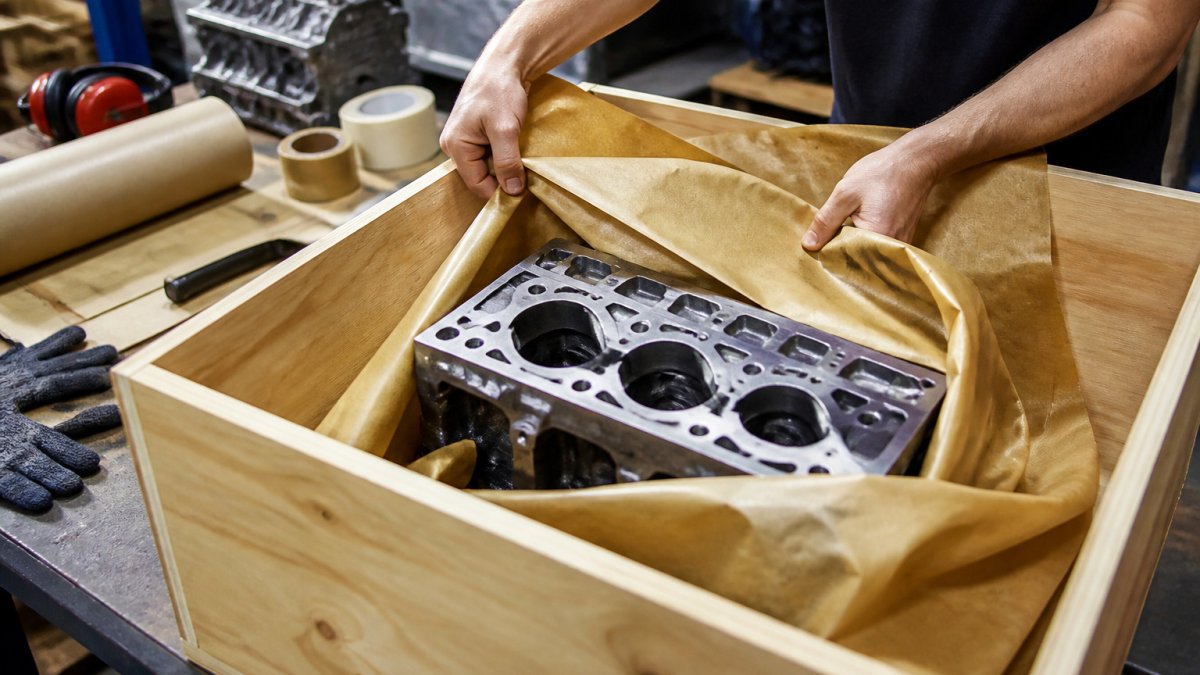
Preparing the Block: Draining, Capping, and Wrapping Openings
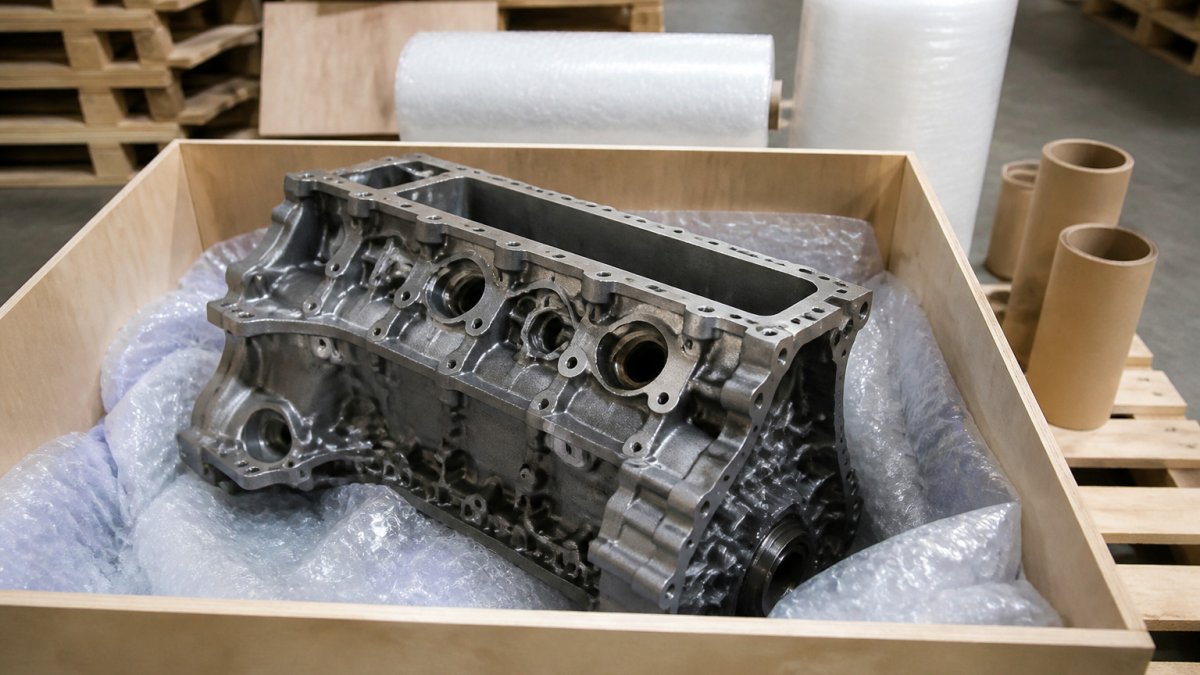
Drain all remaining fluids, including coolant and oil, before packing. Residual fluid can leak and damage other parts in the same shipment. Then cap every opening: oil galleries, coolant passages, and bore openings. Use plugs or tape rated for the purpose.
A common mistake is wrapping the block tightly while leaving open ports exposed to moisture. Seal the ports first, then wrap the whole part.
Load Ratings, Pallet Engineering, and Blocking
Engine blocks compress and shift under transit stress. Set the block on a wooden base sized to its footprint, then secure it with blocking at each side so it cannot slide. Confirm the crate or pallet has a stated load rating above the block's weight, and allow a margin for handling. Do not rely on the crate alone to hold the part still.
Corrosion Protection for Metal Parts in Transit
Bare machined metal rusts quickly when exposed to humidity, condensation, and temperature swings during shipping. Corrosion protection is therefore a standard requirement, not an optional extra. For guidance on sourcing genuine replacement parts in good condition, see how to replace Porsche brake pads step by step.
Watch out: sealing a part in plastic without a moisture control agent can trap condensation against the metal and speed up rust.
Crate vs. Box for Heavy Components: Choosing the Right Container
Choose a crate when the part is heavy, irregularly shaped, or valuable. Wooden crates resist crushing and let you attach internal blocking directly to the frame.
That is the short answer. The longer answer is where most guides stop, and where the real decision gets made: load ratings, pallet engineering, and the total cost of ownership across a shipment's life.
Load Ratings: What the Numbers Actually Mean
A container's capacity is not a single number, and a material name tells you nothing about whether it will hold. Look for a stated rating and compare it to the shipping weight with a margin for handling and stacking.
- Corrugated cartons are rated by burst strength (Mullen test) or edge-crush test (ECT). ECT is the more useful figure for stacking because it predicts how the carton performs under vertical load. A double-wall carton with a higher ECT resists crushing better than a single-wall carton of the same footprint.
- Wood crates and pallets carry a working load limit (WLL), the maximum load the assembly is designed to carry in service. Confirm the WLL exceeds the shipping weight, and allow a margin for dynamic loads during handling and transport.
- Plastic reusable containers carry a load rating that often drops when stacked. Check the stacked rating, not just the single-container rating.
If a supplier cannot state a rating, treat the container as unrated. An unrated container is a guess, and a guess is not a packaging specification.
Pallet Engineering: Where Heavy Loads Actually Fail
Most crate failures are pallet failures. The crate holds, the pallet gives way, and the load shifts or drops. Three engineering points matter more than the crate itself:
- Deck board spacing and thickness determine whether the load is spread across the pallet or concentrated on a few boards. Heavy, concentrated loads need closer deck board spacing or a solid deck.
- Stringer versus block pallets: block pallets generally offer better four-way access and more consistent load transfer, which matters for heavy engine components that need to be approached from multiple sides by a forklift.
- Load distribution: center the weight over the pallet's structural members, not the edges. A crate that overhangs the pallet puts the load on unsupported deck boards and invites failure.
Cost and Total Cost of Ownership
Purchase price is the smallest part of the decision. The real comparison is total cost of ownership across the shipment's life: purchase cost, freight cost, damage risk, return logistics, and disposal or reuse.
| Cost Factor | Corrugated Box | Wood Crate | Reusable Plastic Container |
|---|---|---|---|
| Purchase cost | Lowest | Higher | Highest upfront |
| Freight cost | Lower weight | Higher weight | Moderate weight |
| Damage risk under heavy load | High if under-rated | Low if engineered | Low if rated for the load |
| Return logistics | Usually one-way | Usually one-way | Requires return freight and tracking |
| Disposal or reuse | Recyclable, one-way | Recyclable or reusable if sturdy | Reusable across many trips |
A box that fails and damages a cylinder head costs far more than the crate that would have protected it. A reusable container only pays back if the return loop is reliable and the container survives enough trips to amortize its purchase price.
A Practical Decision Rule
Use a reinforced corrugated box when the shipping weight is well within the carton's rated capacity, the part is not fragile at its load-bearing faces, and the shipment is one-way. Use an engineered wood crate when the part is heavy, irregularly shaped, valuable, or fragile at its load-bearing faces, and confirm the pallet's working load limit and deck configuration before you seal the crate.
Engine Parts Cushioning and Blocking: Stopping Movement in Transit
Cushioning absorbs shock, while blocking stops movement. Both are needed.
Booking Your Next Genuine Parts Order for Shipping
Packing well only helps if the part you ship is the right one. Confirm your vehicle's part number before ordering, then check that the component is genuine OEM. Before you buy, read about the risks of installing fake VW parts. You can search by vehicle with our vehicle picker or by VIN to match parts to your specific Audi, Porsche, or Volkswagen.
Frequently Asked Questions
What is the best packaging material for heavy engine components?
For most heavy engine components, a combination works best: a wooden crate or reinforced corrugated carton for the outer shell, VCI paper or film to prevent rust on machined surfaces, and custom foam or molded inserts to lock the part in place. Wood offers the highest load capacity for blocks and heads, while foam suits smaller, precision parts such as sensors and covers. Match the material to the weight, the part's geometry, and how far and how roughly the shipment will travel. Pricing for packaging materials depends on quantity and supplier, so request current quotes from your carrier or packaging supplier.
How should you package an engine block for shipping?
Drain all fluids, cap or plug every opening, and cover machined faces, threads, and flanges with protective film. Set the block on a wooden pallet base and secure it so it cannot shift.
When should you use a crate instead of a heavy-duty box?
Use a crate when the component is very heavy, has sharp or protruding parts, or will face stacking and rough handling during freight transit. A corrugated box handles light to moderate loads, but once a component exceeds the box's rated weight or lacks a solid base, the carton can crush or tear. Wooden crates with proper pallet engineering distribute weight evenly and resist puncture.