 how-to
Is That VW Part Genuine? How to Spot Fakes
Last Updated: October 28, 2026
Quick Summary
Identifying counterfeit VW parts starts with the packaging and the part markings: genuine boxes have clean printing and sharp text, while fakes show blurry logos, off-shade colors, or peeling labels. Check that the part number on the box matches the marking on the metal, since a mismatched suffix is one of the strongest signals you have. Confirm fitment against your VIN, not the seller's listing.
- Genuine VW packaging uses clean printing, consistent colors, and sharp text.
- A box number that disagrees with the metal marking is a strong fake signal.
- Do not install a part whose metal marking and box label disagree.
- Photograph the box label, logo, part number, and batch code before installing.
- A legitimate aftermarket part carries its own brand, number, and warranty.
Table of Contents
- Why Counterfeit VW Parts Are a Safety Problem, Not Just a Bargain
- Packaging and Label Checks That Expose Fake Vehicle Parts
- How to Check VW Part Numbers and Product Markings
- VW OEM Parts Verification Through Official Catalogs and Dealer Channels
- The Real Risks of Aftermarket Car Parts and How Counterfeits Differ
- Photo-Based Inspection Checklist for Commonly Counterfeited Components
- Marketplace Warning Signs and What to Do After a Suspected Fake
- Source Genuine Parts With a VIN Search Before You Install
- Frequently Asked Questions
Why Counterfeit VW Parts Are a Safety Problem, Not Just a Bargain
Identifying counterfeit Volkswagen auto parts starts with one hard truth: a fake brake pad does not look dangerous. It looks like a deal. That is exactly why it sells.
At European OEM Parts Direct, we offer genuine VW, Audi, and Porsche components. Counterfeit auto parts are unlicensed copies of genuine parts, made by unknown manufacturers and sold under a real brand's name and packaging.
The risk is not cosmetic. Fake brake pads can wear unevenly or crumble under heat. Counterfeit spark plugs can misfire or damage the engine. A bogus safety switch or contact plate can stop a system from working when you need it most.
Watch out: the most dangerous fakes are safety-critical components, because the failure shows up at speed, not on the driveway. If you want the full picture of what goes wrong after installation, read our breakdown of what happens if you install fake VW parts.
Packaging and Label Checks That Expose Fake Vehicle Parts
Start with the box, because packaging is where counterfeiters cut corners. Genuine VW packaging uses clean printing, consistent colors, and sharp text. Fakes usually show blurry logos, off-shade colors, or labels that peel at the edges.
Run these checks before you open anything:
- Compare the logo to a known genuine box, side by side
- Look for misspelled words or odd spacing on the label
- Check that the part number on the box matches the part
- Scan the barcode and confirm it resolves correctly
- Feel the label: cheap paper and weak adhesive are common
- Look for a serial number or batch code, and check it is legible
A common mistake is trusting a hologram sticker on its own. Counterfeiters copy stickers too. Treat every single check as one clue, not proof.
How to Check VW Part Numbers and Product Markings
The part itself tells you more than the box ever will. Genuine VW components carry crisp, stamped or laser-etched product markings. Fakes often have shallow engravings, uneven lettering, or markings that rub off with a thumb. But to use markings as evidence, you need to know what a real VW number looks like and where the manufacturer puts it.
Decode the number before you compare it
A common pattern: the box carries the correct number, but the marking on the metal carries a different suffix. That mismatch is one of the strongest signals you have.
Where the markings live on commonly counterfeited parts
- Brake pads: backing-plate stamp with the VW logo, the part number, and a friction-code or batch marking. Check that the stamp is cut into the metal, not printed on top of it.
- Brake discs: hub-face or edge casting with the logo and a minimum-thickness marking. Cast marks should be raised or recessed cleanly, not smeared.
- Spark plugs: metal shell marking with the brand and heat range; the ceramic insulator should be clean and the electrode geometry consistent across the set.
- Oil filters: canister or housing print with the part number and a date/batch code; the filter media and bypass valve are where fakes cut corners, so inspect inside as well as outside.
- Safety switches and contact plates: molded housing marks with the logo and a production code; look for mold-flash, sink marks, or a logo that sits crooked in the tool.
Read the date and batch codes
Genuine parts usually carry a production date or batch code in addition to the part number. The format varies by component and supplier, but the principle is consistent: the code should be legible, consistent with the packaging, and plausible for a part that is currently in production. A date code that predates the part design, or a batch code that does not match the one on the box, is worth a second look. Do not treat a single code as proof either way, treat it as one more clue in the chain.
Check fitment against your VIN, not the listing
A correct number on the box proves nothing if the marking on the metal is wrong, and neither proves the part fits your car. Confirm fitment against your VIN.
If you want the full picture of what goes wrong after installation, read our breakdown of what happens if you install fake VW parts.
Genuine markings differ by component, so here is where to look on the parts counterfeiters target most.
| Component | Where to check | What genuine looks like |
|---|---|---|
| Brake pads | Backing-plate stamp | Logo, part number, friction or batch code cut into metal |
| Brake discs | Hub-face or edge casting | Logo and minimum-thickness marking raised or recessed cleanly |
| Spark plugs | Metal shell marking | Brand and heat range; clean insulator, consistent electrode geometry |
| Oil filters | Canister or housing print | Part number and date or batch code; inspect media and bypass valve |
| Safety switches and contact plates | Molded housing marks | Logo and production code; no mold-flash or crooked logo |
VW OEM Parts Verification Through Official Catalogs and Dealer Channels
VW OEM parts verification works best when you check the number against an official catalog, not against the seller's own listing.
For a closer look at how far verification goes, see our guide on whether OEM verification prevents fraud.
The Real Risks of Aftermarket Car Parts and How Counterfeits Differ
If you are weighing the two categories, our OEM vs aftermarket VW parts comparison walks through where each one makes sense.
Photo-Based Inspection Checklist for Commonly Counterfeited Components
Take photos before you install anything. Photos give you a record, and they make small defects obvious when you zoom in.
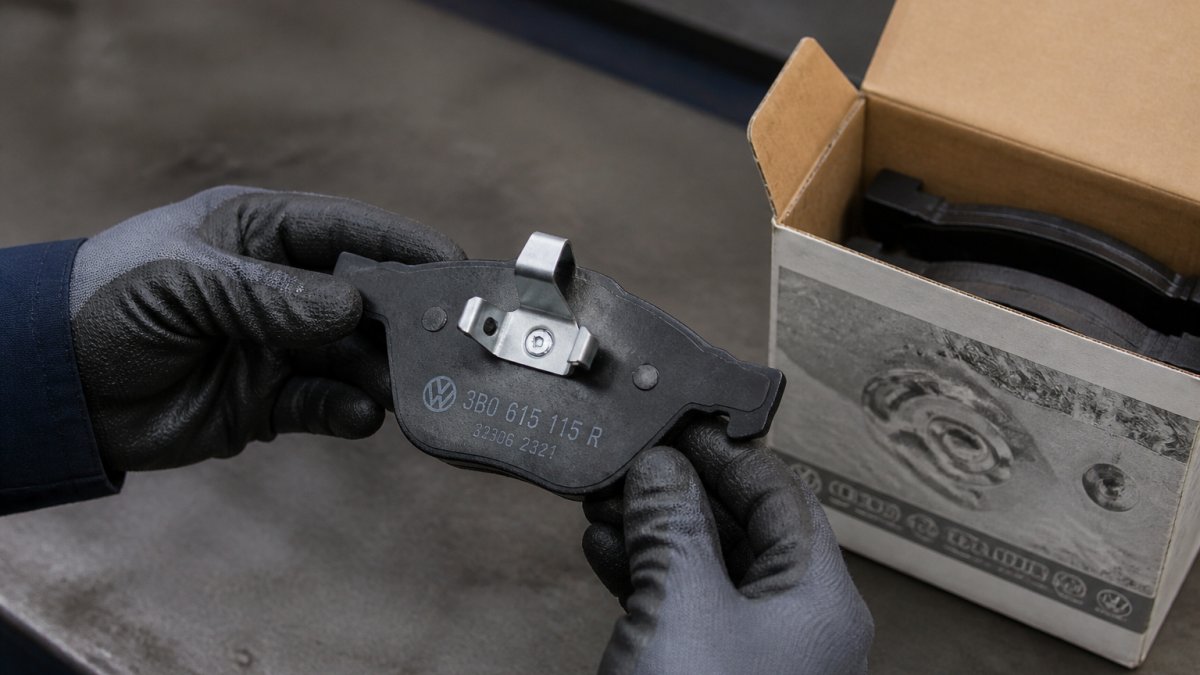
Use this checklist for the most commonly counterfeited components: brake pads, brake discs, spark plugs, oil filters, safety switches, and contact plates.
- Photograph the box label and barcode in good light
- Photograph the logo on the part, zoomed in
- Photograph the part number marking on the component
- Photograph any serial number or batch code
- Compare each photo to a known genuine part
- Note any blurry text, uneven stamping, or loose packaging
For a hands-on example, our guide on how to check for counterfeit Volkswagen oil filters applies this photo method step by step.
Marketplace Warning Signs and What to Do After a Suspected Fake
Online marketplaces carry real risk because anyone can list a part. The warning signs repeat: an unusually low price, a new seller with little history, stock photos instead of real ones, and pressure to buy fast. But the warning signs only help before you buy. The harder question is what to do after a part arrives and something feels wrong, and that is where most guides stop.
Warning signs worth acting on before checkout
- No returns accepted, or return terms buried in the listing
- The listing avoids the words "genuine" or "OEM" and leans on phrases like "OEM quality" or "direct fit"
- The seller cannot confirm fitment by VIN
- Reviews mention poor fit, premature failure, or a part that "looked different"
- The listing photo shows a box that does not match the part, or a logo that looks slightly off
- The price sits far below what authorized sellers charge for the same number
Buyer protections that actually matter
Before you pay, note the return window and who pays return shipping. A seller who accepts returns but makes the buyer cover shipping on a heavy brake disc has effectively made the return uneconomical.
What to do after a suspected fake arrives
- Stop before installation. Do not mount the part, do not discard the packaging, and do not modify anything.
- Photograph everything. The box from every side, the label and barcode, the part marking, the serial or batch code, and the packing slip. Shoot in good light and zoom in on the logo and number.
- Keep the packaging and the part together. A return or a report is much stronger when the evidence is intact.
- Contact the seller in writing. Use the marketplace messaging system so there is a record. State what you received, what you expected, and what you want, a refund, a replacement, or a return authorization.
- Open a marketplace case if the seller stalls. Most platforms have a resolution window; missing it can forfeit your protection.
- Ask your card issuer about a chargeback if the seller will not resolve it and the marketplace case does not produce a refund.
- Report the listing and the seller. Use the marketplace's report function and the brand's anti-counterfeiting contact. The FTC guidance on counterfeit goods explains your options as a buyer and where to file a complaint.
Distinguish a fake from a legitimate aftermarket part
Not every part that lacks a VW logo is counterfeit. A legitimate aftermarket part carries its own brand, its own part number, and its own warranty, and it is legal to sell. A counterfeit carries Volkswagen's branding without permission. If the part has a different manufacturer's name on it and the seller described it as aftermarket, that is a quality question, not a fraud question.
If you are weighing the two categories before you buy, our OEM vs aftermarket VW parts comparison walks through where each one makes sense.
Source Genuine Parts With a VIN Search Before You Install
A VIN search can help identify a component for your vehicle.
European OEM Parts Direct offers a vehicle picker and VIN search to help customers find parts for Audi, Porsche, and VW vehicles. We offer genuine OEM parts and have a comprehensive inventory on hand.
You can use our VIN search to find genuine parts. Browse our genuine VW components by VIN search.
Frequently Asked Questions
How can I tell if a Volkswagen part is genuine?
Use the vehicle picker or VIN search to help identify the part for your vehicle.
What are the risks of using counterfeit auto parts?
Counterfeit parts are most dangerous in safety-critical components like brake pads, brake discs, and safety switches, where poor materials can cause premature failure. Even in less critical spots, fake parts often fit poorly, wear faster, and can damage surrounding components. You also lose any warranty protection. The savings from a cheap fake rarely outweigh the cost of replacing it twice or repairing the damage it causes.
Are third-party Volkswagen parts always counterfeit?
No. Legitimate aftermarket brands make quality replacement parts that are clearly labeled with their own name and part number. The problem is parts sold as genuine OEM that are not. A real aftermarket part tells you who made it and stands behind a warranty. A counterfeit hides behind VW branding. If a seller claims OEM authenticity but the price is far below dealer pricing, treat that as a red flag.
Where should I buy genuine Volkswagen parts to avoid scams?
European OEM Parts Direct offers genuine Volkswagen parts and a VIN search to help you find parts for your vehicle.
Counterfeit parts thrive on uncertainty, and the fix is a verified part number tied to your VIN. European OEM Parts Direct removes that uncertainty with a vehicle picker, VIN-based part matching, and a full inventory of genuine OEM components for Audi, Porsche, and Volkswagen. Get started with European OEM Parts Direct and install a part you can trust.