 Ultimate guide
Dangers of Low Quality European Replacement Parts: What to Know
Last Updated: November 8, 2026
Quick Summary
Low quality European replacement parts cost more than they save because early failures mean paying for installation twice, plus the failed part and any secondary damage it causes. Counterfeit parts carry no traceability and can fail in safety-critical systems like brakes, steering, and airbags, where there is no second chance.
- Counterfeit parts are unlicensed copies made without manufacturer quality control and with no traceability.
- A failed timing belt on an interference engine can bend valves and destroy the cylinder head.
- Verify a part by asking for the manufacturer name, part number, and warranty terms in writing.
- Match the part category to the consequence of failure, choosing genuine or top-tier aftermarket for safety-critical systems.
- Stop driving if a suspect part affects a safety system, then document the part, packaging, and labeling.
Table of Contents
- Why Low Quality European Replacement Parts Cost More Than You Save
- Counterfeit Car Parts Risks: What Happens When Fakes Get Installed
- OEM vs Aftermarket Car Parts: Where the Real Difference Shows Up
- How to Identify Fake Car Parts Before You Install Them
- VIN Lookup for Car Parts: Matching the Right Component to Your Vehicle
- What to Do After Discovering a Suspect Part
- Find Genuine Parts for Your Audi, Porsche, or Volkswagen
- Frequently Asked Questions
Why Low Quality European Replacement Parts Cost More Than You Save
The cheapest replacement parts rarely stay cheap. A low-quality European replacement part can save money at checkout, then charge you back through repeat labor, damaged surrounding components, and reduced resale value. Owners of Audi, Porsche, and Volkswagen models who buy a bargain component can end up paying twice to fix what it broke.
The math is simple. A part that fails early means paying for installation twice, plus the failed part itself, plus whatever it damaged on the way out.
- Repeat labor: the job gets done again, often at a higher rate
- Secondary damage: a failing component takes healthy parts with it
- Downtime: your car sits while a correct part is sourced
- Resale impact: documented non-genuine repairs raise questions at sale time
Genuine parts are manufactured to the specification your vehicle was designed around. Anything less introduces risk you did not budget for.
Counterfeit Car Parts Risks: What Happens When Fakes Get Installed
Counterfeit car parts risks go beyond poor performance. A counterfeit component is an unlicensed copy made without the manufacturer's quality control, often from low-quality materials and with no traceability. It may look convincing in photos and fail the moment it is under load. The risk is not uniform across the car, though. Severity depends on what the part does and what happens when it stops doing it.
A Part-by-Part Risk Assessment for Safety-Critical Systems
Replacement-part risk is commonly ranked by consequence of failure, not by purchase price. The table below is a practical severity guide for the systems where a low-quality or counterfeit part does the most damage.
| System | Typical counterfeit or low-quality failure | Severity | Why it matters |
|---|---|---|---|
| Brakes (pads, rotors, hoses, calipers) | Friction material crumbles or glazes; hose bulges or bursts; caliper piston seizes | Critical | Stopping distance grows unpredictably; a burst hose means no service brake on that corner |
| Steering (tie rod ends, ball joints, rack components) | Loose stud, cracked boot, premature play | Critical | Loss of steering control at speed; a separated tie rod end is unrecoverable |
| Suspension (control arms, bushings, struts) | Bushing tears out, arm cracks, strut leaks | High | Altered alignment and handling; a cracked control arm can collapse the corner |
| Airbags and restraint components | Squib or inflator out of specification; module not matched to vehicle | Critical | Non-deployment or unexpected deployment; no second chance |
| Timing components (belts, tensioners, chains) | Belt sheds teeth, tensioner seizes, chain stretches | High to critical | On interference engines, a slipped belt bends valves and can destroy the cylinder head |
| Sensors (O2, MAF, ABS wheel speed, cam/crank) | Slow or biased signal, connector corrosion | Moderate to high | Drivability faults, failed emissions, and in the case of ABS or crank sensors, loss of a safety or engine-control function |
| Filters (oil, air, fuel, cabin) | Media collapses, bypass opens early, poor fit | Low to moderate | Contaminant bypass accelerates wear in engines and fuel systems; the damage is slow but cumulative |
Two patterns stand out. First, the parts that cost the least to buy, filters, sensors, bushings, are often the ones whose failure quietly damages expensive connected components. Second, the parts with the highest severity are exactly the ones where a counterfeit is hardest to spot by eye, because the external casting or housing can look correct while the internal material or specification is not.
Safety Systems That Fail First
Braking system components, steering components, and suspension components carry the highest stakes. A counterfeit brake pad or tie rod end can fail under exactly the conditions you need it most: hard braking, evasive steering, uneven road surfaces.
Restraint systems deserve separate mention because they are all-or-nothing. An airbag module or inflator that is not built and matched to the vehicle's specification may not deploy, may deploy late, or may deploy with the wrong force. There is no gradual warning and no second chance in a crash.
Secondary Damage and the Repair Bill That Follows
When a cheap component fails, it rarely fails alone. A failed timing belt can bend valves and damage the cylinder head (Timing Belts: Interference Engines). A failing sensor can push the engine into a poor running condition that accelerates wear. A collapsed oil filter or a filter that goes into bypass sends contaminated oil through bearings and turbocharger journals. The repair bill that follows often dwarfs what the original part would have cost, and the damage is frequently not covered by the part seller's warranty because the failed part itself is the only thing the warranty addresses.
Traceability: The Check That Separates Counterfeit From Merely Cheap
A legitimate part, whether genuine or aftermarket, can usually be traced. That means a manufacturer name and address on the packaging, a part number that matches the application, batch or serial information where the maker provides it, and documentation that ties the part to a warranty.
Watch out: a convincing photo, a clean-looking box, and a low price are not evidence of legitimacy. Ask the seller for the manufacturer's name, the part number, and the warranty terms in writing before you pay, and keep that record.
OEM vs Aftermarket Car Parts: Where the Real Difference Shows Up
OEM vs aftermarket car parts is not a simple genuine-versus-fake story, and treating it as one leads owners to the wrong decision in both directions. There are three distinct categories, and they carry different risks.
The Three Categories, Defined
Genuine (OEM) parts are manufactured to the vehicle manufacturer's specification and sold under its brand, usually through a dealer network.
Legitimate aftermarket parts are made by independent manufacturers to their own specification, which may meet, exceed, or fall short of the OEM specification depending on the maker and the product line.
Economy or budget parts are a sub-tier of aftermarket: lower-cost products, often with thinner material, less testing, and shorter warranty coverage.
Counterfeit parts are a separate category entirely: unlicensed, untraceable copies sold under false pretenses, often in packaging designed to mimic a genuine or reputable brand.
Where the Real Difference Shows Up
The difference between a good part and a bad one shows up in four places, regardless of category:
- Precision engineering and tolerances: genuine parts are manufactured to the specification the vehicle was designed around; good aftermarket makers publish their tolerances, budget makers often do not
- Materials: friction compounds, bearing grades, rubber compounds, and housing alloys determine how a part behaves under heat, load, and time
- Quality control: genuine parts pass the manufacturer's own testing regime; aftermarket quality control ranges from rigorous to nominal
- Traceability and warranty: genuine parts carry documented provenance and a manufacturer-backed warranty; aftermarket coverage depends entirely on the maker and seller
How to Choose Without Assuming All Non-Genuine Parts Are Unsafe
The practical rule is to match the category to the consequence of failure.
Watch out: the label on the box is not the specification. A part sold as "OEM quality" or "meets or exceeds OEM standards" is making a marketing claim, not a certification. Ask for the manufacturer's name, the part number, the warranty terms, and, for safety-critical parts, the specification the part is built to.
How to Identify Fake Car Parts Before You Install Them
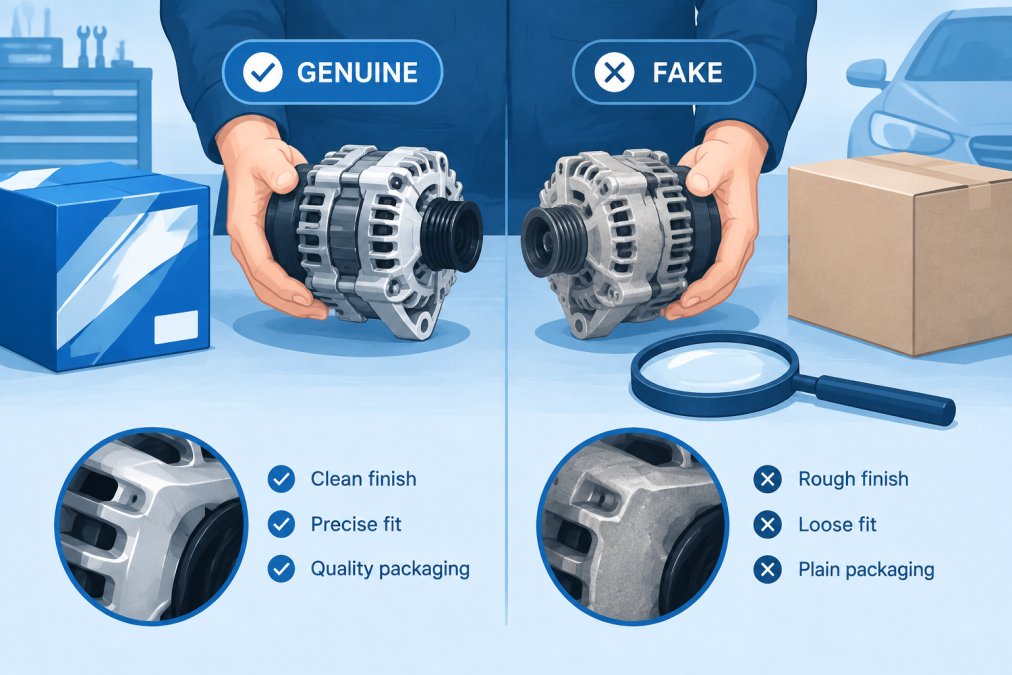
Identifying fake car parts comes down to packaging, appearance, and measurement. Check all three before you install anything.
Packaging, Labeling, and Licensing Checks
- Look for official licensing marks and manufacturer branding printed cleanly and consistently
- Check the part number against your vehicle's documentation
- Examine the packaging for misspellings, blurry printing, or flimsy materials
- Verify the seller's credentials and return policy before ordering
Fitment, Finish, and Tolerances You Can Inspect
Poor fit and compatibility issues are the clearest warning signs. Look for rough edges, inconsistent finish, or poorly molded plastic. A genuine part should seat cleanly without force. If bolt holes do not line up or a connector will not click home, stop. For a step-by-step process, our guide on avoiding counterfeit European auto parts walks through the checks in order.
VIN Lookup for Car Parts: Matching the Right Component to Your Vehicle
VIN lookup for car parts eliminates the guesswork that leads owners to buy the wrong component. Your vehicle identification number encodes the exact specification your car was built to, including engine code, trim, and production variations.
Even within one model year, Audi, Porsche, and Volkswagen can use different components across trim levels. Buying by model name alone invites fitment problems. A VIN-based search matches the part number to your specific vehicle. Our step-by-step VIN lookup guide shows how to decode your number and confirm the correct component, including for older and less common models.
What to Do After Discovering a Suspect Part
Stop driving if the suspect part affects a safety system. Then document everything: photographs of the part, packaging, and any labeling, plus your order confirmation.
Next, request a return authorization from the seller. Follow the seller's process exactly and keep records of every communication. Our guide on requesting a return authorization for auto parts covers the steps and what to include.
Watch out: installing a suspect part "just to test it" can void your return options and put you and other road users at risk.
Find Genuine Parts for Your Audi, Porsche, or Volkswagen
Genuine parts remove the guesswork. Our tips for finding reliable European car parts online explain what to verify before you buy, and our OEM vs aftermarket comparison goes deeper on quality differences.
Skip the counterfeit lottery and the repeat repair bills.
The risk with low-quality replacement parts is not the part itself. It is everything it takes down with it. European OEM Parts Direct helps you avoid that cycle with genuine OEM parts for Audi, Porsche, and Volkswagen, a user-friendly vehicle picker, VIN search for accurate identification, and a comprehensive inventory on hand.
Frequently Asked Questions
What are the risks of using low-quality replacement parts in a car?
Low-quality replacement parts can fail prematurely, damage connected components, and compromise safety systems like brakes and steering. Poor fit and out-of-spec tolerances cause vibration, power loss, and secondary damage that turns a cheap repair into an expensive one. Counterfeit parts carry the added risk of unknown materials and no warranty coverage, leaving you responsible for the full cost of a second repair.
How can you tell if a European car part is counterfeit?
Check the packaging for misspellings, missing licensing marks, and flimsy materials. Inspect the part itself for rough edges, inconsistent finish, and poorly molded plastic. Compare the part number against your VIN lookup results and verify seller credentials. Genuine parts carry traceable branding, a warranty, and a clear return policy. If the price is far below every other source, treat that as a warning sign.
Are aftermarket parts as reliable as OEM parts?
It depends on the aftermarket brand. Legitimate aftermarket parts from established manufacturers can meet or exceed OEM specifications, but economy-tier and counterfeit parts often do not. OEM vs aftermarket car parts comes down to quality control and traceability. For safety-critical systems like braking, steering, and suspension, genuine OEM components remove the guesswork because they are built to the same tolerances as the part that came off your vehicle.
How do I verify that a replacement part fits my Audi, Porsche, or Volkswagen?
Use a VIN lookup for car parts. Your 17-character VIN identifies the exact model year, engine, and trim, so the part number you pull matches what the factory installed. Cross-check the number on the seller's listing and confirm the return policy before ordering. A vehicle picker works for common models, but VIN search is the reliable route for older or rare vehicles where part numbers changed mid-year.