 ultimate-guide
Are OEM Audi Parts Worth It for Maintenance?
Last Updated: November 1, 2026
Quick Summary
OEM Audi parts are components manufactured to the exact specifications Audi sets for your vehicle, making them the safest baseline for maintenance. The benefits come down to fit, durability, and resale, since genuine parts are designed to fit the first time and wear at the rate the factory engineered for.
- Genuine parts are built to factory drawings, so mounting points line up and connectors seat correctly.
- Aftermarket can be reasonable for high-wear, low-consequence items on older cars, but not for safety or engine parts.
- Match the part number stamped on the part to the number for your VIN before installing anything.
- A VIN search narrows the catalog to parts matched to your vehicle's build, which matters on older or rare models.
- The genuine Audi front wiper blade set (4M1-998-002) is priced at $81.67 and includes right and left blades.
Table of Contents
- Why OEM Audi Parts Matter for Long-Term Maintenance
- OEM vs Aftermarket Audi Parts: Where the Real Differences Show Up
- How to Identify Genuine Audi Parts Before You Install Them
- Finding the Right Audi OEM Parts by VIN
- Warranty Coverage, Dealer Support and What Voids a Claim
- Total Cost of Ownership: OEM Parts, Resale Value and Repair Costs
- Audi Maintenance Examples Where Genuine Parts Pay Off
- Find Your Exact Audi Part With a VIN Search
- Frequently Asked Questions
Why OEM Audi Parts Matter for Long-Term Maintenance
OEM Audi parts are components manufactured to the exact specifications Audi sets for your vehicle, and they are the safest baseline for any maintenance schedule. Over years of ownership, genuine parts are designed to fit the first time, wear at the rate the factory engineered for, and keep the car behaving as it did when it left the lot.
Here is the part most owners miss. Maintenance is not just about replacing a worn component. It is about preserving a system. A brake pad, a coolant hose, or a wiper blade is designed to work with everything around it, and small deviations in material or tolerance add up.
The National Highway Traffic Safety Administration treats replacement parts as a safety matter for good reason. When a critical component does not meet the original specification, the failure mode is not always obvious until it matters.
Below, we break down where OEM and aftermarket parts actually diverge, how to spot a genuine part before you install it, and when aftermarket can be the right call. The benefits of using OEM Audi parts for maintenance come down to fit, durability, and resale, and each one is worth understanding before your next service.
OEM vs Aftermarket Audi Parts: Where the Real Differences Show Up
The OEM vs aftermarket Audi parts question usually gets answered with vague talk about "quality." That is not useful. The real differences show up in three concrete places: how the part fits, what it is made of, and whether it was tested against your specific model.
Fit, Finish and Factory Specifications
Genuine parts are built to the manufacturer's drawings. That means mounting points line up, connectors seat correctly, and clearances match what the assembly expects. An aftermarket part may be "close," but close is where installers lose an afternoon and where premature wear begins. Factory specifications exist because the surrounding components were designed around them.
When Aftermarket Parts Make Sense
Aftermarket is not automatically wrong. For a high-wear, low-consequence item on an older car, a reputable aftermarket option can be a reasonable budget choice. Where it stops making sense is on anything tied to engine performance, safety systems, or a part that is buried behind hours of labor. If a cheap part fails early, you pay the labor twice.
| Factor | OEM Audi Parts | Aftermarket Parts |
|---|---|---|
| Fit and tolerances | Built to factory drawings | Varies by maker |
| Material and testing | Manufacturer standards | Inconsistent |
| Warranty support | Backed through dealer network | Depends on seller |
| Best for | Safety, engine, long-term ownership | Low-stakes, older vehicles |
Best for: owners planning to keep the car and protect its value. Skip if: you are flipping a high-mileage car and the part carries no safety role.
How to Identify Genuine Audi Parts Before You Install Them
Learning how to identify genuine Audi parts starts with the packaging and the part itself. Genuine components typically carry manufacturer branding and a legible part number. Counterfeits can copy the look, so the details are worth checking.
A common mistake is trusting a listing that says "authentic" without a verifiable part number. Our advice: match the number stamped on the part to the number for your VIN before you install anything. If they do not agree, stop.
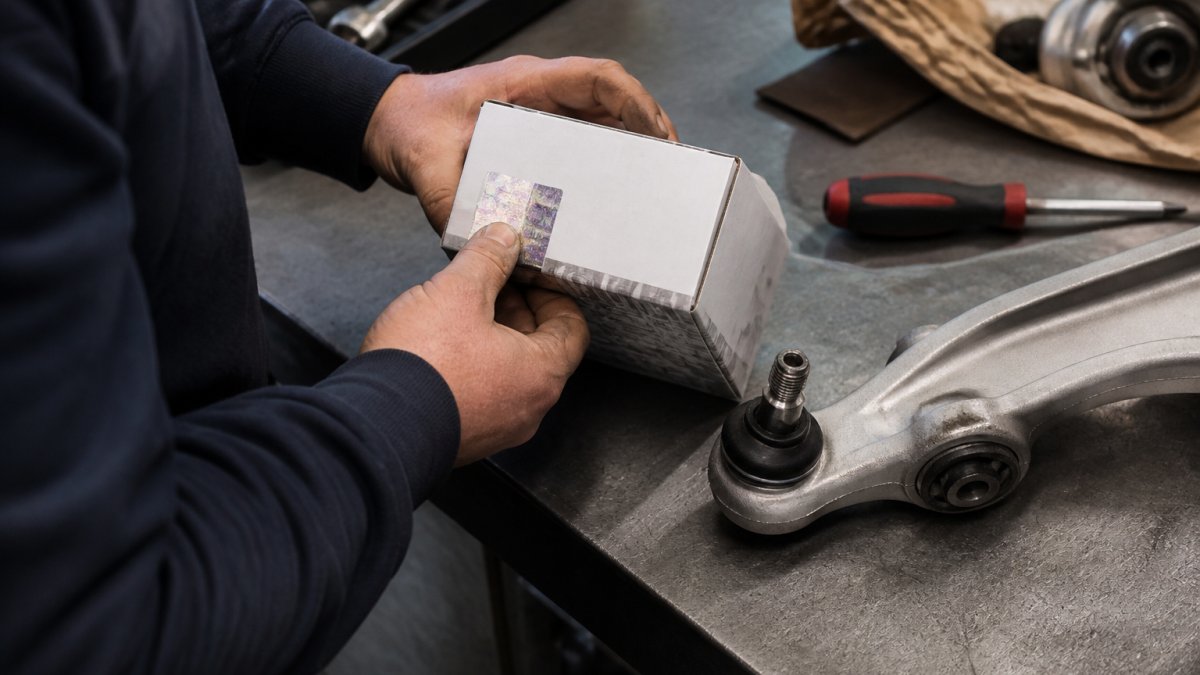
A few checks help catch counterfeits:
- Confirm the part number is stamped on the part itself.
- Look for consistent branding and clean casting on metal parts.
- Check that the packaging and labels match the component inside.
- Cross-reference the number against your vehicle before installation.
For a deeper walkthrough, our guide on best practices for sourcing Audi replacement parts covers the verification steps we recommend before any purchase.
Finding the Right Audi OEM Parts by VIN
The fastest way to get the correct component is to search Audi OEM parts by VIN. A VIN search helps narrow the catalog to parts matched to your vehicle's build. That matters most on older or rare models, where a part number can change mid-production.
This is where a VIN search beats guessing from a model year alone. Two cars of the same year can carry different components depending on trim, engine, and build date. Entering the VIN removes that ambiguity and reduces the odds of ordering something that almost fits.
Our vehicle picker and VIN search are designed to help you find the right part for your vehicle.
Warranty Coverage, Dealer Support and What Voids a Claim
Warranty coverage is one of the clearest practical differences between genuine and aftermarket parts, but the details matter more than the headline. Genuine parts are generally covered by a manufacturer warranty, and coverage terms vary. Aftermarket warranties depend on the seller, and terms can differ widely.
The nuance most owners miss is that "warranty" is not one thing. It has a duration, a parts-versus-labor split, and a set of exclusions. Before you buy, confirm four things: how long the coverage runs, whether labor is reimbursed or only the part, what documentation the seller requires for a claim, and whether the part must be installed by an authorized technician.
2017-2025 Audi - Wiper Blade - Audi (4M1-998-002) →
Under the Magnuson-Moss Warranty Act, a manufacturer generally cannot void your vehicle warranty simply because you used a non-OEM part, but it can deny a claim if the part caused the failure. That distinction is why genuine parts reduce friction: there is no argument about whether the component was the cause. When you want the cleanest path through a warranty claim, genuine parts remove the ambiguity.
Dealer support is the other half of the equation, and genuine parts generally make the service history easier to trace. Aftermarket support is only as good as the seller's return policy, and that policy is often shorter than the part's expected service life.
A balanced way to think about it: warranty is part of the purchase price. A cheaper part with thin coverage can cost more over the ownership period than a genuine part with clear terms, especially on anything that requires significant labor to reach. For owners weighing the long view, our article on how long genuine Audi parts last lays out what to expect from service life.
Total Cost of Ownership: OEM Parts, Resale Value and Repair Costs
Genuine parts often cost more up front. Owners weigh that against total cost of ownership, including the potential for fewer repeat repairs and a documented maintenance history.
The math is simple. A part that lasts and fits correctly costs you once. A part that fails early costs you the part, the labor, and sometimes the component it damaged on the way out. Across long-term ownership, that gap is where repair costs quietly climb. For owners weighing the long view, our article on how long genuine Audi parts last lays out what to expect from service life.
Audi Maintenance Examples Where Genuine Parts Pay Off
Concrete cases make the argument better than theory, and Audi-specific systems are where the difference is easiest to see. Consider a cooling system service on a higher-mileage Audi. Cooling system and turbocharger components are designed to fit the factory layout, and small fitment deviations can cause leaks or fault codes on some vehicles.
Brake components are generally designed to work as a matched system. Mismatched friction material can affect noise, wear, and stopping distance, which makes correct parts important for safety.
Wipers are a small but telling example. The genuine Audi front wiper blade set (4M1-998-002), priced at $81.67, is a listed front wiper set that includes right and left blades.
Modern vehicles rely on control modules and sensors that must communicate correctly. Some replacement sensors or modules may require coding or adaptation after installation, so check the procedure for your specific part.
Installation is the other practical consideration. Following the correct torque specifications and procedures matters on jobs like timing belt service and suspension work. If you want the full picture on keeping the cooling system healthy, our Audi engine cooling system maintenance guide walks through it step by step. For the underlying case for genuine components, see why genuine Audi parts matter for repairs.
Find Your Exact Audi Part With a VIN Search
The benefits of using OEM Audi parts for maintenance only pay off if you order the right part. That is the whole game: correct fitment, verified number, genuine component. Guessing wastes time and money, and it is the single most common reason a DIY job stalls.
European OEM Parts Direct offers genuine OEM parts for Audi, Porsche, and Volkswagen, with a vehicle picker and VIN search to help match components to your vehicle. We aim to provide competitive pricing and convenient shipping.
Start with your VIN and see the exact part for your car. Browse the Audi wiper blade listing to see how fitment works in practice, then find your part and get back on the road.
Frequently Asked Questions
What are the benefits of using OEM Audi parts?
OEM Audi parts are made to factory specifications, which is why fitment and materials are designed to match the original components. Many owners choose them for consistent fit and long-term ownership. For a daily driver you plan to keep, those factors usually outweigh the higher upfront price.
Are OEM Audi parts better than aftermarket parts?
For most maintenance work, yes. OEM Audi parts meet manufacturer standards for materials, testing and fit, which matters on sensors, suspension components and anything tied to engine management. Aftermarket parts vary in quality and construction, which can affect fit and how well they work with the rest of the vehicle. Aftermarket can work for consumables like wiper blades or cabin filters, but for anything that affects performance or safety, genuine is the safer call.
How can I tell if an Audi part is genuine?
Check three things. First, the part number should be stamped or molded into the component itself. Second, check that the packaging and labels are consistent and match the part. Third, buy from a seller who lets you search by VIN so you can confirm the part matches your model and trim. If the price is far below every other source, treat that as a warning sign.
Can using aftermarket parts affect my Audi warranty?
Under federal warranty rules, a manufacturer generally cannot void your entire warranty just because you used an aftermarket part. However, if a non-genuine part fails and causes damage to a warranted component, the dealer can deny coverage for that specific repair. That distinction matters: an aftermarket suspension part that damages a control arm could leave you paying for the arm. Genuine Audi parts remove that argument entirely, which is why owners still under factory or extended coverage usually stick with OEM.
The real challenge with Audi maintenance is not the repair itself. It is trusting that the part in your hand is the one your car was engineered for. European OEM Parts Direct exists to remove that doubt, with genuine OEM parts, a VIN search that confirms fitment, and an inventory built around Audi, Porsche, and Volkswagen owners who do their own work. Get started with European OEM Parts Direct and order the exact part your car needs, backed by accurate matching and quick shipping.