 How-to
How to Identify Discontinued VW Part Numbers
Last Updated: November 26, 2026
Quick Summary
To learn how to identify discontinued VW part numbers, search the full number with its suffix in a current electronic parts catalog and note the exact status label it returns. Confirm the status in writing with a dealer parts desk, then cross-check the number against a second catalog before concluding the part is discontinued.
- A VW part number's first three digits name the platform, such as 1K0 for the Mk5/Mk6 Golf.
- Always include the trailing suffix letter when searching a part number, since it marks revisions.
- A backordered part is still valid and should not be treated as a discontinuation.
- A superseded number has a live replacement chain, while an obsolete part has no official replacement.
- Two independent catalog no-results on the verified full number count as reasonable evidence.
Table of Contents
- VW Part Numbers Explained: Decoding the Structure
- VW Part Numbers Lookup: Finding the Right Number for Your Vehicle
- Using the VW Parts Catalog VIN Search for Accurate Fitment
- How to Confirm a VW Part Number Is Actually Discontinued
- Tracing Supersessions and Replacement-Number Chains
- Verifying Fitment Before Buying a Replacement Part
- Sourcing from a Genuine VW Parts Catalogue and Interpreting Conflicting Results
- What to Do After Confirming a Part Is Discontinued
- Frequently Asked Questions
VW Part Numbers Explained: Decoding the Structure
A Volkswagen part number is a structured code that tells you the model family, main group, component type, and revision of a part.
The code is not random. Each block of digits means something specific.
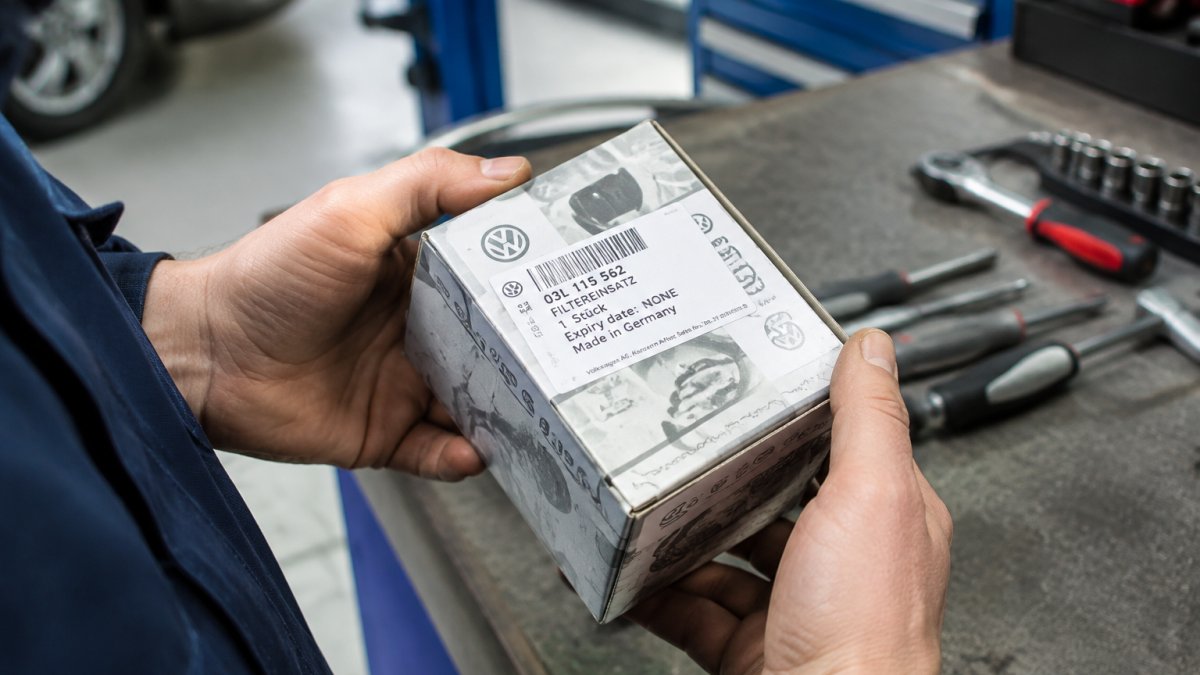
Main Groups, Subgroups, and Three-Digit Codes
Most VW part numbers begin with a three-digit main group code. Common examples include 1K0 for the Mk5/Mk6 Golf platform and 8P0 for the Audi A3. The first digits point to the vehicle family or platform. The next block names the component system: brakes, cooling, electrical, body. A final three-digit group narrows it to the exact component.
Suffixes, Revisions, and Hyphenated Groups
Letters at the end of a number mark revisions. An "A" suffix often means an updated version of the original part. Hyphens split long numbers into readable groups. When you search by part number, always include the suffix. Dropping it is a common mistake.
VW Part Numbers Lookup: Finding the Right Number for Your Vehicle
Looking up a part by VIN is generally more precise than searching by year and model, because the VIN reflects the vehicle's specific build record. Year, make, and model alone can return several possible numbers, and one of them will be wrong.
Here is a common lookup order:
- Start with your 17-digit VIN from the dashboard or door jamb
- Run it through a VIN-based parts catalog
- Confirm the result shows your engine code and trim
Using the VW Parts Catalog VIN Search for Accurate Fitment
VIN search works because your vehicle identification number encodes the build details: model year, engine code, trim level, and production date. A catalog that reads the VIN filters out parts that fit a different build of the same model.
Why VIN Beats Year, Make, and Model Alone
Two 2015 Golfs can carry different brake components depending on engine and trim. Year, make, and model cannot separate them. The VIN can. If you want a full walkthrough of the process, our guide on how to find Volkswagen parts by VIN covers each step.
How to Confirm a VW Part Number Is Actually Discontinued
Calling the dealer is a common first step, but it can be hard to tell a genuinely discontinued part from one that is merely backordered, region-restricted, or hidden behind a catalog error. The distinction matters because each status leads to a different next step, and only one of them means you should start hunting the secondary market.
The Four Statuses You Will Actually Encounter
When you look up a number in an electronic parts catalog or ask a dealer parts desk, you are usually seeing one of four states. Learn to name them before you act.
- Active, the number is current and orderable. No action needed beyond normal fitment checks.
- Backordered, production continues, but stock is temporarily unavailable. The number is still valid; wait or source from another dealer. Do not treat a backorder as a discontinuation.
- Superseded, the original number is no longer produced, but the manufacturer has issued a replacement number. The chain is live; trace it (see the next section).
A fifth state, region-restricted, is the one most owners misread. A part can be active in one market and unavailable in another because of emissions, safety, or trim differences.
A Step-by-Step Verification Method
- Search the full number, suffix included, in a current electronic parts catalog. Note the exact status label the catalog returns, not just whether a result appears.
- Look for a replacement number on the same listing. If one is shown, you are in a supersession, not a discontinuation. Write down the replacement number and its suffix.
- Ask the dealer parts desk for the availability status in writing, email or a printed quote is fine. Ask specifically: "Is this number active, backordered, superseded, or discontinued?" Vague answers like "we can't get it" are not a status.
- Cross-check the number against a second catalog (a different dealer's system or an independent catalog that mirrors manufacturer data). A single "no result" is weak evidence; two independent no-results on the full number is stronger.
- Confirm the production date range and market spec for your VIN before you conclude the part is gone. A part that was discontinued for a later build may still be active for an earlier one, and vice versa.
Watch out: A catalog that returns "no result" for a number you copied from a forum is more likely to be a mistyped or truncated number than a discontinued part. Re-verify the number character by character, including hyphens and the trailing suffix letter, before you accept a discontinuation.
Why "Discontinued" and "Obsolete" Are Not Synonyms
A discontinued part has ended production but may still have a live supersession chain pointing to a buyable replacement. An obsolete part has ended production with no official replacement at all. The practical difference: a discontinued part can often still be bought new through the replacement number, while an obsolete part usually cannot. Treat the two labels as different decision points, not as the same dead end.
What Counts as Proof
A verbal "I think that's discontinued" from a counter employee is not proof. Reasonable evidence is one of: a written dealer status confirmation, a manufacturer catalog entry explicitly marked NLA with no replacement, or two independent catalog no-results on the verified full number. Anything short of that is a lead, not a conclusion, and it is not enough to justify paying secondary-market prices.
Tracing Supersessions and Replacement-Number Chains
A supersession is the manufacturer's record that one part number has been replaced by another. Chains can run several links long, and the links are not always simple suffix bumps. A brake pad might move from an original number to a revised suffix, then to a number in a different main group entirely when the platform or supplier changes. Reading the chain correctly is the difference between buying the right part and buying a superficially similar one that does not fit.
How a Chain Actually Looks
A typical chain has three kinds of links:
- Suffix revision, the base number stays the same and the trailing letter advances (for example, a number ending in no suffix moving to an "A" or "B" suffix). This is the most common and usually the safest link to follow.
- Base-number change, the main group or component block changes while the part function stays the same. This often happens when a platform is refreshed or a supplier is swapped. Fitment can change here, so verify against your VIN.
- Cross-group replacement, the replacement number sits in a different main group altogether. These are the riskiest links because the replacement may have been engineered for a different build.
Walking the Chain Step by Step
- Start with the number you have and search it in a current catalog. Note whether a replacement number is shown and what kind of link it is (suffix, base-number, or cross-group).
- Record each link in order, original number, first replacement, second replacement, and so on, until the catalog stops offering a further replacement. That last number is the current buyable part.
- Check the replacement's fitment notes against your VIN, engine code, trim, and production date. Do not assume the last link fits just because it replaced your original number.
- Ask the dealer parts desk for the full replacement history if the catalog shows only the first link. Catalogs sometimes display the original number as "no longer available" without surfacing the rest of the chain.
- Confirm the final number is orderable before you commit. A chain that ends in another NLA number is not a solution.
Watch out: A replacement number that fits a different engine code or trim is not a direct fit for your car, even if the catalog presents it as the successor. Cross-group replacements in particular can carry different mounting points, connector types, or calibration, verify before you buy.
When a Replacement Is Not a Direct Fit
Three situations commonly break the assumption that "the replacement fits because it replaced my part":
- Production-date splits, a mid-year change can mean the replacement was engineered for later builds and does not match earlier ones.
- Market-specific variants, a replacement released for one market may carry different emissions or safety hardware than your market's original.
- Trim and engine differences, a shared-platform part can look identical but differ in calibration or connector pinout.
In each case, the chain is real but the fitment is conditional. Treat the replacement number as a candidate, not a conclusion, until your VIN confirms it.
Why the Final Number Is the One to Buy
The last link in a live chain is the number the manufacturer currently produces and supports. Buying an earlier link, even if a secondary seller still lists it, means buying a part the manufacturer has already moved past. Trace to the end of the chain, verify fitment, then buy the final number.
Verifying Fitment Before Buying a Replacement Part
Fitment is whether a part physically and electronically works in your specific vehicle. Never assume a superseded number fits just because it replaced the old one. Regional and model-year differences can break the chain.
Before you order, confirm these match your car:
- Engine code
- Trim level
- Production date range
Our Volkswagen genuine parts buying guide walks through this check in detail.
Sourcing from a Genuine VW Parts Catalogue and Interpreting Conflicting Results
Conflicting catalog results usually come from mixed data: some catalogs list the original number, others list the superseded one. Neither is wrong. They are showing different points in the chain.
Here is how to read a conflict:
| What You See | What It Likely Means | What to Do |
|---|---|---|
| Original number marked NLA | Part discontinued, chain exists | Trace the supersession |
| Two numbers, same part | Old and new revision | Buy the newer suffix |
| Number fits two models | Shared platform part | Confirm by VIN |
| No result at all | Obsolete or bad number | Verify the number first |
For trustworthy sources when results conflict, see our list of reliable places to buy genuine VW components.
What to Do After Confirming a Part Is Discontinued
Once a part is confirmed discontinued, your options narrow to three: a superseded replacement, a good used OEM part, or a verified genuine part from remaining stock.
If you buy from the secondary market, learn how to spot counterfeit VW parts before you pay. Owners sourcing hard-to-find European components can also read our tips for finding reliable European car parts online.
Discontinued part numbers do not have to stall your repair. The key is confirming status, tracing the replacement chain, and checking fitment by VIN before you order.
Frequently Asked Questions
How do I know if a VW part number has been discontinued?
Check the number in an electronic parts catalog like ETKA or a dealer parts system. If it returns no active listing, ask a parts specialist to run the number and confirm whether it shows as discontinued, superseded, or simply backordered. A discontinued part has no future production; a backordered part is temporarily out of stock. Get the status in writing before you assume a part is gone, because the distinction changes what you do next.
Can a discontinued VW part number be replaced by a newer number?
Yes. Volkswagen frequently supersedes a part with a revised number, and the chain can run through several revisions. A parts specialist can trace the original number forward to the current replacement. Write down each number in the chain and confirm the final number fits your vehicle by VIN before ordering. Skipping a step in the chain is how people end up with a part that looks right but does not fit.
How do I find the correct VW part number using a VIN?
Use a VIN-based lookup, either through a dealer parts department or an online catalog that accepts a 17-character VIN. The VIN encodes model year, plant, engine code, and trim, so the catalog filters to parts built for your exact car. This matters most on older or rare models where year and model alone return several possible numbers. Confirm the number matches your VIN before you buy.
What should I do if a Volkswagen part is no longer available?
First confirm the status is truly discontinued, not backordered. Then trace the supersession chain to the latest replacement number. If no replacement exists, look for genuine new-old-stock inventory from a specialist that stocks older components, and verify fitment by VIN before ordering. Avoid assuming an aftermarket equivalent is identical; check dimensions, connectors, and mounting points against the original part.