 how-to
How to Troubleshoot an Incorrect Car Part Delivery
Quick Summary
To troubleshoot an incorrect car part delivery, first compare the part number on the box with your order confirmation and product listing. Then check fitment against your VIN, year, make, model and trim, and document everything before contacting the seller.
- Compare the part number on the box with your order confirmation and product listing.
- Check fitment using your VIN, year, make, model and trim.
- Decide whether the seller picked the wrong item or the listing was a fitment mismatch.
- Get a return authorization (RMA) number in writing before shipping anything back.
- If the seller refuses to fix it, escalate through a written demand, payment dispute, complaint, then small claims.
Table of Contents
- Why the Delivered Part Might Be Wrong
- Step 1: Check the Order Confirmation and Product Description
- Step 2: Verify Part Compatibility With Your Vehicle
- Step 3: Document the Problem and Contact the Seller
- Requesting an Incorrect Order Replacement Request or Refund
- Return Shipping, Restocking Fees, and Return Windows
- Handling Shipping Delays and Escalating a Dispute
- Safely Handling a Partly Disassembled Vehicle and Getting the Right Part Installed
- Frequently Asked Questions
Why the Delivered Part Might Be Wrong
Last Updated: October 30, 2026
An incorrect car part in the box can happen, and it usually has a simple cause. The seller may have picked the wrong item from the warehouse shelf, the listing may have matched the wrong fitment data, or the part may be a near-match that looks right but does not fit your specific vehicle.
Here are the most common reasons a delivered part turns out to be incorrect:
- Picking errors: A warehouse worker grabs a similar-looking part number.
- Fitment mismatches: The listing applies to a different trim, engine, or model year than yours.
- Supersessions: The manufacturer replaced the part number, and the old number still appears in search results.
Before you assume the seller made a mistake, pause. A part can be correct for the listing and still be an incorrect car part for your vehicle. That distinction matters later when you decide who is responsible for the return.
Step 1: Check the Order Confirmation and Product Description
Start by comparing the item you received with what you ordered. Pull up your order confirmation email and open the product page you bought from. Look at the part number, the description, and any fitment notes.
Check these details first:
- Part number: Does the number on the box or label match the one on your confirmation?
- Product name: Does it describe the same component?
- Quantity: Did you get the right number of pieces?
Take photos of the box, the label, and the part itself. These images are your proof if you need a replacement or refund later.
Step 2: Verify Part Compatibility With Your Vehicle
Even if the part matches the listing, you still need to confirm it fits your car. This article explains whether OEM verification can confirm a part matches your vehicle and is genuine.
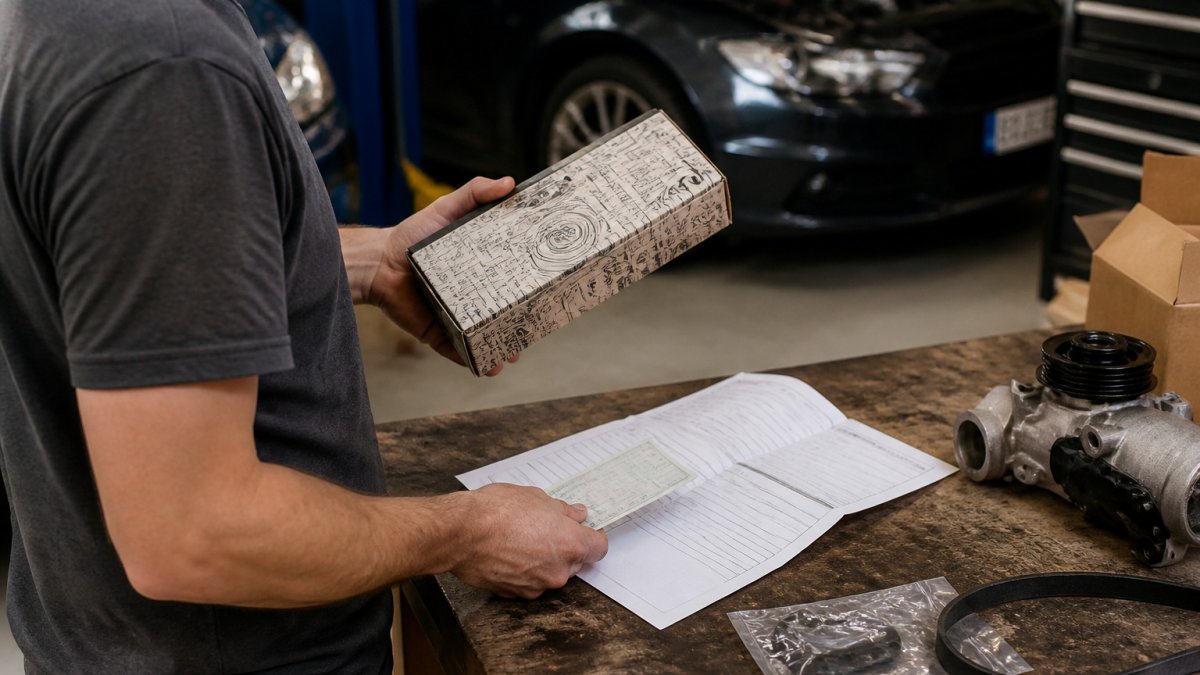
!Close-up of a DIY car owner in a home garage holding a boxed replacement part beside an open printed order confirmation and a vehicle registration card
Begin with the car part compatibility check. Compare the part number against the manufacturer's fitment data. Then confirm the details on your vehicle's registration or door-jamb sticker.
Using Your VIN, Year, Make, Model, and Trim
Your VIN is the most reliable way to confirm fitment. You can follow a guide on decoding the VIN to confirm the exact vehicle specification to check your build details. It encodes the exact build details of your vehicle, including the engine, body style, and options.
Follow these steps:
- Locate your VIN on the dashboard near the windshield or on the driver's door jamb.
- Enter the VIN into the parts lookup on the seller's site, if it offers one.
- Confirm the engine configuration and trim match your car.
- Compare the results with the part you received.
Trim and engine differences matter a lot. Two cars of the same model year can use different parts because of their options or engine size.
Distinguishing a Seller Picking Error From a Fitment Mismatch
This is the step where many buyers get stuck. Ask yourself one question: Was the part correct for the listing, or was the listing wrong for your car?
- Seller picking error: The part does not match the order confirmation or listing. The seller shipped the wrong item.
- Fitment mismatch: The part matches the listing exactly but does not fit your vehicle. The listing itself was the issue, or the wrong vehicle was selected at checkout.
A picking error is the seller's responsibility to fix. A fitment mismatch may still be fixable, but the path can differ, so note which one you are dealing with before you contact anyone.
Step 3: Document the Problem and Contact the Seller
Once you know what went wrong, contact the seller with clear evidence. Good documentation speeds up the process and protects you if the dispute drags on.
Gather these items before you reach out:
- Order number and date
- Photos of the box, label, and part
- Screenshots of the listing and fitment details
Keep your message short and specific. For example: "I ordered part number [number] for my [year, make, model, trim].
Save every reply. A written record is far easier to act on than a phone call you cannot prove.
Requesting an Incorrect Order Replacement Request or Refund
Once the seller acknowledges the problem, move quickly and put the request in writing. You can follow the specific steps for obtaining a return authorization to get this started. The single most important thing to ask for is a return merchandise authorization (RMA) number, sometimes called a return authorization or RA. Without it, many warehouses will refuse the package at the dock, and you lose both the part and the shipping cost.
Replacement first, refund second
Ask for a replacement before a refund in most cases. A replacement ships the correct part against the same order, which is usually faster than waiting for a refund to post and then reordering. Ask for a refund instead when:
- The correct part is back-ordered with no confirmed ship date.
- The seller cannot confirm the part number you need.
- You no longer trust the listing's fitment data.
What to confirm in writing before you ship anything back
Get the seller to state each of these in an email or chat transcript you can save:
- RMA number and expiration date. Many RMAs expire in 14 to 30 days; miss the window and the return may be refused.
- Who pays return shipping. When the error is the seller's (wrong part picked, wrong part shipped versus the listing), the seller should issue a prepaid label. When the mismatch traces to fitment data you selected at checkout, expect to pay return shipping yourself.
- Restocking fee. A restocking fee is a percentage deducted from your refund, commonly in the 10% to 25% range for opened parts, and often waived when the seller shipped the wrong item. Ask for the waiver in writing.
Pack it the way it arrived
Reuse the original box and internal packing when you can. Include all hardware, brackets, gaskets, and instruction sheets, missing pieces are one of the most common reasons a return is rejected or a restocking fee is applied. Do not install, cut, drill, or modify the wrong part; once a part shows installation marks, most sellers treat it as non-returnable.
If the seller stalls
If the seller will not issue an RMA, will not confirm who pays shipping, or goes silent after you send evidence, do not keep shipping the part back on hope. Move to the escalation steps in the next section and keep every message.
The article lays out the main return terms to confirm in writing before shipping a part back.
| Term | What to confirm | Typical detail |
|---|---|---|
| RMA number | Get it in writing before shipping | Often expires in 14 to 30 days |
| Restocking fee | Ask for a waiver when seller erred | Commonly 10% to 25% for opened parts |
| Refund timing | Ask for the posting window | Commonly 5 to 10 business days after inspection |
| Return shipping | Confirm who pays | Seller pays for seller errors |
Return Shipping, Restocking Fees, and Return Windows
Return rules vary by seller. Read the return policy before you ship anything back. Look for the return window, which is the number of days you have to send an item back, and any restocking fee.
Many sellers cover return shipping when the error is theirs. If the fitment mismatch came from a listing you chose, you may pay return shipping yourself.
Keep the original packaging and all parts. Missing pieces can delay your refund.
Handling Shipping Delays and Escalating a Dispute
Two different problems get lumped together here: a late package and a wrong part the seller will not fix. Handle them separately.
When the package is late, not wrong
Check the tracking number first. If the carrier shows the package stalled or "in transit" for an unusual stretch, contact the carrier and the seller at the same time so neither can pass the problem to the other. Ask the seller to open a trace with the carrier. If tracking shows delivered but nothing arrived, ask the seller to file a claim and confirm in writing whether they will reship or refund while the claim is open.
When the seller will not fix a wrong part
If the seller refuses a valid return, will not issue an RMA, or stops responding, escalate in this order.
**1.
**2.
3. Consumer-protection complaint. Every state has an attorney general's consumer protection division, and most accept online complaints.
4. Small claims court. For a disputed amount within your state's small-claims limit, filing is often inexpensive and does not require a lawyer.
Safely Handling a Partly Disassembled Vehicle and Getting the Right Part Installed
If you already started the repair, stop before you go further. Leave the vehicle in a safe, stable state.
Do not reinstall or force a part that does not fit. Forcing a mismatched component can damage nearby parts and make your return harder to process.
Taking these steps protects both your car and your return. Fix the part problem first, then finish the job.
Frequently Asked Questions
What should I do if I receive the wrong car part?
Stop before installing anything. Compare the part number on the box and invoice against your order confirmation, then check the part against your vehicle's VIN using the seller's fitment tool. Photograph the label, packaging, and any visible part numbers, and contact the seller with your order number. Ask for a return authorization and a replacement or refund in writing, and keep every message and tracking record for your files.
How can I tell whether a car part is incorrect or incompatible with my vehicle?
An incorrect part means the seller shipped something other than what you ordered, such as a different part number. An incompatible part means you received what you ordered but it does not fit your vehicle's specific year, model, trim, or engine configuration. Check the part number on your order against the part number printed on the box. If they match but the fitment check fails, the issue is compatibility, and you should confirm your VIN with the seller before requesting a return.
Who pays return shipping when a seller sends the wrong car part?
When the seller made the error, they should cover return shipping and issue a replacement or refund at no cost to you. If the part is correct for your order but does not fit your vehicle because of an ordering mistake, return shipping and any restocking fee may apply under the seller's return policy. Read the return policy before shipping anything back, and request a return authorization number first so the package is matched to your order.
How long does it usually take to resolve a wrong-part delivery?
Resolution time depends on the seller's response speed, stock availability for the correct part, and the carrier's return transit time. Many cases close within a week or two once a return authorization is issued and the original part is shipped back. Delays grow when the replacement is back-ordered. Following up in writing every few business days and noting each response date keeps the timeline clear if you need to escalate.