 blog
blog
EuropaParts vs AutohausAZ: Which Store Wins in 2026?
Table of Contents
- EuropaParts vs AutohausAZ: The 2026 Comparison at a Glance
- What Makes the Best Online European Auto Parts Store
- Genuine vs OEM Auto Parts: What You're Actually Buying
- Pricing, Shipping, and Total Cost of Ownership
- Fitment Accuracy, Part Number Verification, and Vehicle Compatibility
- Returns, Warranty Claims, and Packaging Integrity
- Customer Support, Mobile Experience, and Order Fulfillment
- Which Store Should You Pick?
- Frequently Asked Questions
Last Updated: September 14, 2026
EuropaParts vs AutohausAZ: The 2026 Comparison at a Glance
Anyone weighing a europaparts vs autohausaz comparison is really asking one question: which store gets the right part to your door with the least hassle. Anyone weighing a europaparts vs autohausaz comparison is really asking one question: which store gets the right part to your door with the least hassle. Neither is a bad choice, and each has a loyal following among DIY owners. Below, we break down both stores across seven practical categories, from genuine vs oem auto parts to warranty claim handling. Neither is a bad choice, and each has a loyal following among DIY owners. Below, we break down both stores across seven practical categories, from genuine vs oem auto parts to warranty claim handling.
What Makes the Best Online European Auto Parts Store
The best online European auto parts store gets three things right: it identifies the correct part for your vehicle, ships it without damage, and stands behind the sale if fitment fails.
A common mistake is judging a retailer by catalog size alone. A huge inventory means nothing if the site cannot confirm that a water pump fits a 2008 A4 with the BPY engine code. Part number verification and compatibility tools matter more than SKU counts.
Look for these signals before you trust any retailer with a repair:
- A vehicle picker or VIN search that filters by trim and engine code
- Clear labeling of genuine components versus aftermarket alternatives
- A published return policy with defined restocking terms
- Shipping options with tracking and damage protection
- Technical documentation or diagrams attached to listings
Genuine vs OEM Auto Parts: What You're Actually Buying
Genuine parts are manufactured for the automaker and sold in branded packaging; OEM parts come from the same production lines but ship in the supplier's own box. Both meet OEM standards. The practical difference is price and packaging, not engineering.
A genuine Volkswagen water pump and an OEM pump from the original supplier are frequently the same component. Aftermarket alternatives are a different category: built by third parties to their own specifications, with quality that varies widely by brand.
For European vehicles, the stakes are higher than most owners realize. Audi, Porsche, and VW models often use tight tolerances and proprietary electronics, so a low-cost aftermarket sensor can trigger fault codes or fail early. Enthusiasts keeping cars long-term stick with genuine components or reputable OEM equivalents.
Pricing, Shipping, and Total Cost of Ownership
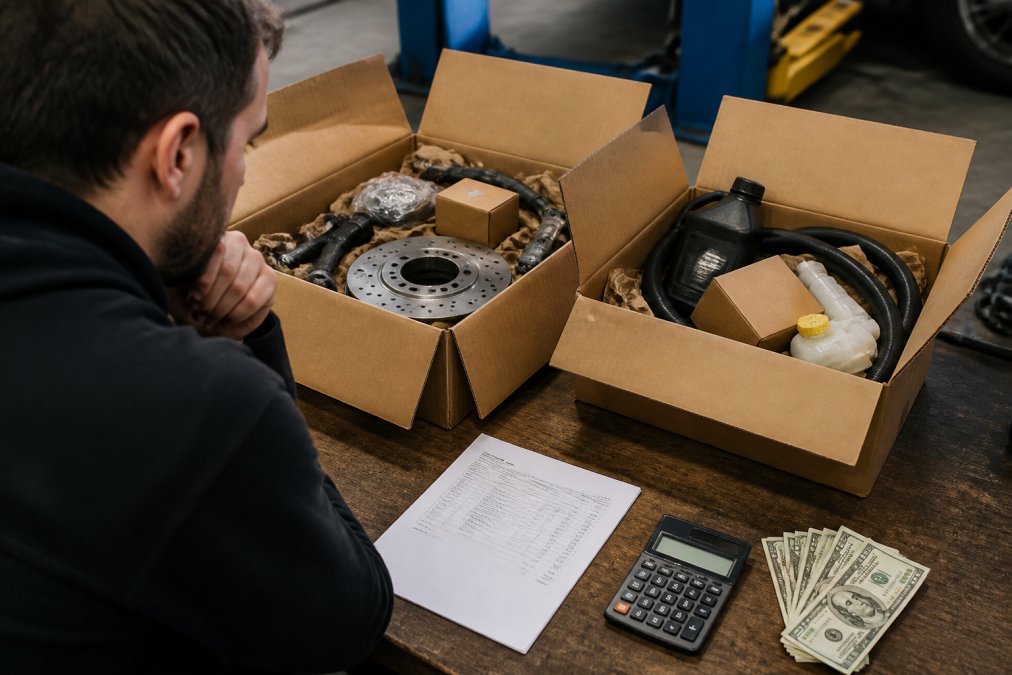
Sticker price is only part of what you pay. Total cost of ownership includes the part, shipping, return shipping if fitment fails, and your time if a wrong part arrives. A cheaper part with slow delivery or a restocking fee can cost more than a pricier part that arrives correct. Most comparison articles stop at the listed price; the math below decides whether a repair stays on budget.
The five cost lines that make up a real TCO
- Part price. The number on the product page, the only line most buyers compare.
- Inbound shipping. Free-shipping thresholds change the effective price of a small order. A $12 filter with $9 shipping is a $21 filter.
- Return shipping. If fitment fails and the store does not cover return freight, that cost lands on you. On a heavy item like a control arm or water pump, return shipping can rival the part price.
- Restocking fees. A 15% restocking fee on a $200 part is $30 you never see again (the FTC).
- Time and rework. A wrong part means a second order, a second wait, and a vehicle on jack stands, the most expensive line of all.
How to run the math before you check out
A simple routine turns a vague comparison into a real number:
- Add the part price and the cheapest shipping option that meets your repair deadline.
- Read the return policy: return window, who pays return freight, and whether a restocking fee applies.
- For heavy or oversized parts, estimate return shipping using a standard carrier rate for the package weight and dimensions.
- Multiply the part price by any restocking percentage.
- Compare the all-in figure, not the sticker price.
A common pattern: the store with the lower sticker price loses on the all-in number once return freight and restocking are included, especially on heavy suspension and cooling components. The reverse is also true, a slightly higher part price with free returns and no restocking fee can win on anything you are not certain fits.
Where the two stores tend to differ
Both EuropaParts and AutohausAZ publish return policies and run periodic promotions, so thresholds and fees change. What does not change is the decision structure:
| Cost line | What to verify before ordering |
|---|---|
| Part price | Whether the listing is genuine, OEM, or aftermarket, since the same part number can appear at three price tiers |
| Inbound shipping | The free-shipping threshold and whether oversized items are excluded |
| Return shipping | Whether the store issues a prepaid label or requires you to ship at your cost |
| Restocking fee | The percentage and whether it is waived for unopened or defective parts |
| Lead time | Whether the listing says in stock or ships in X days, since a weekend repair depends on it |
Delivery lead times vary by warehouse location, and neither store guarantees next-day on every SKU. Build lead time into your TCO estimate.
Fitment Accuracy, Part Number Verification, and Vehicle Compatibility
Fitment accuracy is the biggest source of frustration in online parts buying, and where the two stores diverge most. EuropaParts built its reputation on a model-specific catalog structure many VW and Audi owners find intuitive. AutohausAZ leans on a broad make-and-model search that covers more brands but requires more manual filtering.
What most guides miss is that part number verification is your job too. Even the best vehicle picker returns multiple options when a model year spans an engine change. Cross-check the part number against your vehicle's documentation or the number stamped on the old component.
A short verification routine saves hours:
- Enter your VIN or full model, year, and engine code
- Note every part number the store returns
- Compare against the number on the failed component
- Confirm the listing notes any superseded part numbers
- Check the return policy one more time before checkout
For older or rare models, VIN search coverage varies. If a store cannot confirm fitment for your specific build, ask customer support directly rather than guessing.
Returns, Warranty Claims, and Packaging Integrity
Return policies and warranty coverage separate a store you trust with a big order from one you only use for small items. Both EuropaParts and AutohausAZ publish return policies and require a return authorization before you ship anything back. The details that matter are window length, who pays return shipping, and whether installed parts are eligible. What most guides skip is how to execute a claim so it is not denied on a technicality.
Packaging integrity: the evidence you need before you open the box
Packaging integrity is the overlooked variable. A water pump or control arm that shifts inside a thin box can arrive with bent mounting points, and damage claims get complicated when the box shows no external crush. The store says the part left the warehouse intact; you say it arrived damaged. The evidence you collect in the first two minutes decides which one holds.
A practical routine:
- Photograph the sealed box from all four sides and the top before cutting tape.
- Note any crush, puncture, or water damage in the photos.
- Open the box on video if the order is high value, keeping the shipping label visible in frame.
- Photograph the part in the packaging, then out of it, with the part number legible.
- Keep all packaging until the claim is resolved. Carriers and retailers often require the original box for inspection.
How a warranty claim actually moves through the system
A warranty claim is not the same as a return. A return is a change of mind or a fitment miss; a warranty claim is a defect or premature failure (Warranties). The two follow different paths, and mixing them up is the most common reason a claim stalls.
Step 1: Confirm you are inside the warranty window. Check the listing or your order confirmation for the stated coverage period. Wear items like brake pads and filters often carry a shorter window than hard parts like water pumps and control arms (nhtsa.gov).
Step 2: Contact support with the order number and a written description of the failure. Include the vehicle, mileage at install, and mileage at failure. "Installed at 84,200 miles, failed at 86,100 miles, coolant leaking from the weep hole" beats "it broke."
Step 3: Provide photos and, if asked, the part number. Photograph the failed part, the packaging, and the stamped or printed part number. For internal failures, a short video of the symptom helps.
Step 4: Receive a return authorization (RA) number. Do not ship anything back before you have this number. Packages that arrive without an RA are frequently refused or lost in the returns queue.
Step 5: Ship within the stated window. Note the carrier and tracking number. Keep the receipt.
Step 6: Wait for inspection and resolution. The store inspects the part to confirm the failure is a defect and not installation damage. Resolution is typically a replacement, refund, or store credit, depending on policy.
The documentation that gets claims approved
Most denied claims fail on documentation, not merits. The pattern that works:
- Order number and RA number in every email subject line
- Photos taken in daylight with the part number legible
- A written timeline of install date, mileage, and failure date
- Original packaging retained until resolution
- A single email thread rather than multiple new tickets
Return versus warranty at a glance
| Situation | Path | Who typically pays return freight |
|---|---|---|
| Wrong part shipped by the store | Return | Store |
| You ordered the wrong part number | Return | You |
| Part failed prematurely | Warranty claim | Store, if the claim is approved |
| Part damaged in transit | Shipping damage claim | Store or carrier, with photo evidence |
| Changed your mind, unopened | Return | You, and a restocking fee may apply |
Both stores require an RA before return shipment, and both inspect parts before issuing a resolution. The deciding factor is rarely the policy language. It is whether you documented the failure and followed the process.
Customer Support, Mobile Experience, and Order Fulfillment
Customer support responsiveness is where forum sentiment gets loudest, because it is the moment a transaction turns into a relationship. Both stores offer phone and email support and mobile-friendly storefronts. Neither is flawless, and response times vary with season and order volume.
The mobile versus desktop question matters more than it used to. Parts shopping involves part numbers, diagrams, and fitment filters, which are easier to read on a larger screen. On a phone, use the store's vehicle picker rather than free-text search to reduce wrong-number orders.
On order fulfillment, the practical test is simple: does the store show real-time stock status, and does it cancel orders when inventory runs out? Inventory quality varies by SKU depth and warehouse, so check whether the listing says "in stock" or "ships in X days" before planning a weekend repair.
Which Store Should You Pick?
Pick EuropaParts for a catalog tuned tightly to Volkswagen and Audi platforms and a model-specific browsing structure. Pick AutohausAZ for broader brand coverage and a long-established catalog across European makes. Both are legitimate retailers with real return policies, and neither is a mistake for routine maintenance.
The deciding factor is rarely the store. It is whether you verified the part number, read the return terms, and chose a shipping speed that matches your repair timeline.
That is exactly the gap European OEM Parts Direct was built to close. We stock genuine OEM parts for Audi, Porsche, and VW, and our user-friendly vehicle picker and VIN search help confirm fitment before you order, so accurate part matching is straightforward. Inventory is held on hand for quick shipping, and genuine components are priced competitively.
Get started with European OEM Parts Direct and find the exact genuine part your Audi, Porsche, or VW needs, matched to your vehicle the first time.
Frequently Asked Questions
Is AutohausAZ a legitimate website for OEM parts?
AutohausAZ has operated as an online European auto parts retailer for years and carries OEM and aftermarket components for Audi, Porsche, and VW. Legitimacy comes down to what you receive: check that the part number matches your VIN-decoded fitment, and confirm the listing states genuine OEM standards rather than a generic description. Ordering from a store that verifies fitment against your specific vehicle and offers a clear return authorization process protects you far more than brand familiarity alone.
Is EuropaParts reliable for Audi and VW components?
EuropaParts stocks a solid range of Audi and VW replacement parts, and community feedback is generally positive on fitment accuracy for common models. Reliability questions usually surface with older or rare vehicles, where inventory availability and part number verification get harder. Before ordering, confirm the retailer shows real-time stock, supports VIN search, and publishes delivery lead times. A store with on-hand inventory and accurate vehicle compatibility data removes most of the risk.
How do shipping times compare between major European auto parts retailers?
Delivery lead times vary by warehouse location, part availability, and order fulfillment method. Some retailers ship same-day from stocked inventory, while others drop-ship from suppliers, adding days. Ask two questions before ordering: is the part in stock now, and where does it ship from? Shipping logistics matter most for DIY repair timelines, since a delayed part can leave a vehicle on jack stands. Always check the estimated arrival window at checkout, not just the marketing banner.
What is the difference between Genuine OEM and aftermarket parts?
Genuine components are made by the vehicle manufacturer's original supplier and sold under the brand's part number. OEM parts come from the same production line but are sold without the automaker's packaging, often at a lower price. Aftermarket alternatives are made by third parties to their own specifications. For Audi, Porsche, and VW maintenance, genuine and OEM parts preserve fitment accuracy, warranty coverage, and resale value. Aftermarket can work for wear items, but verify quality assurance standards before installing.