 how-to
7 Porsche Performance Parts You Can Install at Home
Last Updated: October 31, 2026
Quick Summary
Installing Porsche performance parts at home is realistic for a careful owner with the right tools, correct fitment data, and patience. Start with easy bolt-on jobs like air intakes, cat-back exhausts, and diverter valves, and confirm every part number against your VIN before ordering.
- Use a torque wrench covering roughly 5-150 lb-ft, since Porsche fasteners have spec values you should not guess.
- A 911 runs around 3,200-3,600 lb, so 3-ton jack stands are the practical minimum.
- Cat-back exhaust installs typically take 2-4 hours and retain factory catalytic converters.
- Intercooler jobs can take 4-8 hours, and a poorly seated charge pipe causes boost leaks.
- ECU tuning carries the highest warranty and emissions risk and is best left to professionals.
Table of Contents
- What Porsche Performance Parts Installation at Home Actually Requires
- Porsche DIY Upgrade Tools You Need Before You Start
- Porsche Parts Fitment by VIN: Matching Parts to Your Model and Generation
- Porsche 911 Exhaust Installation and Sports Exhaust Upgrades
- Intake Pipes, Airboxes, and Airflow Components You Can Bolt On
- Engine Tuning, Power Kits, Intercoolers, and Diverter Valves
- Common Mistakes, Troubleshooting, and Post-Install Verification
- Find the Right Porsche Performance Parts for Your Build
- Frequently Asked Questions
What Porsche Performance Parts Installation at Home Actually Requires
Installing Porsche performance parts at home is realistic for a careful owner with the right tools, correct fitment data, and patience, not a way to cut corners. The installs that go well start with accurate part numbers, not a wrench.
The gap between a smooth weekend job and a ruined one is usually information. Most guides skip the boring parts and treat every upgrade as equally DIY-friendly. They are not.
Three things decide whether a job belongs in your garage:
- Access. Can you reach the part safely with the car raised?
- Fitment certainty. Do you know the exact part number for your model and generation?
- Reversibility. Can you put it back to stock if something goes wrong?
A bolt-on air intake or a cat-back exhaust passes all three. An engine swap does not. Knowing which side of that line a job sits on is the whole skill.
Porsche DIY Upgrade Tools You Need Before You Start
The tool list matters more than most people think. A common mistake is buying the part first and discovering mid-job that you need a special socket or torque wrench. The bigger mistake is treating a home garage like a professional lift bay.
Start with the basics that cover most bolt-on work:
- A quality click-type or split-beam torque wrench covering roughly 5-150 lb-ft, because Porsche fasteners have spec values you should not guess
- A low-profile floor jack and jack stands rated well above curb weight, a 911 runs around 3,200-3,600 lb, so 3-ton stands are the practical minimum
- Metric socket and wrench sets, including Torx and triple-square (XZN) bits for trim, underbody panels, and driveline fasteners
- A trim removal kit so you do not crack plastic panels
- Nitrile gloves, safety glasses, and a headlamp
- A drain pan and shop towels even for "dry" jobs, coolant and oil surprises happen
Then add job-specific tools. Exhaust work often needs penetrating oil, a breaker bar, and new gaskets and clamps on hand. Intake work usually needs a hose clamp tool and a small torque wrench for plastic housing fasteners. Intercooler work may need a bumper trim tool set and hose picks. Buy or borrow these before the weekend, not during it.
Home-Garage Setup: Lift Points, Ventilation, and Workspace
This is the part most guides skip, and it decides whether you finish the job or damage the car.
Lift points. Porsche publishes specific jacking and stand points for each generation.
Stands, not just a jack. A hydraulic jack is a lifting device, not a support device.
Ventilation. Exhaust work, intake work, and any job that runs the engine in the garage produces carbon monoxide. Never run the engine in a closed garage, even briefly to check for leaks.
Workspace. You want roughly a 10 ft by 20 ft clear footprint, good overhead light, and a fire extinguisher rated for fuel and electrical fires within reach.
Porsche Parts Fitment by VIN: Matching Parts to Your Model and Generation
Fitment is where home installs succeed or fail. A 911 spans generations that look similar but use different components. A part that fits a 991.2 may not fit a 991.1, and a 996 is a different car underneath entirely.
The most reliable way to confirm fitment is to decode your VIN and match it to your model year, generation, and trim. You can follow how to decode Porsche VIN for parts to read your own vehicle's code before you order anything.
Here is a quick reference for how the generations differ in character:
| Generation | Common DIY-Friendly Upgrades | Fitment Watch-Out |
|---|---|---|
| 996 | Cat-back exhaust, air filter, diverter valves | Early and late cars differ; confirm by VIN |
| 991.1 | Axle-back exhaust, intake pipes, airbox | Do not assume 991.2 parts fit |
| 991.2 | Turbo-era intake and intercooler upgrades | Turbo and non-turbo paths diverge |
| GT3 / Turbo | Sports exhaust, diverter valves | Higher-spec parts often model-specific |
The rule is simple. Never order from a photo. Order from a part number verified against your VIN. A VIN search on our platform can help you confirm the correct part for your vehicle.
Porsche 911 Exhaust Installation and Sports Exhaust Upgrades
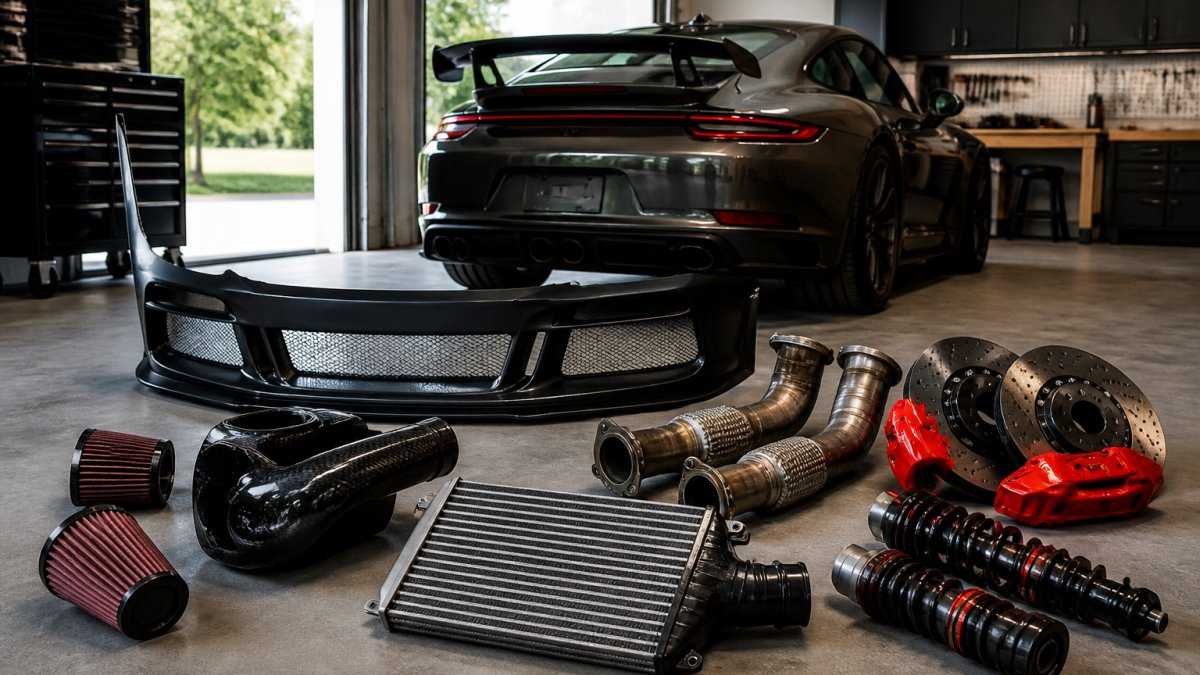
A cat-back or axle-back sports exhaust is one of the best first projects. It changes the sound and frees up airflow without touching engine internals, and stainless steel systems resist corrosion.
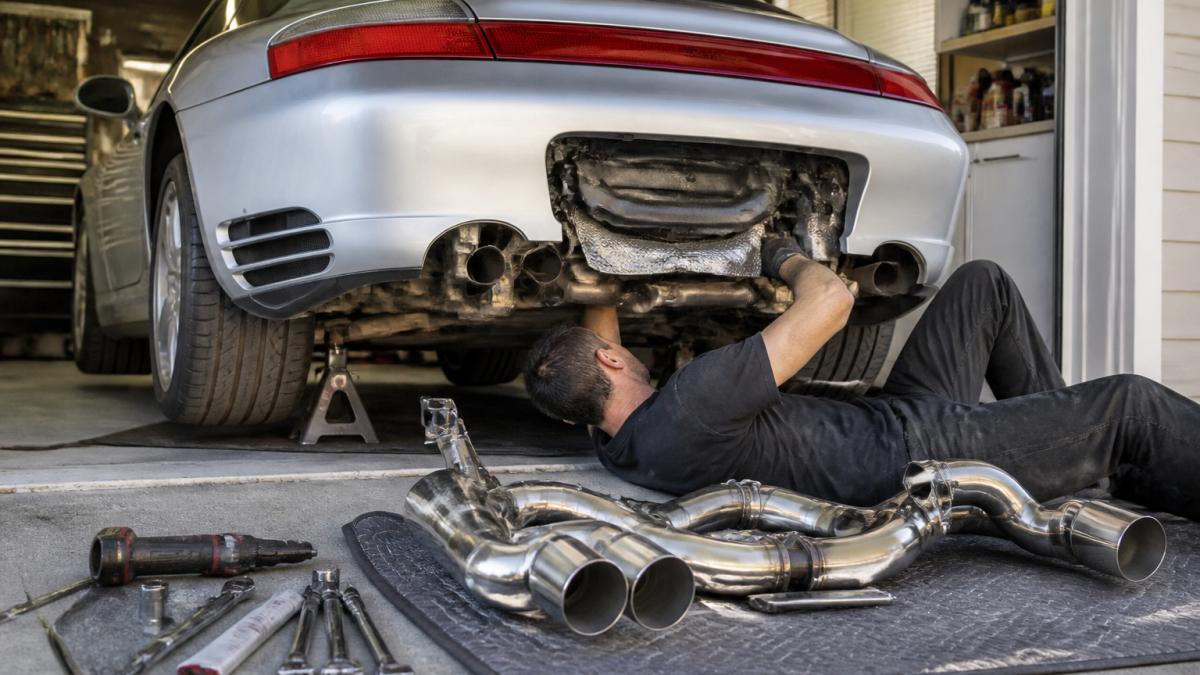
The process follows a predictable path:
- Let the car cool completely, then raise it safely on stands.
- Spray penetrating oil on the exhaust clamps and hangers the night before.
- Support the old system before you unbolt it.
- Remove the clamps, then the hangers, working front to back.
- Fit the new system loosely, check alignment, then tighten.
Watch out: tightening every clamp before checking alignment is the classic mistake. It twists the system, causes rattles, and stresses the hangers. Snug it, check the tips sit level, then torque to spec.
Take a before-and-after sound clip. It is the easiest way to confirm the result and spot an exhaust leak early.
Intake Pipes, Airboxes, and Airflow Components You Can Bolt On
An intake upgrade is the most approachable airflow change. The Porsche 911 performance air intake we carry is engineered for the 911 and integrates with OEM mounting points for a fit that does not require fabrication.
Porsche 911 performance air intake →
The install is straightforward:
- Disconnect the battery and let the car sit.
- Remove the factory airbox lid and the old filter element.
- Unclip the intake pipe and set the old parts aside.
- Fit the new intake, aligning it to the OEM mounts.
- Reconnect the sensor wiring and check every clamp is tight.
Watch out: leaving a sensor connector loose or a clamp finger-tight causes a check-engine light and rough running. Recheck every connection before you start the engine.
Once it is on, it needs care. Follow a proper guide on how to maintain your Porsche 911 performance air intake so the filter stays clean and the airflow stays consistent.
Engine Tuning, Power Kits, Intercoolers, and Diverter Valves
This is where we draw a firm line. Some of these jobs belong at home; others do not.
Diverter valves are a genuine DIY item on many turbo cars.
Intercoolers are more involved. They sit deeper in the engine bay, and the job often means removing the bumper cover and working around tight plumbing and charge pipes.
ECU tuning and power kits are a different category. Flashing the ECU carries real risk. A bad tune can damage the engine, and it can affect your warranty and emissions compliance.
Warranty, Emissions, and Road-Legality: What to Check Before You Modify
This is the part most build guides leave out, and it costs owners the most when it goes wrong.
Warranty. Warranty coverage for aftermarket modifications is a question to resolve with your dealer or manufacturer before you modify. Read your policy and keep your receipts.
Emissions. Emissions rules and state inspection requirements vary, so check your state's current rules before modifying your vehicle. A cat-back exhaust that retains the factory catalytic converters is usually the safest emissions choice.
Verification after engine-adjacent work. Any job that touches intake, intercooler, or engine management should end with an OBD scan.
A quick difficulty guide helps you decide:
| Upgrade | Difficulty | Typical Time | DIY or Pro | Warranty/Emissions Note |
|---|---|---|---|---|
| Diverter valve | Easy | 1-2 hours | DIY | Low risk; confirm part by VIN |
| Air intake | Easy | 1-2 hours | DIY | Low risk if factory sensors retained |
| Sports exhaust (cat-back) | Moderate | 2-4 hours | DIY | Retains cats; usually inspection-safe |
| Intercooler | Moderate to hard | 4-8 hours | DIY with care | Boost-leak risk; scan after install |
| ECU tune / power kit | Hard | Varies | Professional | Highest warranty and emissions risk |
Common Mistakes, Troubleshooting, and Post-Install Verification
The install is only half the job. Verification is the other half, and it separates careful owners from rushed ones.
Run this checklist before you call the job done:
- Recheck every fastener with a torque wrench
- Confirm all wiring and sensor connectors are fully seated
- Start the car and listen for leaks or rattles
- Take a short test drive at low speed first
- Scan for fault codes with an OBD reader
- Recheck the work after the first 100 miles
The most common mistakes we hear about:
- Skipping the torque spec. Guessing on fasteners causes leaks and stripped threads.
- Rushing the cold engine. Working on a hot exhaust is how people get burned.
- Ignoring a new noise. A rattle after an exhaust job usually means a loose clamp or a misaligned hanger.
If something does not fit or seems off, stop. Do not force it. A suspect component is worth replacing with a verified part. If you are unsure how to source a correct replacement, this guide on how to source authentic Porsche restoration parts walks through the checks.
Find the Right Porsche Performance Parts for Your Build
The best upgrade is the one that fits your car, your tools, and your comfort level. Start with the easy wins: intake, exhaust, and diverter valves. Build confidence before taking on intercoolers or tuning.
When you are ready to buy, sourcing genuine parts matters. Counterfeit and mismatched components can cause fitment problems. For a clear buying process, read our best practices for buying genuine Porsche parts before you order.
At European OEM Parts Direct, we offer genuine OEM parts for Porsche, Audi, and VW. Our vehicle picker and VIN search help you find the exact components for your vehicle.
Frequently Asked Questions
Can you install Porsche performance parts at home?
Yes, for many bolt-on upgrades. Air intakes, cat-back exhausts, diverter valves, and intercoolers on most 911 and Boxster models can be installed in a home garage with basic hand tools and jack stands. Engine tuning and ECU work usually require a specialist with diagnostic software. Job time varies with difficulty, and you should always confirm fitment for your exact model and generation before ordering.
What tools do you need for Porsche DIY upgrade tools and performance parts installation?
A low-profile floor jack, four jack stands rated for your car's weight, wheel chocks, a torque wrench, a socket set with extensions, Torx and hex bit sets, and penetrating oil cover most jobs. Add nitrile gloves, safety glasses, and a magnetic parts tray. For exhaust work, a penetrating lubricant and a breaker bar save significant time on rusted hardware. Rent specialty tools like spring compressors or oxygen sensor sockets rather than buying them.
How do you confirm Porsche parts fitment by VIN before ordering?
Use your 17-character VIN to look up the exact part number for your model year, generation, and trim. A VIN search removes guesswork on mid-cycle changes like the 991 to 991.2 transition, where exhaust and intake layouts differ. Compare the returned part number against the listing before you buy, and check whether the part is listed for your engine code.
Can installing aftermarket parts affect a Porsche warranty?
Under the Magnuson-Moss Warranty Act, a dealer cannot void your entire warranty just because you installed aftermarket parts. They can deny coverage for a specific failure if they can show the aftermarket part caused it. Genuine OEM parts reduce that risk because they meet factory specifications. Keep your receipts and installation records, and avoid engine tuning if your car is still under a factory powertrain warranty.
Your car deserves parts that fit the first time. Get started with European OEM Parts Direct and use our VIN search to find the genuine Porsche performance parts built for your model, backed by accurate fitment and fast shipping.